
Now Reading: Rammed earth meets heritage: Leo Berellini’s multipurpose hall at Domaine d’Ors, Châteaufort
- 01
Rammed earth meets heritage: Leo Berellini’s multipurpose hall at Domaine d’Ors, Châteaufort

Rammed earth meets heritage: Leo Berellini’s multipurpose hall at Domaine d’Ors, Châteaufort

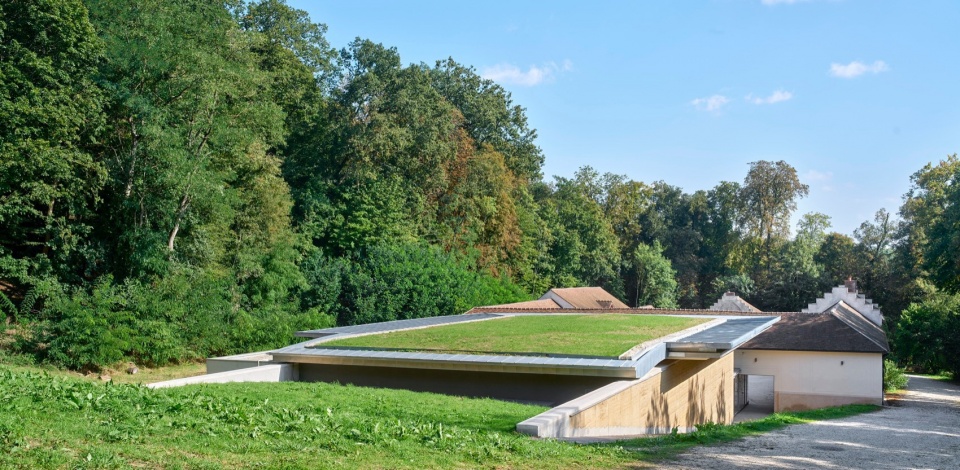
In the former service quarters of the Château of the Domaine d’Ors, architect Leo Berellini has completed a new multipurpose hall for the town of Châteaufort, bringing a contemporary civic programme into a protected landscape where architecture is already charged with memory. Set within a vast natural reserve in the Yvelines department, the project sits among a constellation of heritage buildings, including a mill, a chapel, an orangery, and other small edifices arranged around a park. The site lies just outside the town, extending across five hectares of woodland and clearings at the edge of the Mérantaise Valley, a protected natural reserve.
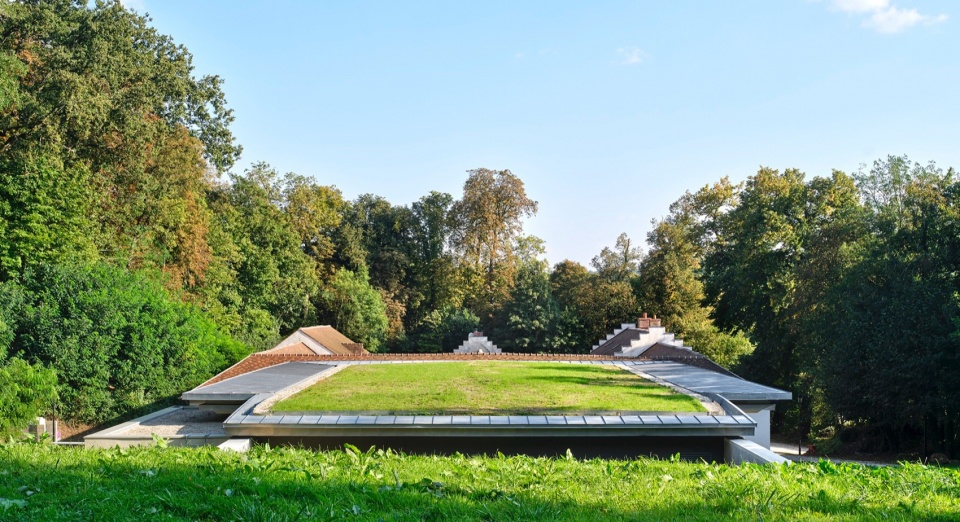
What makes this intervention compelling is not an urge to announce itself, but a commitment to discretion. The new hall is conceived as an architecture of proximity: close to the ground, close to the terrain, close to the existing ensemble. Rather than competing with the service quarters of the château and their particular charm, the building seeks a calm coexistence, as if it had always belonged to the clearing.
A COURTYARD, A FOREST, A HIDDEN NORTH
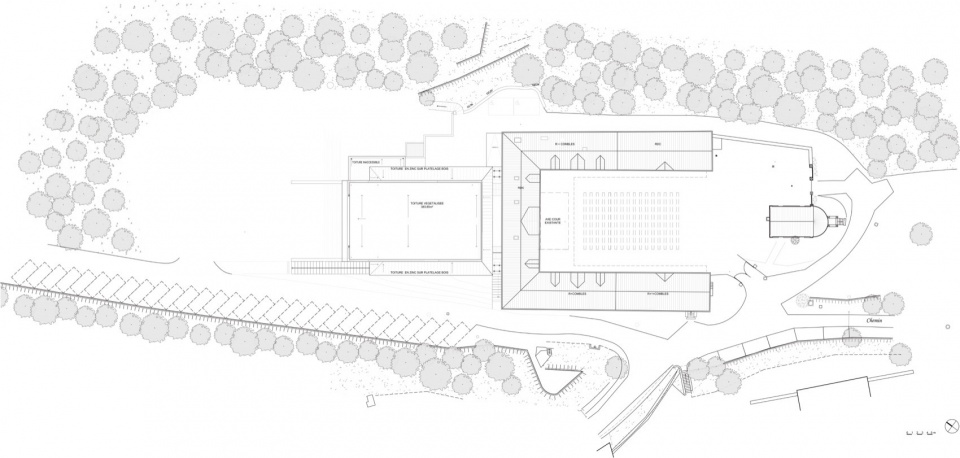
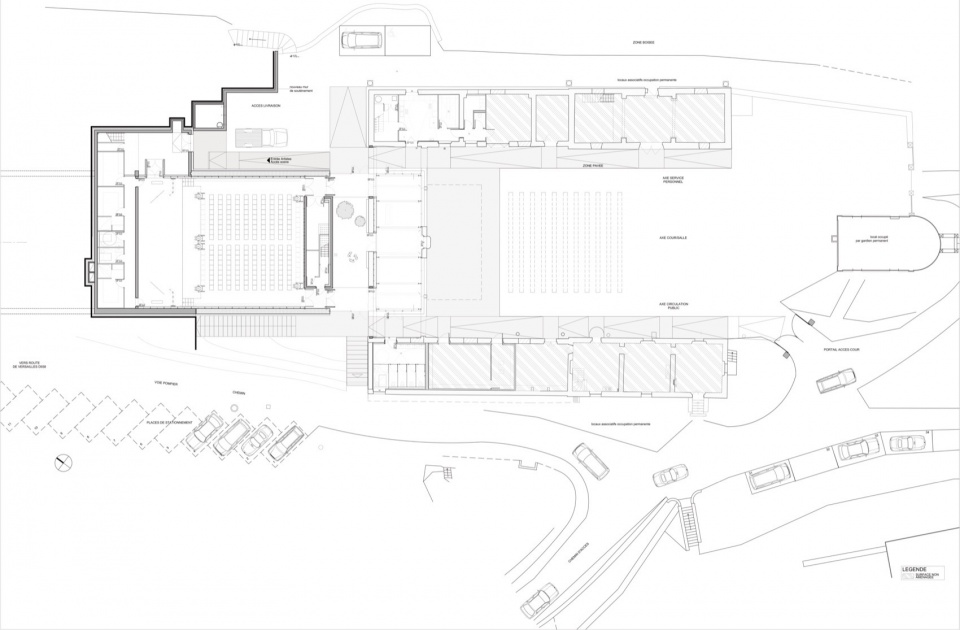
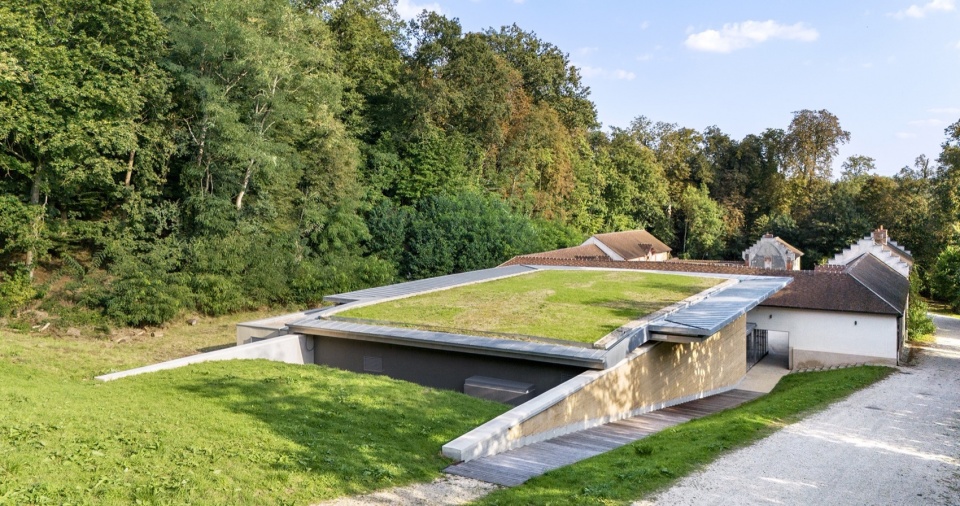
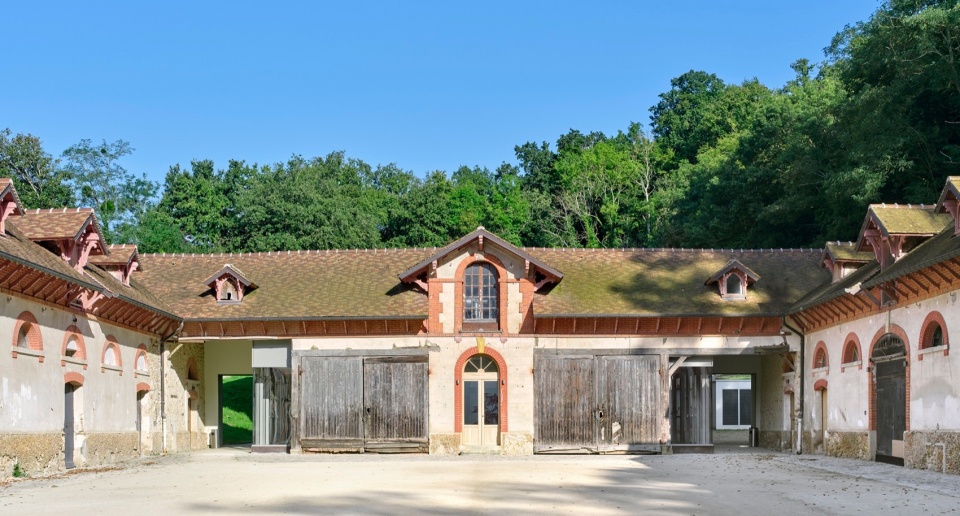
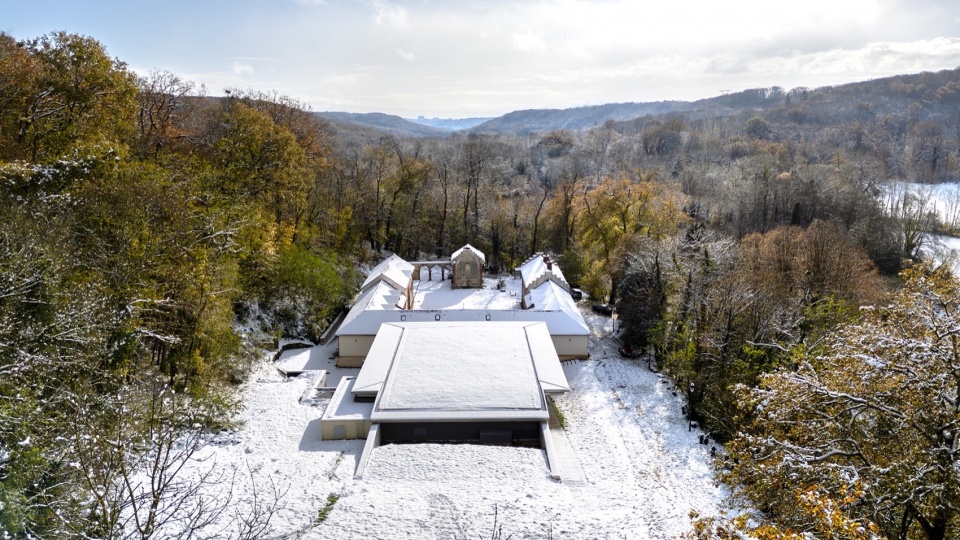
The service quarters are comprised of three buildings forming a U shaped arrangement around a grand south facing courtyard of roughly 600 square metres. The wooded perimeter is protected, reinforcing the sense of a site defined as much by vegetation as by construction. Berellini’s extension is positioned to the north, tucked into a clearing behind the existing structure. This choice is strategic: it preserves the primacy of the heritage courtyard while placing the new hall where it can slip into the landscape.


The plan aligns the new volume with the axis of the existing ensemble, respecting its symmetry. From the park, the hall reads less as an added object than as a continuation of the terrain’s logic. Its posture is deliberately restrained, accepting the château’s service buildings as the visible figure and assigning itself the role of background, support, and infrastructure for communal life.
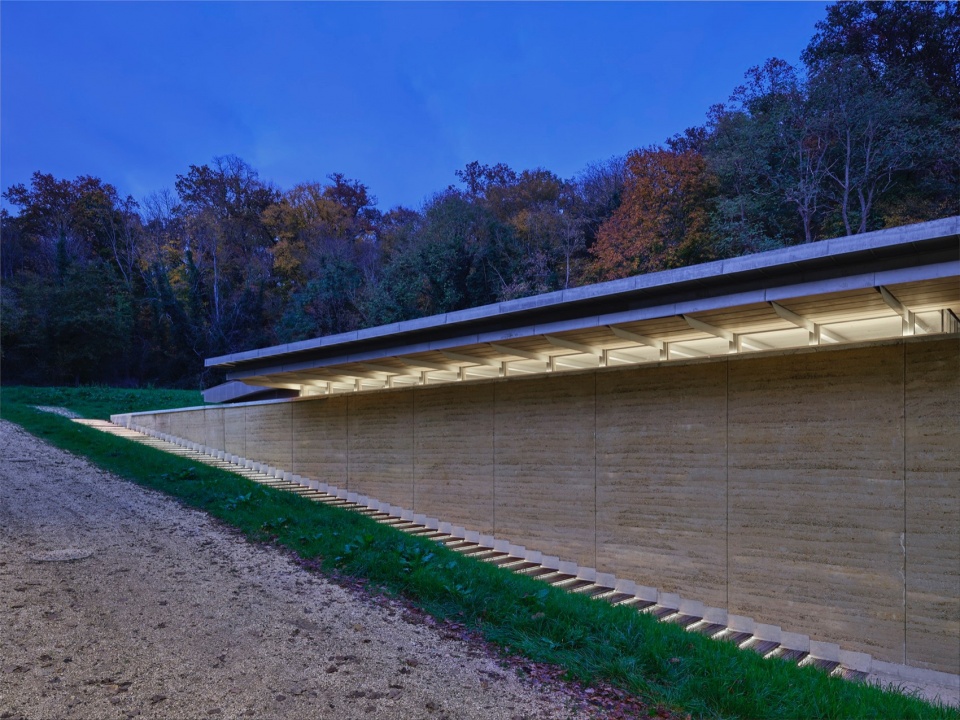
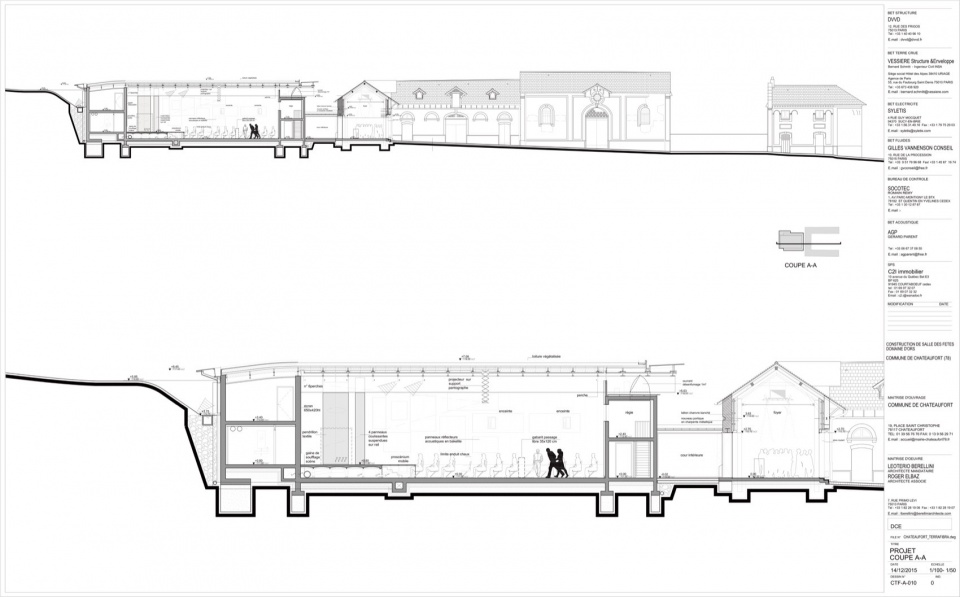
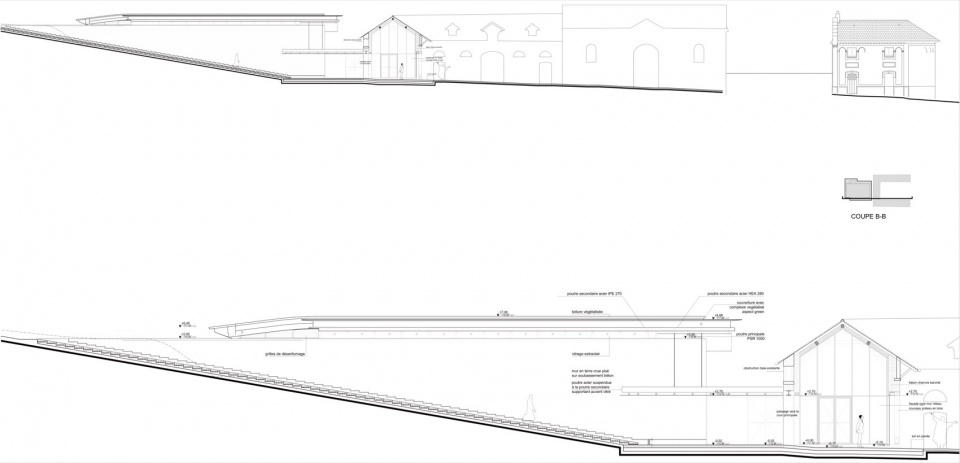
The project’s most immediate gesture is its refusal of height. The hall nestles into the slope, covered by a green roof that extends the clearing and preserves the continuity of the site’s ground plane. In winter, when the landscape turns sparse and pale, the building’s low silhouette becomes even more subdued, its presence registered through subtle shifts in contour rather than contrast.
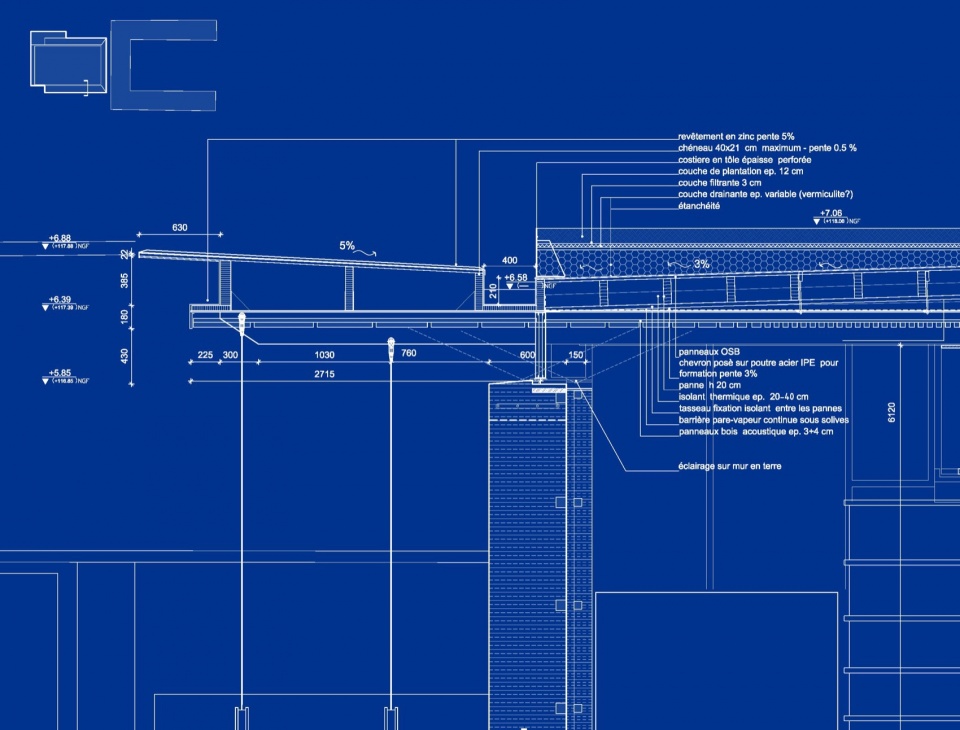
This roof is not an accessory applied to soften an otherwise assertive form. It is the form. It makes the building legible as terrain, offering an architectural answer that does not interrupt the wooded edge with an object, but instead thickens the ground to accommodate a new interior.
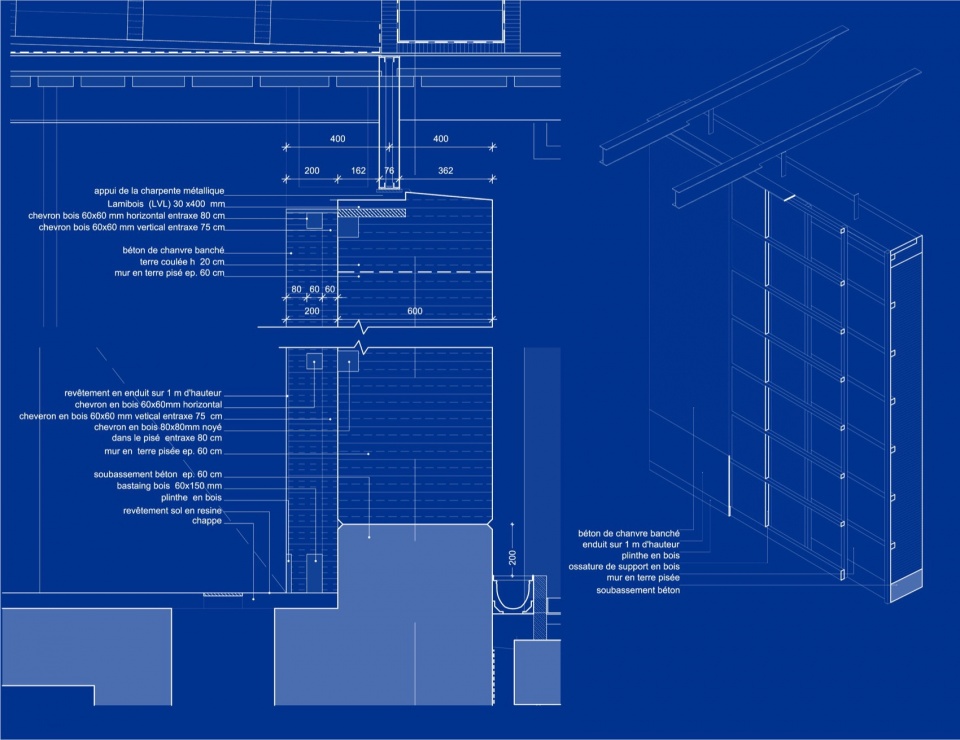
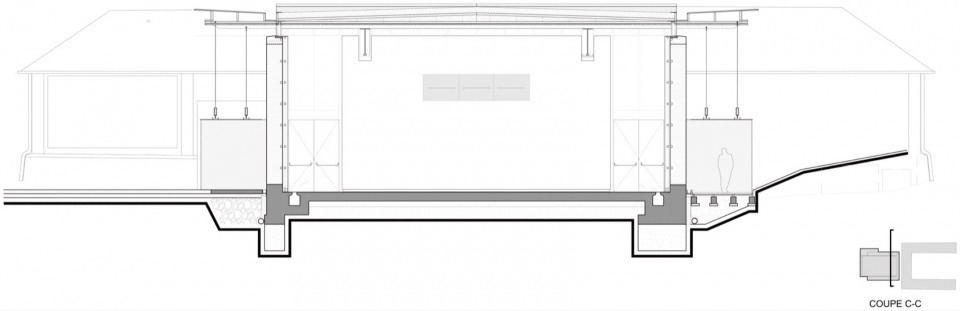
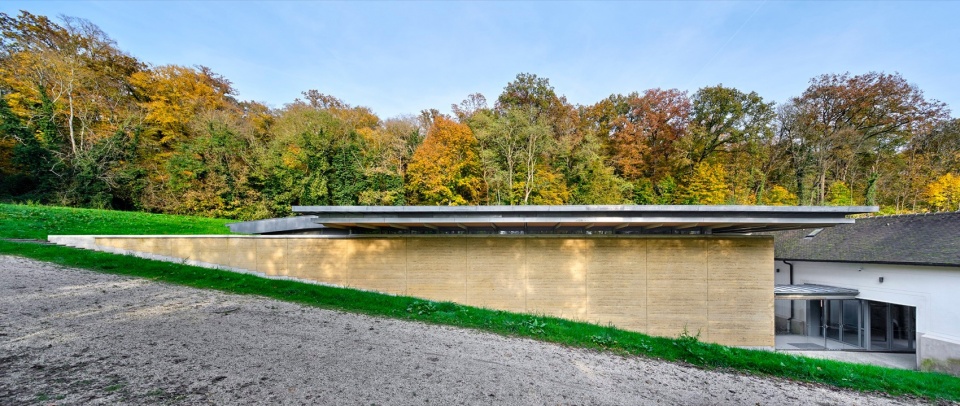
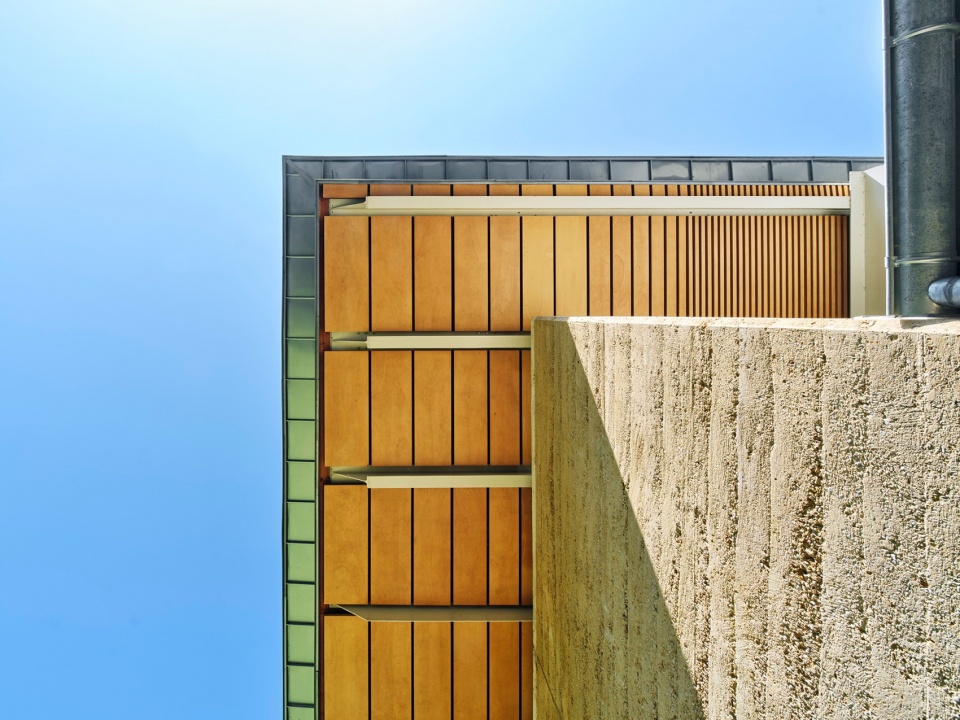
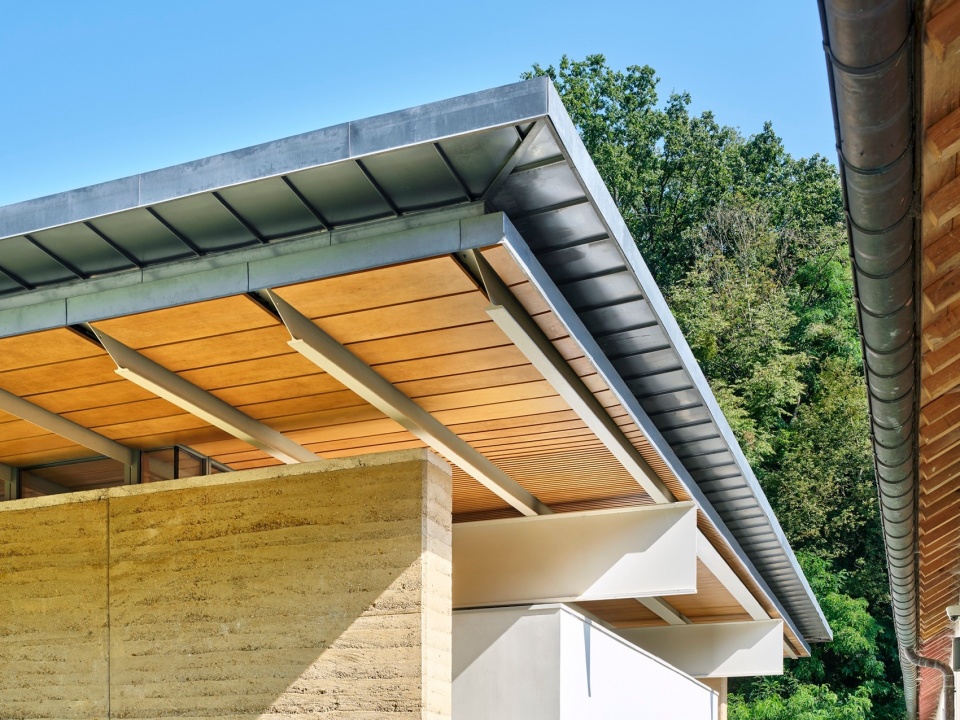
If the roof merges with the clearing, the longitudinal walls provide the project’s material anchor. They are designed and built in rammed earth, evoking the sensation that the hillside has been cut away to reveal its interior, exposing a stratigraphy of geological layers. The metaphor is direct yet convincing: the walls do not imitate nature, they are nature translated into construction, using the site’s own soil to achieve integration without altering texture or colour.
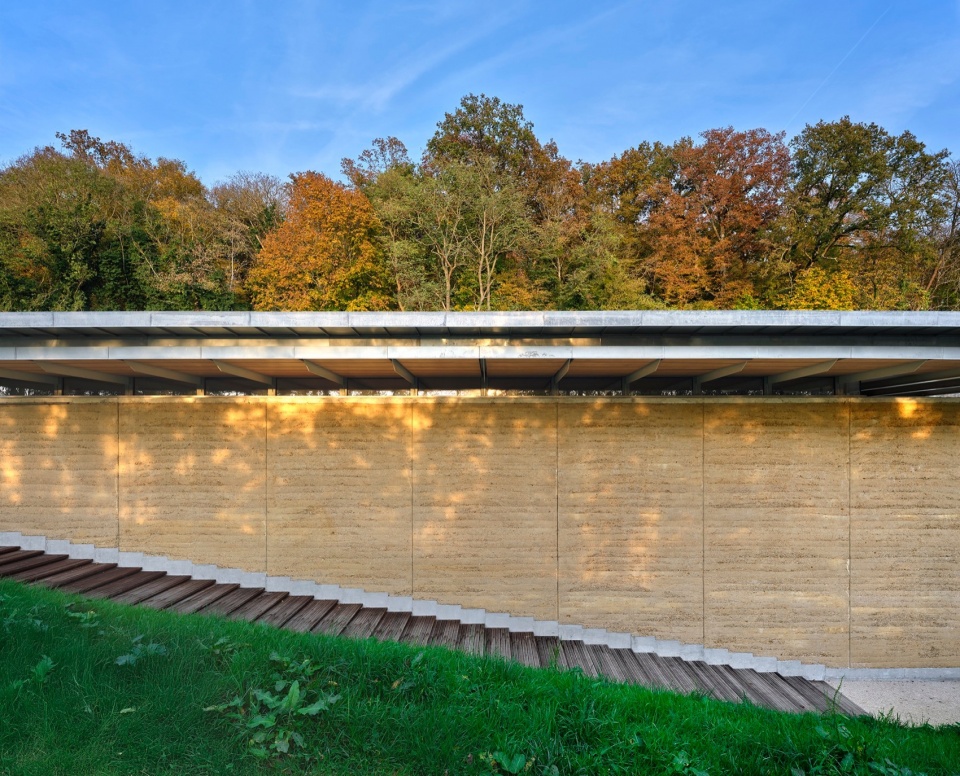
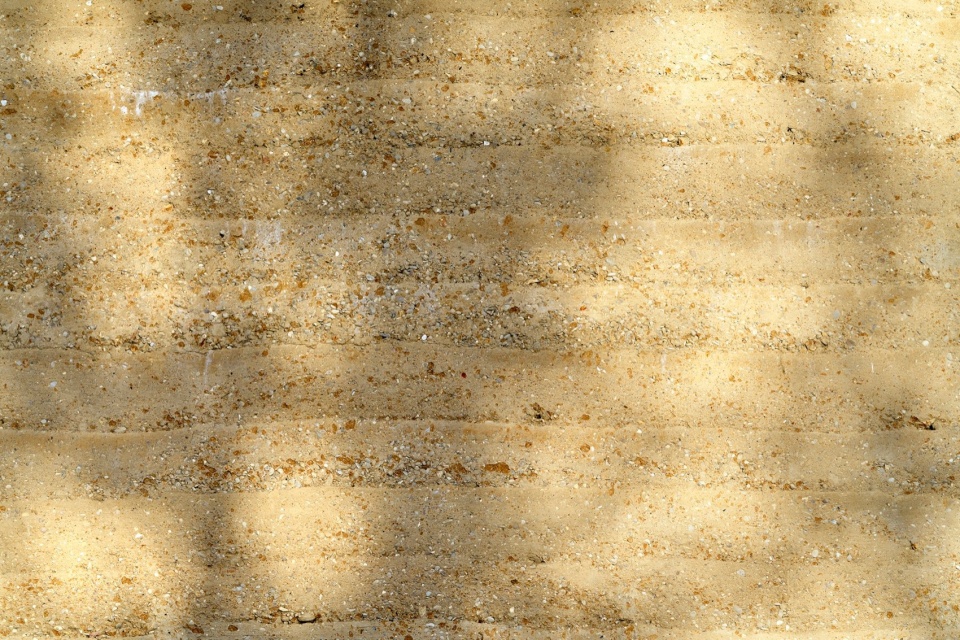
Rammed earth here operates on multiple registers. Visually, it reads as sedimented mass, introducing depth and time into the building’s surfaces. Spatially, it gives the hall a sense of protected enclosure, a thick edge between interior civic use and the surrounding forest. Environmentally, it supports the project’s ambition to push thermal performance through passive means.
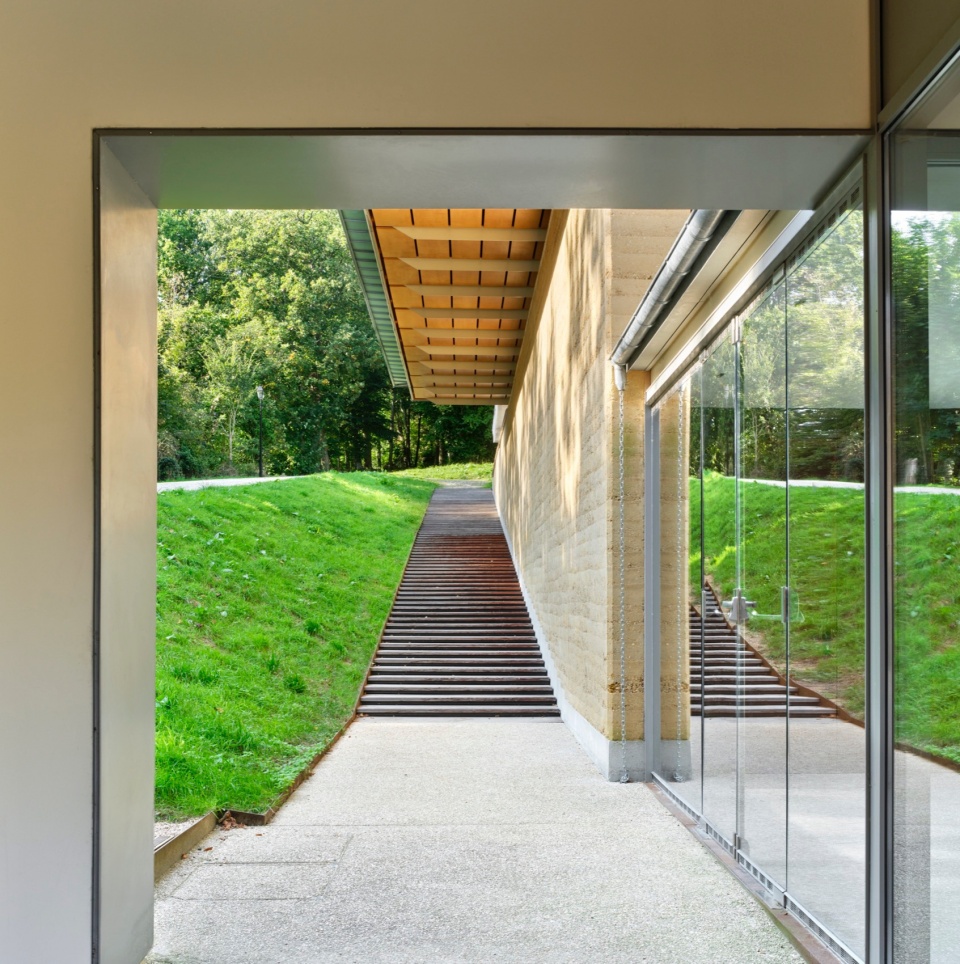
RAMMED EARTH WALLS AS CUT TERRAIN
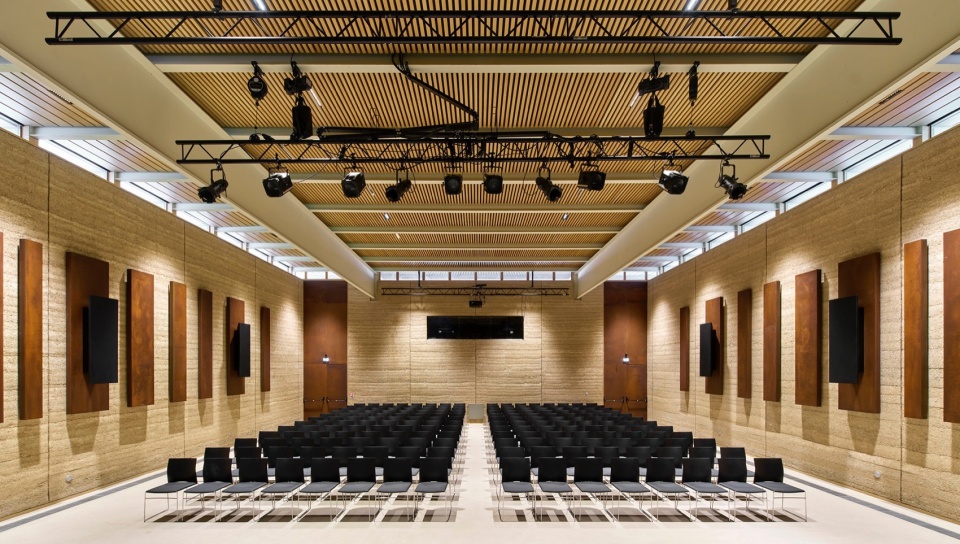
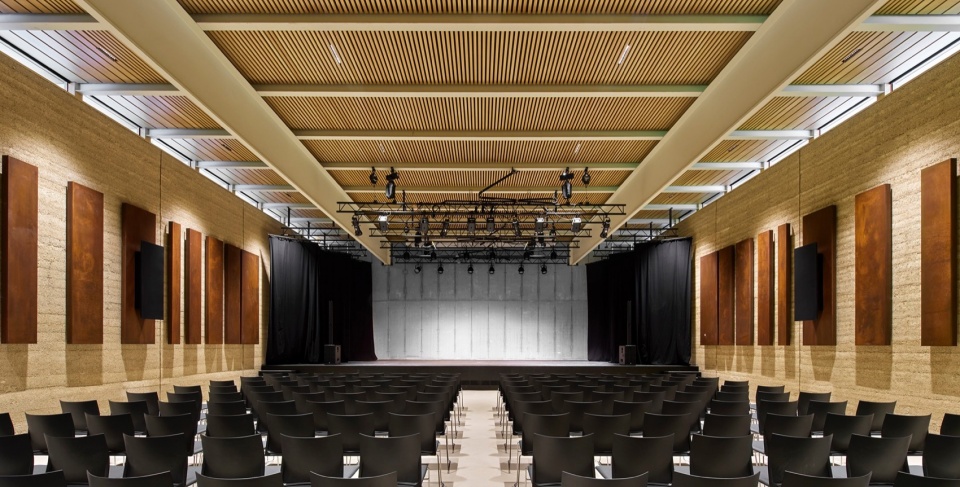
On the inside, the supporting rammed earth walls are lined with a twenty centimetre layer of poured hempcrete. The lining is left exposed, affixed to the earth walls with wooden studs embedded within its thickness. The assembly is both technical and tactile, producing an interior that communicates how it is made while avoiding didactic display.


The pairing of rammed earth and hempcrete suggests a broader attitude to sustainability that is rooted in material intelligence rather than spectacle. These are low carbon materials with real architectural presence: porous, warm, textured, and capable of absorbing light rather than reflecting it harshly. The result is an atmosphere that feels grounded, literally and perceptually, reinforcing the project’s aim of discretion.
THERMAL PERFORMANCE AS DESIGN CULTURE
During the design phase, the architectural elements were evaluated to maximise thermal characteristics, turning performance into a guiding culture rather than a late stage calculation. This approach is consistent with the project’s overall restraint: the building does not rely on formal extravagance to feel contemporary, but on careful decisions about section, enclosure, and material behaviour.
The hall’s embedded position in the slope, the insulating continuity of the roof, and the mass of the rammed earth walls work together as an environmental strategy. It is an architecture that uses thickness, inertia, and continuity to stabilise interior comfort, appropriate for a multipurpose civic programme that must adapt to changing seasons and varied occupancy.
A CIVIC ROOM IN A HERITAGE LANDSCAPE
Placing a new public facility within an important heritage site demands a particular kind of humility. At Domaine d’Ors, the multipurpose hall adds to a landscape already structured by historic buildings and long established pathways, where the chapel and other structures are not simply landmarks, but anchors of identity. Berellini’s intervention avoids the trap of picturesque mimicry, yet also refuses the easy drama of contrast. Instead, it proposes continuity: continuity of axes, continuity of ground, continuity of matter.
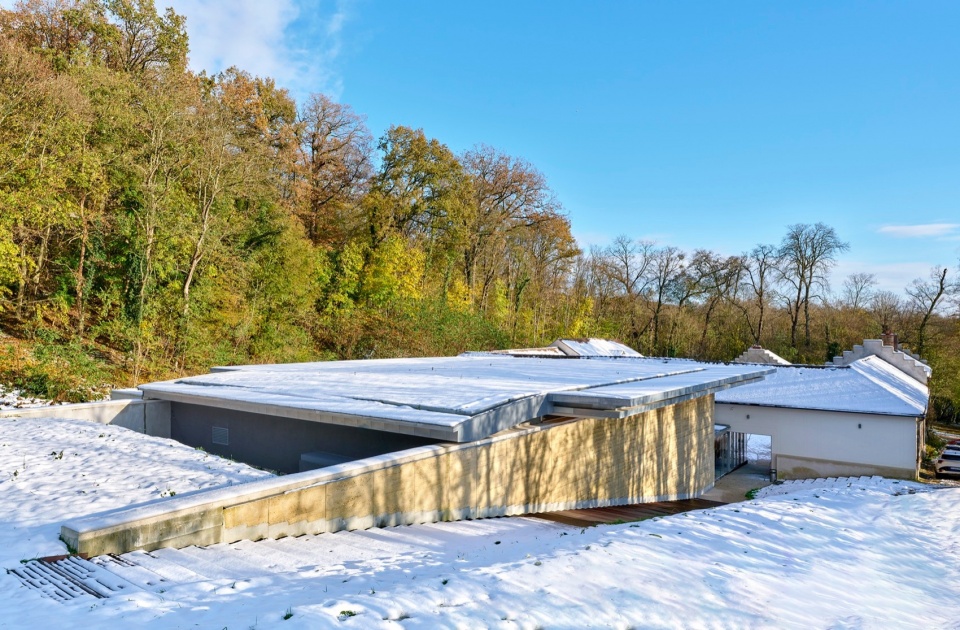
The building’s success lies in this balance. It brings a new civic interior to Châteaufort while preserving the atmosphere of the site, allowing the heritage ensemble to remain legible and the natural reserve to remain dominant. In a time when public architecture is often asked to become a symbol, this project argues for another possibility: a hall that serves its community by becoming part of the terrain that surrounds it.
Project Credit
Design: Berellini Architecte
Location: Paris, France
Photographer: Michel Denance
More Photos