
Now Reading: Scalpers Seville: Between vernacular memory and contemporary attitude
- 01
Scalpers Seville: Between vernacular memory and contemporary attitude


The new flagship of Scalpers opens in Seville, the city where the brand was born and where tradition remains a living, tactile presence in daily life. Set within an urban fabric shaped by vernacular architecture yet situated close to the city’s most emblematic contemporary intervention, the Metropol Parasol by Jürgen Mayer, the project is framed by a productive tension. It is precisely this coexistence of heritage and experimentation that informs the spatial and conceptual direction of the store.
Rather than treating context as a backdrop, the design interprets Seville as a layered condition. The store negotiates between the city’s material warmth and its emerging architectural boldness, translating this duality into a retail environment that feels both rooted and assertive.

The interior unfolds across three levels, each assigned a distinct program. Menswear occupies the ground floor, womenswear and childrenswear the first floor, while the upper level is reserved exclusively for tailoring. This vertical organization is not merely functional. It operates as a conceptual deconstruction of the Scalpers emblem, the skull and crossed shins that have long defined the brand’s visual identity.
On the ground floor, the idea of the head is expressed through a large circular stainless steel frame that anchors the space and sets the tone upon entry. Above, the first floor introduces elongated oval forms that reference the shins, shaping display zones and circulation paths. Fabricated in vibrated steel, these elements assert a distinctly urban character. Their industrial precision sits deliberately alongside softer materials, reflecting a dialogue between discipline and defiance that mirrors the brand’s ethos.


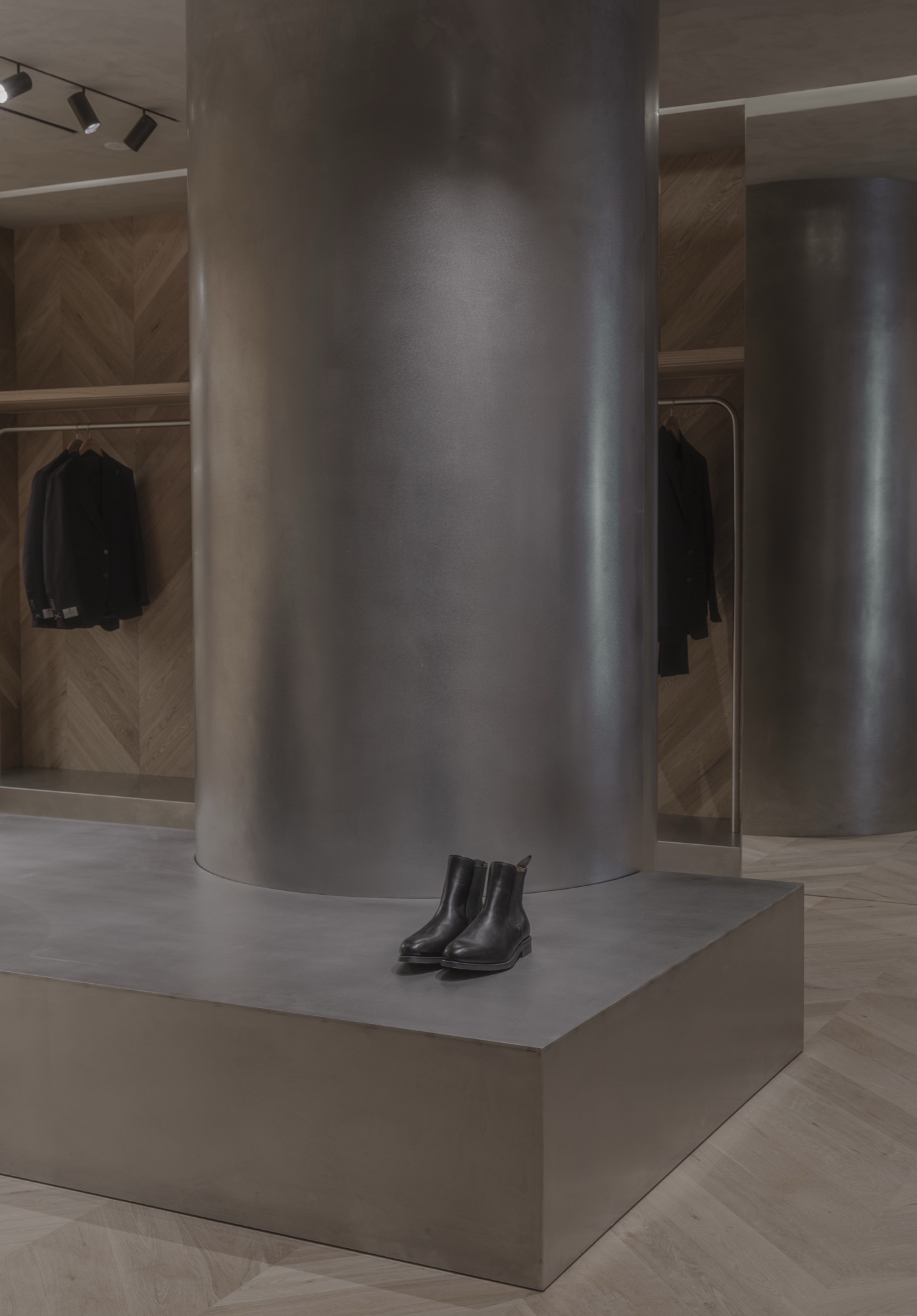
Metal plays a central role throughout the project, not as ornament but as structure. Custom steel systems provide flexible solutions for hanging garments, integrating mirrors and accommodating changing retail needs. At the same time, they rationalize the existing building constraints, enveloping original pillars and reinterpreting them as sculptural columns that stand independently within the space.


This industrial language is carefully balanced by a restrained palette. Warm grey concrete surfaces are paired with oak wood applied in a Hungarian Point pattern across floors and selected walls. The result is a calibrated contrast that elevates key areas without slipping into excess. Material choices are deployed with precision, allowing texture and craftsmanship to carry the narrative rather than overt decoration.


Vertical movement is treated as a defining spatial moment. A U shaped staircase acts as the project’s central architectural feature, drawing visitors upward through the store. At its core, a panoramic elevator reinforces the sense of continuity between levels, offering shifting views of the interior as a sequence rather than a stack.
Along this route, digital screens are discreetly integrated, presenting the brand’s latest campaigns. Their placement avoids visual overload, instead punctuating the journey and reinforcing the connection between physical space and visual culture.


Lighting is not an afterthought but a primary design tool. A custom luminaire composed of multiple LED elements extends across the first two floors, executed in the same vibrated steel that defines the structural features. Its presence introduces a contemporary rhythm, reinforcing the project’s industrial undertone while maintaining a controlled and atmospheric glow.


The tailoring floor shifts register entirely. Here, lighting adopts a more classical and intimate approach, combining downlights, shelf integrated LEDs and custom spotlights. The ambiance softens, supported by sofas and armchairs that transform the space into something closer to a domestic interior than a conventional retail setting. Precision gives way to comfort, and commerce momentarily yields to experience.

The Scalpers flagship in Seville operates through contrast rather than uniformity. It balances urban sharpness with material warmth, conceptual rigor with spatial ease. By allowing different atmospheres to coexist within a single architectural framework, the project proposes a new model of retail experience. One that acknowledges tradition without nostalgia, embraces rebellion without excess, and situates fashion within a broader architectural and cultural conversation.


Project Credit
Location: Seville, Spain
Dimensions: 1,100 m2
Photos: Javier Márquez / @javiermarquezphoto
Design: Francesc Rifé Studio / @francescrifestudio
More Photos