
Now Reading: Chiton transforms a Madrid townhouse into a restaurant and club
- 01
Chiton transforms a Madrid townhouse into a restaurant and club

Chiton transforms a Madrid townhouse into a restaurant and club

Located on Calle Bárbara de Braganza in Madrid, Chitón occupies a 407 square metre space defined by an unexpected duality. Behind a discreet street presence lies a restaurant and club organized around an interior courtyard, where architecture unfolds gradually through a carefully choreographed sequence of rooms, textures, and atmospheres.
Developed by De la Villa Studio, the project takes its name from a concept created by Luis Muelas. Chitón evokes silence, discretion, and discovery, establishing a narrative that guides visitors from the moment they enter. Rather than revealing itself immediately, the venue invites exploration through a series of increasingly immersive spaces shaped by light, materiality, and changing perspectives.


The experience begins on the ground floor restaurant, where a restrained palette creates an atmosphere of calm and intimacy. Dark oak, polished resin surfaces, textured finishes, and custom furnishings establish a quiet backdrop for dining. At the rear, a sculptural bar crafted from Rosso Levanto marble and travertine anchors the space, acting as both functional centerpiece and visual focal point. Throughout the restaurant, carefully integrated artworks, bespoke lighting, and subtle material contrasts enrich the experience without overwhelming it.


A more introspective mood emerges in the ground floor restroom, where dark surfaces, candlelight, and a reproduction of Francisco Goya’s Chitón etching replace conventional decorative gestures, offering a moment of pause while revealing the origin of the venue’s identity.


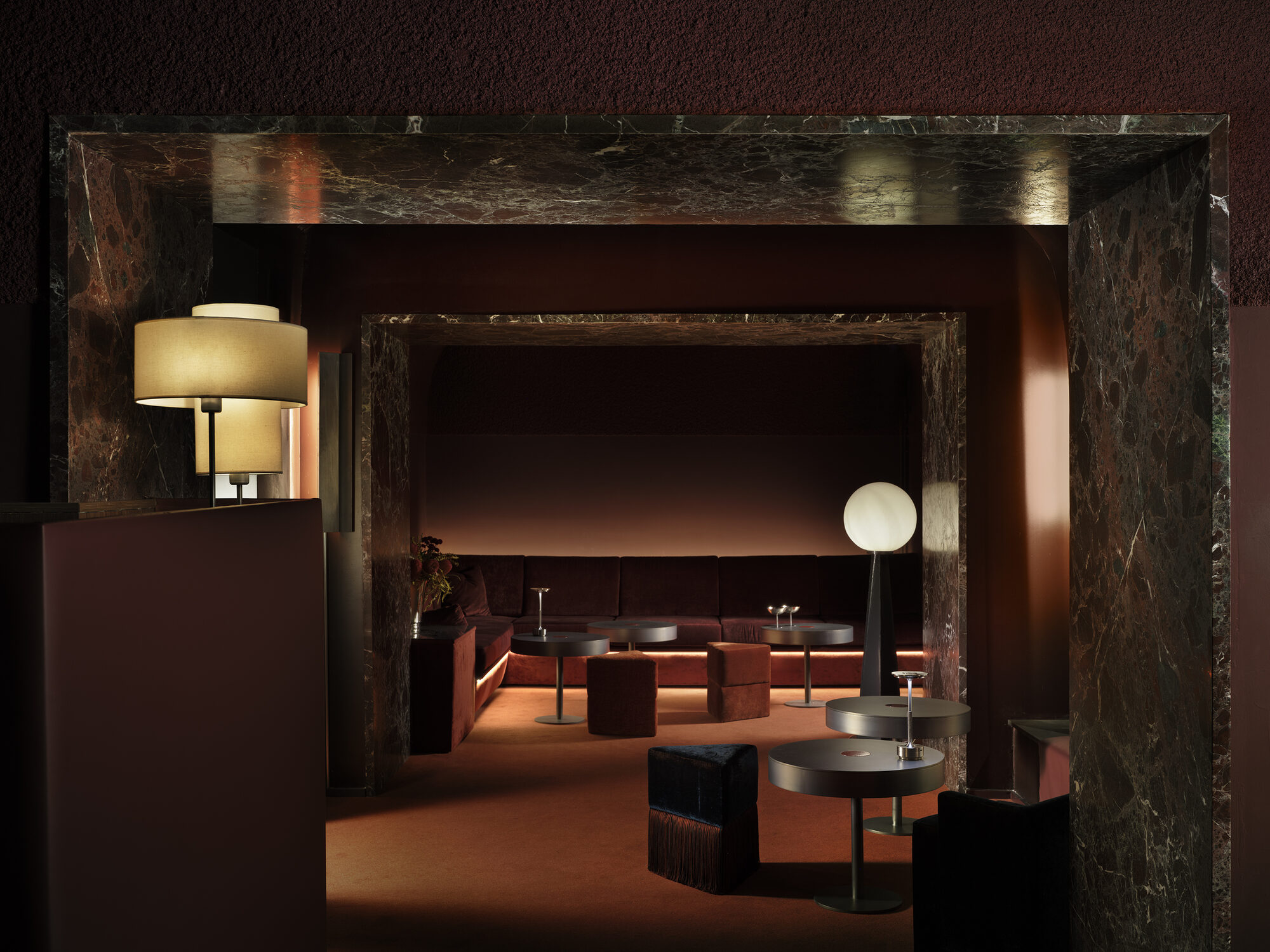
Marked by an Amarula stone portal, the descent to the lower level introduces an entirely different atmosphere. Here, the project transforms into a club conceived around the building’s interior courtyard, which becomes both spatial and emotional center. Circulation unfolds through a sequence of interconnected rooms arranged around this hidden void, encouraging movement, encounter, and discovery.


Burgundy tones dominate the lower level, paired with burnt orange carpets, textured walls, mirrored surfaces, and richly layered upholstery. The spaces maintain a sense of visual continuity while offering distinct atmospheres that shift throughout the evening. Bars, lounges, and seating areas share a common architectural language of clean lines, material depth, and understated elegance.


Rather than concealing secondary functions, the design extends the social experience into every corner of the venue. Restrooms become reflective rooms animated by mirrors, stone, and light, while circulation spaces operate as transitional galleries framed by artworks and custom designed furnishings.


Throughout the project, materiality plays a central role. Rosso Levanto marble, Amarula stone, travertine, dark timber, polished resin, and reflective surfaces are combined to create a layered environment that balances intimacy with theatricality. Every detail has been carefully considered to reinforce the project’s central idea: architecture that reveals itself slowly and leaves a lasting impression through atmosphere rather than spectacle.

Moving between restaurant and club, day and night, openness and enclosure, Chitón demonstrates how hospitality design can transform a hidden urban interior into an immersive spatial narrative. It is a project defined not by excess, but by precision, where architecture speaks quietly while remaining unforgettable.
Project Credit
Project name: Chitón
Location: Madrid, Spain
Square Meters: 407 m²
Design Firm: De La Villa Studio / @delavillastudio
Photo: Germán Saiz