
Now Reading: Jevany Villa is a quiet countryside retreat surrounded by Czech forest
- 01
Jevany Villa is a quiet countryside retreat surrounded by Czech forest

Jevany Villa is a quiet countryside retreat surrounded by Czech forest

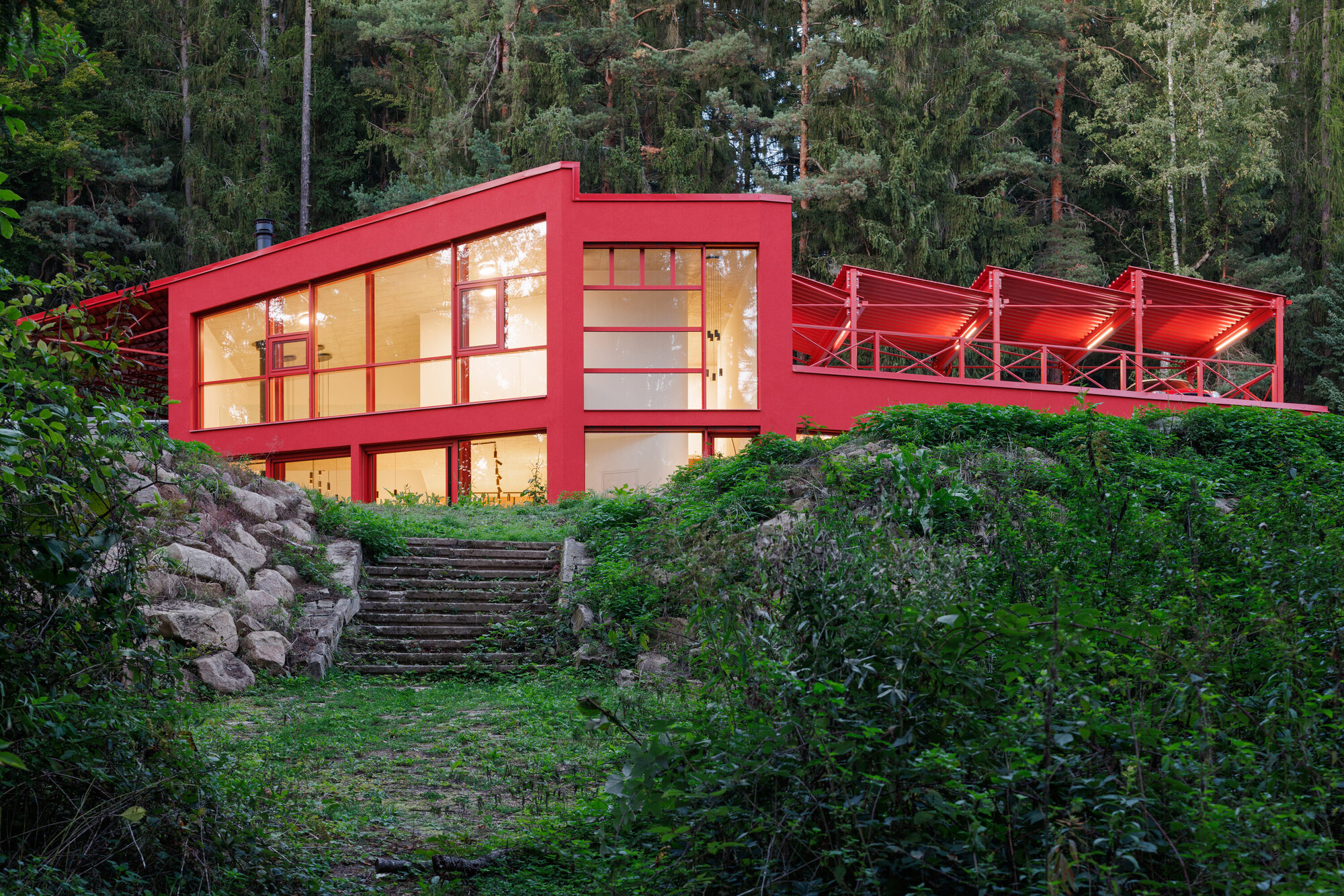
Set within a dense spruce forest in the Czech countryside, Jevany Villa by Architektura Studio is conceived as an architectural organism woven into its natural surroundings. Built on a steeply sloping site overlooking a landscape of mature trees and ponds, the house transforms dramatically depending on the point of view. From the access road above, it appears as a discreet single-storey volume almost hidden within the terrain. From the garden below, it unfolds into a generous two-storey residence that opens fully toward the forest.


The project occupies a former residential plot where the remains of an older house left a deep excavation in the landscape. Rather than imposing a dominant object onto the site, the architects positioned the new dwelling within the existing topography, allowing the surrounding trees to remain the primary visual presence. The result is a house that appears less as an isolated building and more as an extension of the woodland itself.


The central design idea is organized around a visual axis leading directly into the forest. Arrival begins unusually on the roof, where a covered parking terrace sits beneath a distinctive sawtooth steel canopy. Supported by a raw red steel structure, the roof introduces the industrial character requested by the client while establishing a striking contrast with the surrounding greenery.


From this elevated arrival point, visitors descend through the heart of the house. A double-height staircase hall acts as the building’s backbone, connecting the eastern and western wings while framing uninterrupted views toward the forest beyond. Irregular glazing recalls the compositions of modernist paintings, transforming the landscape into a constantly shifting series of framed scenes.


As one moves downward through the space, a curved wall softens the otherwise angular geometry of the building and guides circulation toward the living areas. The journey becomes less a transition between floors than a gradual immersion into the landscape itself.


At forest level, the house opens into a spacious living environment where cooking, dining, and relaxation share a single continuous volume. Full-height glazing dissolves the boundary between interior and exterior, allowing the towering trunks of the surrounding forest to become part of everyday life.


Red steel window frames introduce a bold graphic element against the irregular green silhouettes of the trees. Above, exposed concrete ceilings retain the imprint of their formwork, while black suspended lighting emphasizes the raw material palette. The interplay of concrete, steel, glass, and natural light creates an atmosphere that feels simultaneously industrial and deeply connected to nature.

The living space rises through two levels, reinforcing the vertical relationship between architecture and landscape. Throughout the day, changing sunlight, moving branches, and seasonal color shifts continuously transform the interior experience.

The private areas extend from the main living space through a long corridor lined with integrated white cabinetry. Bedrooms, bathrooms, and family spaces are oriented toward the forest, ensuring that every room maintains a visual connection to the surrounding landscape.


A bright study positioned near the entrance level serves multiple purposes, functioning as a workspace, guest room, or fitness area. Its elevated position creates another point of dialogue between the upper arrival sequence and the lower living spaces.
At the end of the residential wing, a secondary connection to the garden introduces flexibility for future family use while reinforcing the house’s relationship with the outdoors.


The restrained intervention extends beyond the building itself. Landscape modifications were intentionally limited, allowing the forest to remain the dominant character of the site. Large stones uncovered during demolition of the original structure were retained and incorporated into the new composition, reinforcing the sense that the house has emerged from the landscape rather than being placed upon it.


Throughout the project, complementary tones of green and red establish a recurring visual dialogue between architecture and nature. The forest provides movement, texture, and seasonal transformation, while the house offers a stable framework through which these changes can be experienced.


Rather than competing with its surroundings, Jevany Villa embraces them. The building becomes a mediator between human habitation and the natural world, transforming everyday domestic life into a continuous encounter with the forest.

Project Credit
Project name: Jevany Villa
Location: Jevany, Czech Republic
Project Year: 2021
Completion Year: 2025
Built-up area: 218 m²
Usable floor area: 338 m²
Plot size: 3027 m²
Design Firm: Architektura / @archi.cz
Photo: Matej Hakár