Now Reading: Rural talent center in Sichuan revives former veterinary station with stone, steel and lemon yellow accents
- 01
Rural talent center in Sichuan revives former veterinary station with stone, steel and lemon yellow accents

Rural talent center in Sichuan revives former veterinary station with stone, steel and lemon yellow accents

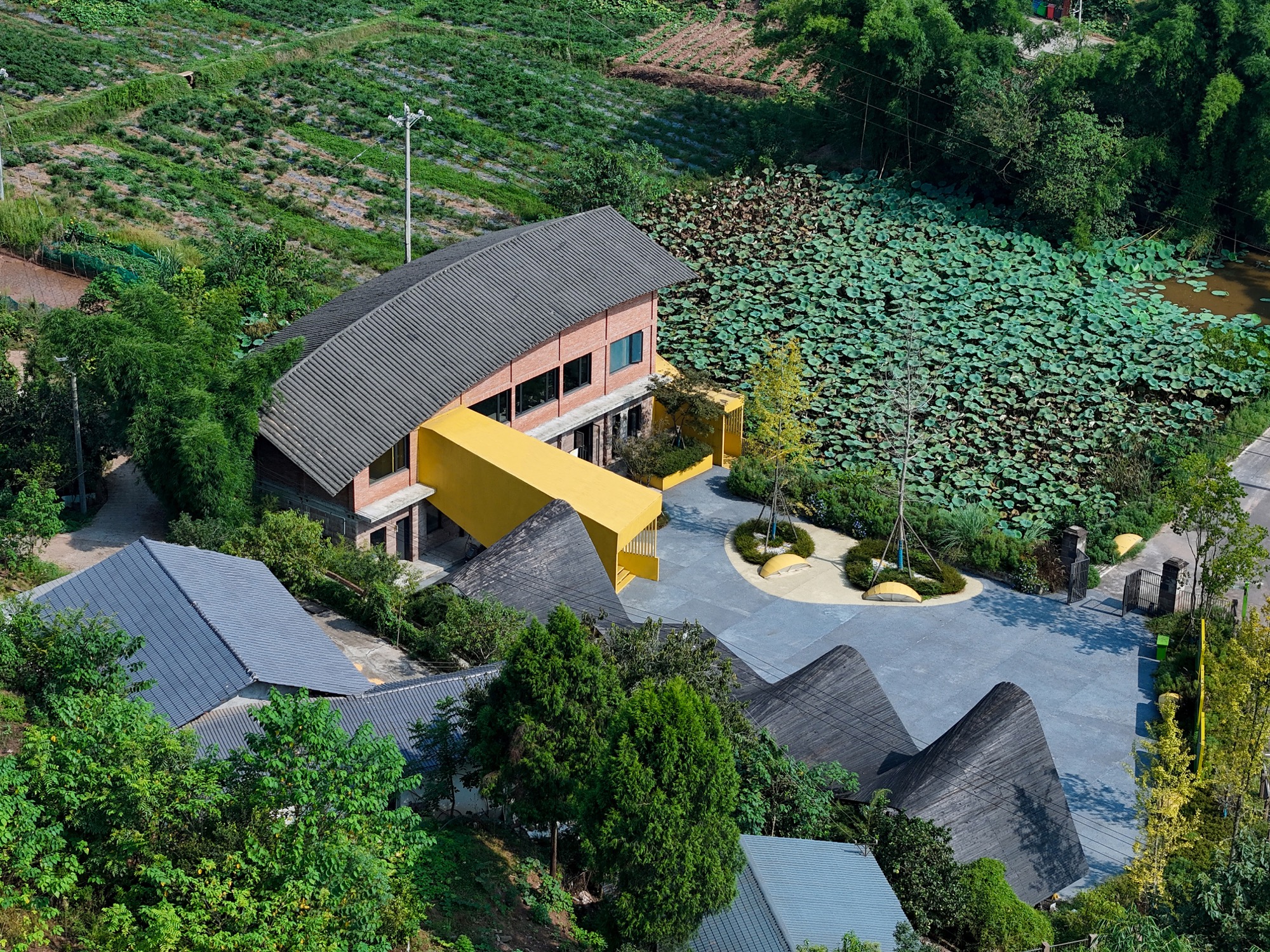
In Guanzihe Village, Sichuan, Archermit has transformed a disused veterinary station into a rural talent center that reconnects architecture with agricultural production, local identity, and everyday life. Rather than framing the project as a cultural attraction, the intervention focuses on practical infrastructure for farmers, embedding new spatial programs within an existing rural fabric.

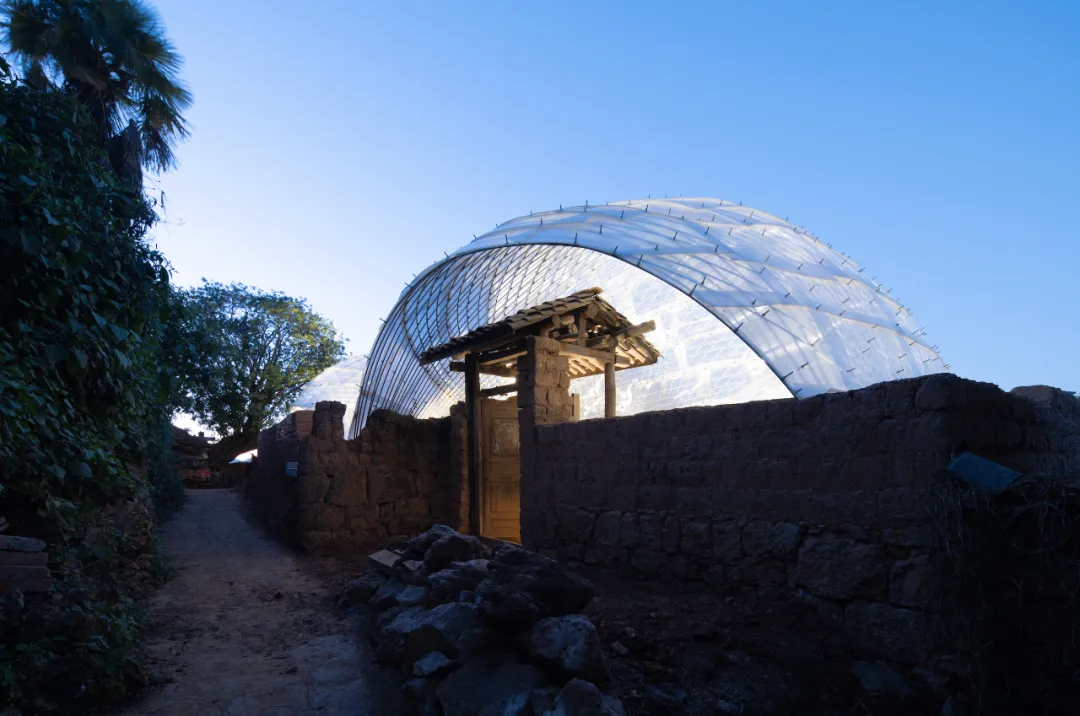
The site, once part of a network of pig farms, had remained idle for years. Its main stone structure, built using traditional dry stacked masonry, retained structural integrity, while later brick additions had partially collapsed. This condition became the starting point for a careful reading of time, distinguishing between elements that could be preserved, repaired, or removed.


The architectural approach balances demolition and insertion. The unstable second floor and annex were removed, while the original stone base was retained and reinforced. A new steel and timber system was introduced, allowing rapid construction and spatial reconfiguration.

The project unfolds through a precise sequence of interventions, from structural consolidation to the installation of a lightweight roof system. Completed in just under two months, the transformation demonstrates how rural construction can operate with speed while maintaining sensitivity to context.


Inside, the design exposes the dialogue between old and new. Rough stone walls meet newly cast concrete slabs, while industrial materials such as OSB panels and polycarbonate surfaces introduce a contemporary layer. The result is neither nostalgic nor purely modern, but a calibrated coexistence of temporalities.


The construction process draws directly from local resources and skills. Elderly villagers who had participated in the original construction returned as craftsmen, particularly in rebuilding the stone masonry. This continuity of labor embeds the project within a living lineage of making, where knowledge is transmitted through practice rather than documentation.


Materials were sourced locally wherever possible. The red brick walls on the upper level were reconstructed using familiar techniques, while timber structures were adapted to match the capabilities of nearby workshops. The design responds not only to place, but to the limits and possibilities of those who build it.


The most distinctive gesture is the undulating roof. Inspired by agricultural greenhouses and the surrounding terrain, its curved profile introduces a sense of movement across the complex. Clad in dark timber and traditional blue tiles, the roof connects visually with vernacular architecture while establishing a new landmark presence.

The adjacent agricultural shed adopts a similar logic, with varied roof heights accommodating different types of machinery. Here, standard timber planks are charred and treated, reducing cost while enhancing durability and texture. The roof becomes both infrastructure and expression, shaping the identity of the center within the landscape.


Color plays a defining role in the project. Guanzihe Village is known for its lemon production, and this agricultural identity is translated into a vivid yellow that runs through the architecture. Applied across circulation elements, facades, and interiors, the color acts as both orientation device and symbolic marker.
The yellow threads together different programmatic zones, from exhibition spaces to training areas and equipment storage. At night, it becomes luminous, transforming the building into a beacon at the village entrance. The intervention shifts from a functional hub to a spatial signal, announcing a renewed sense of collective presence.


The Rural Talent Center operates as a multi functional platform supporting agricultural production, education, and commerce. It accommodates supply distribution, training, digital sales, and cultural display, reflecting a broader shift in rural development strategies.
Rather than relying on tourism driven narratives, the project positions architecture as an active participant in local economies. Its value lies not in spectacle, but in its capacity to sustain daily operations and future growth. In doing so, it redefines rural revitalization as a process rooted in continuity, adaptability, and shared knowledge.
Project Credit
Project name: Rural Talent Center in Guanzihe Village
Location: Guanzihe Village, Qianlong Town, Anyue County, Sichuan Province, China
Architecture studio: Archermit / @archermit_architects
Gross floor area: 705 square metres
Completion: 2023
Photo: Archermit
More Photos