
Now Reading: Verdant Ridges by Wutopia Lab transforms a former silk factory into a theatrical mountain in Suzhou
- 01
Verdant Ridges by Wutopia Lab transforms a former silk factory into a theatrical mountain in Suzhou

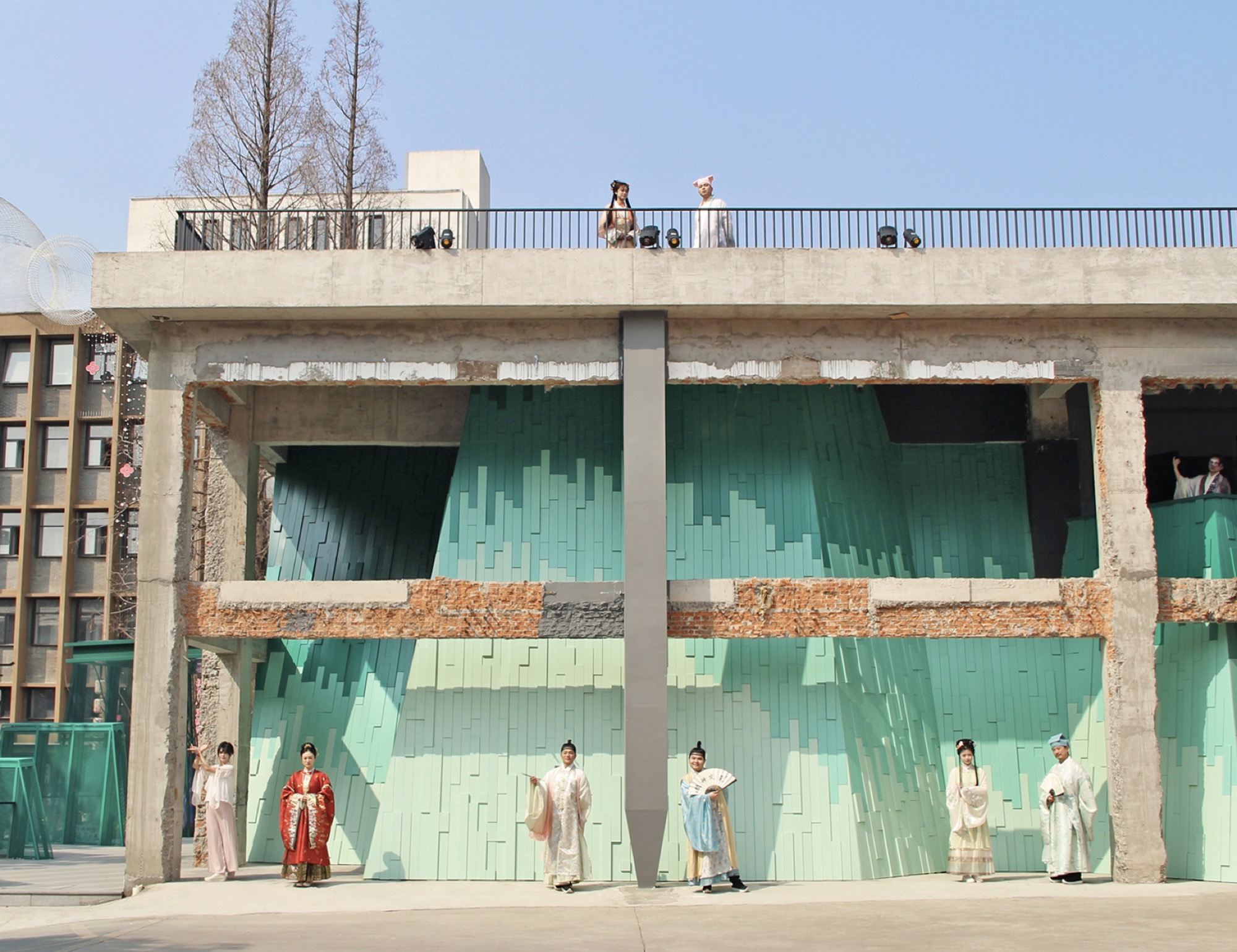
Verdant Ridges by Wutopia Lab transforms a former silk factory into a theatrical mountain in Suzhou

In Suzhou’s historic Taohuawu district, Wutopia Lab has transformed a former silk weaving factory into Verdant Ridges, a compact theatre that stages a dialogue between architecture, painting and memory. Commissioned within a district long associated with craft, literature and urban culture, the project reimagines Building No. 5 of the former Xinguang Silk Weaving Factory as a 282 square metre venue for Suzhou style performance and medium sized cultural events.

Rather than treating renovation as an act of either preservation or replacement, the Shanghai based studio proposes a third position. The existing factory is neither frozen as heritage nor erased for a new image. Instead, it becomes a narrative framework through which the life of Tang Bohu, one of Jiangnan’s most celebrated Ming dynasty artists, is translated into space, colour, structure and stagecraft.


The project takes Tang Bohu’s life as its conceptual anchor. In 1499, the artist’s expected official career was abruptly broken by his implication in an imperial examination scandal. The loss of bureaucratic ambition became the condition through which his artistic life fully unfolded. For Wutopia Lab, this rupture offers a way to read the old factory as a figure of constraint, while the new theatre becomes an image of release, transformation and artistic rebirth.
Tang Bohu was known for both landscape and figure painting. Traditional Chinese landscapes often rely on restraint, ink tone and atmosphere, while figure painting allows for greater chromatic richness. Drawing on this contrast, Wutopia Lab introduces vivid colour into a landscape inspired architectural language. The result is a theatre that borrows from classical green blue Shan Shui painting while refusing to become a literal image of the past.


On the east side of the building, a column shaped like an inverted brush appears as a discreet monument. It is at once structural, symbolic and almost theatrical, suggesting the persistence of artistic legacy within the fabric of a renovated industrial shell.
Inside, the theatre shifts into a quieter register. Black, white and grey form the dominant palette, allowing the richness of traditional Chinese stage costumes and performance to stand in contrast with the surrounding space. This restraint also refers to another dimension of Tang Bohu’s character. Behind his reputation as a romantic and flamboyant Jiangnan literatus, his Peach Blossom Hermitage Song reveals a more introspective sensibility, marked by a desire for dignity, withdrawal and inner calm.

The interior is conceived as a monochrome mountain. Acoustic panels and textured coatings reinterpret the cún brushstrokes of Chinese ink painting as vertical reliefs. A mezzanine follows the inclined geometry of the ground floor walls, deepening the feeling of entering a constructed landscape. The theatre is not simply a container for performance. It becomes a spatial passage from exterior colour to interior stillness, from public history to a more private state of mind.


The custom stage adopts an I shaped plan, departing from conventional theatre layouts. This configuration allows actors and audiences to move through a temporal field in which the present and the late Ming dynasty overlap. Rather than presenting history as background, the architecture turns it into a spatial condition.
Because of Suzhou’s historic preservation regulations, an existing central column could not be removed. Wutopia Lab absorbed it into the new design by cladding it in black timber, turning a constraint into part of the theatre’s visual order. Some seating areas were also adapted into standing zones, giving the small venue greater flexibility for different modes of performance and gathering.

On the ground floor, undulating ink wash mountain silhouettes form a scenographic backdrop. A ticket office and bar occupy one side, while dressing rooms are placed on the other. Above, a control room is arranged on the second level, with an external staircase on the north side leading toward the rooftop. The old concrete frame, the new mezzanine and the decorative layers are treated with distinct material strategies, allowing roughness and refinement to remain visible beside each other.

The exterior develops the idea of duality through material and depth. In the foreground, metal mesh forms an ethereal mountain silhouette, while behind it, more solid metal clad volumes suggest heavier terrain. At the entrance, the negative space of a mountain becomes a visual threshold, framing the passage into the performance realm.


Because the site stands close to a fire station, the new structure is set back to the north, creating a grey transitional zone that leads visitors beneath the eaves and into the interactive area. On the second floor, a terrace is positioned among the peaks, offering the sensation of standing inside the constructed landscape. From the first encounter with the building, the visitor is drawn into a theatrical exchange between past and present.
The metal curtain wall uses four types of metal panels with different tones and thicknesses. V shaped panels resolve the corner junctions, giving continuity to the facade’s folded geometry. Above, a trapezoidal metal mesh outlines the roof, extending the rhythm of the mountain profile beyond the building edge.

Verdant Ridges is presented by Wutopia Lab as a third approach to renovation. It is not a total redesign, and it is not a fixed act of conservation. Instead, it seeks a more equal exchange between historical material and contemporary imagination. Tang Bohu’s life, the memory of the silk factory, the traces of construction and the demands of a working theatre are woven into a single architectural text.
The theatre’s resident performances extend this idea. As actors move through the I shaped stage, the boundary between historical narrative and present experience becomes unstable. Architecture is no longer a mute backdrop. It becomes a participant in the performance, carrying symbols, fragments and unfinished meanings.


For Wutopia Lab, the project reflects a broader position. The studio respects the mainstream while continuing to search for a path of its own. In Verdant Ridges, that path emerges through intertextual design: architecture as a field where symbolism, history, artistic biography, construction traces and urban renewal meet.
The project also proposes a question for the future of small scale urban regeneration. Can a modest building, shaped by the story of one historical figure, reactivate a neighbourhood’s cultural meaning? The answer may take time to appear. What Verdant Ridges offers now is a theatre that treats renovation not as cosmetic repair, but as a form of cultural interpretation.
Project Credit
Project name: Verdant Ridges
Design firm: Wuto-mills by Wutopia Lab / @wutopia.lab
Photo: Liu Guowei / @dailyliuguowei
Location: Suzhou, China
Timeline: May 2024 to December 2024
Area: 282 square metres
More Photos