Now Reading: Gravity: Resistance to Falling
- 01
Gravity: Resistance to Falling

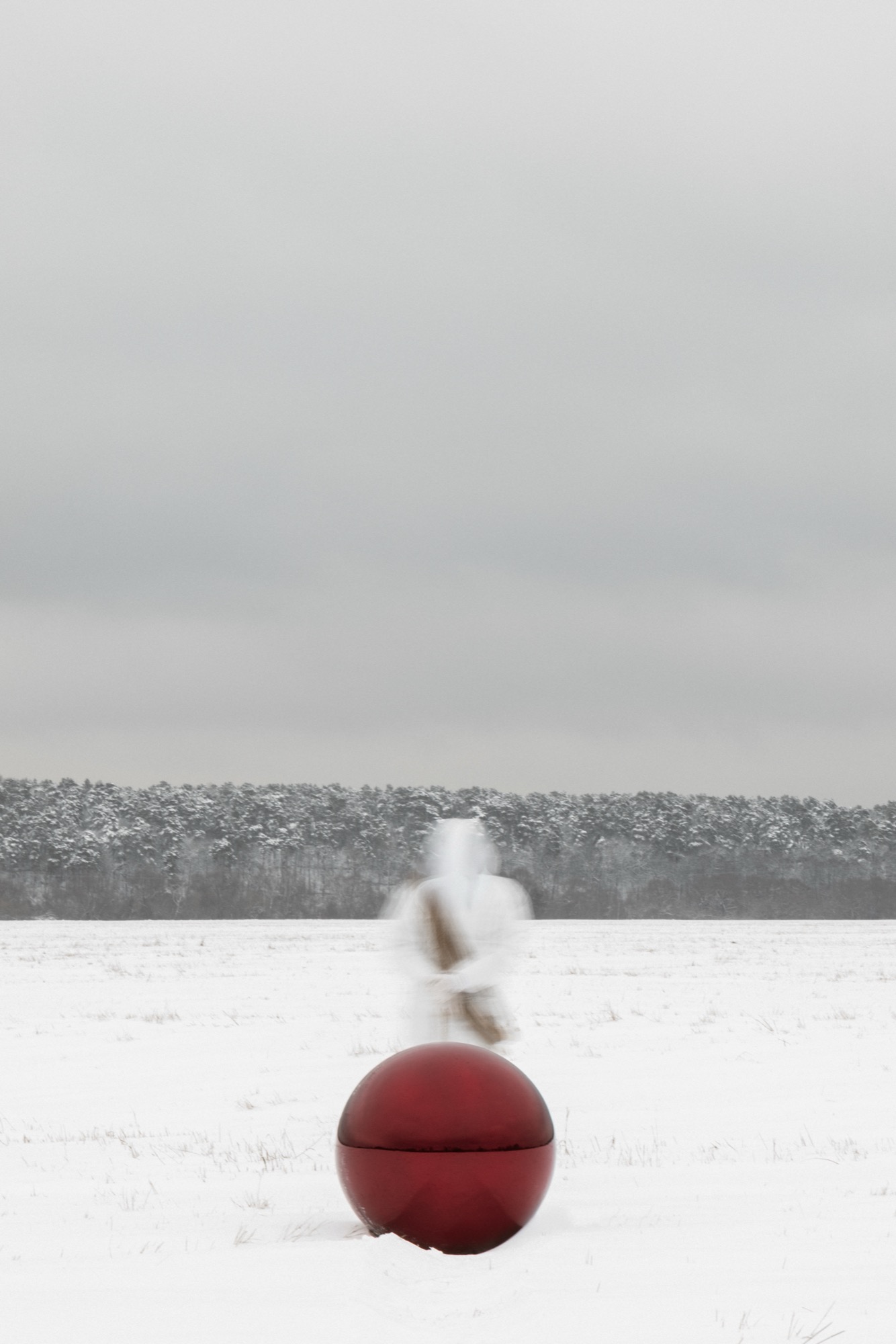

In Gravity, Gregory Orekhov places a single red sphere into a winter landscape and lets it carry the weight of a world that no longer feels stable. What begins as a familiar emblem of seasonal ritual is removed from its usual role and relocated as a vulnerable mass, exposed to cold air, bare branches, and the unyielding pull of physics.

The sphere arrives with cultural baggage: the promise of celebration, anticipation, and a kind of domesticated magic. Orekhov strips that expectation away. In this setting, the object cannot decorate, cannot comfort, and cannot resolve into symbolism that feels safe. It becomes heavy, defenseless, and almost too present, as if the landscape itself has turned into a testing ground for meaning.


Hung by a hemp rope from a barren, century old tree, the sphere occupies an uneasy interval between ground and space. It is neither falling nor settled. The tension is the point: not balance as harmony, but endurance as resistance. The work stages a prolonged moment of instability, where the possibility of rest is postponed and the prospect of release never arrives.

The accompanying video extends this condition rather than explaining it. The sphere is dragged across the ground, then shifted into oscillation, trading linear movement for a suspended swing. Yet no change of state becomes an exit. The human figure and the object remain linked by a shared dependence on gravity, held together by the same force that limits them. The work suggests that constraint is not a scene, but a relationship.
Here, red refuses to behave like an accent. It condenses into a visual mass that gathers traces of loss and historical memory, until celebration drains out of the color entirely. The sphere becomes a symptom rather than a sign, a blunt presence within a landscape that will not transform it into beauty. The tragic does not arrive as an event; it settles into the background as something ordinary, something lived with.


Nature does not offer resolution. The tree does not redeem, protect, or moralize. It simply permits the object to exist, standing as a silent witness to what unfolds. In Gravity, the landscape is not a space of harmony but a stage of exposure, where the world appears without foundation and without outcome.


Orekhov’s gesture is spare, almost brutal in its simplicity: one object, one rope, one tree, one season. But the restraint sharpens the reading. Gravity records a contemporary condition in which stability is not promised, and meaning is not guaranteed to conclude. The work does not perform catastrophe. It shows how catastrophe can become a climate of thought.

Project Credit
Artist: Gregory Orekhov / @gregory.orekhov
Title: Gravity
Year: 2026
Location: Finland
Medium: Mirror-polished stainless steel with transparent coating, hemp rope
Photography: Nikita Subbotin