Now Reading: Concrete as Connection: Gottfried Böhm from Neviges to the Postwar City
- 01
Concrete as Connection: Gottfried Böhm from Neviges to the Postwar City

Concrete as Connection: Gottfried Böhm from Neviges to the Postwar City
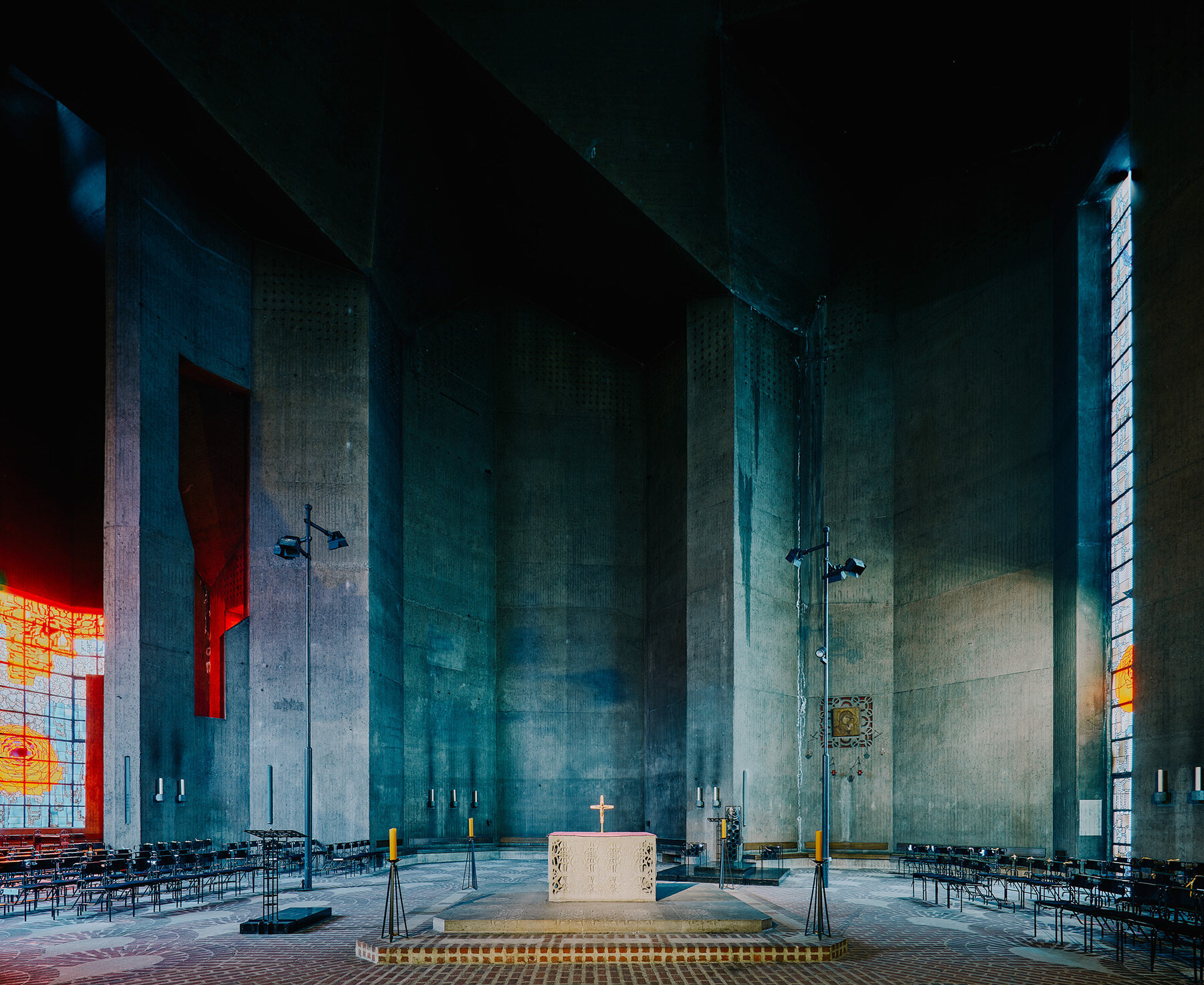
Upon arriving in Neviges, a small town set among the green hills of Germany’s Bergisches Land, you do not expect a church to rise from the slope like a jagged mountain. Yet this is exactly what Maria, Königin des Friedens (Mary, Queen of Peace) does. Better known as the Neviges Mariendom, the pilgrimage church is less a building in the conventional sense than a landform made architectural: folded, faceted, and sharply profiled, as if geological pressure had crystallized into concrete. Built as an exposed-concrete ensemble between 1963 and 1968, it is the defining work of Gottfried Böhm’s most intense sculptural period and, for many, the moment his lifelong idea of “connections” becomes fully visible in built form.
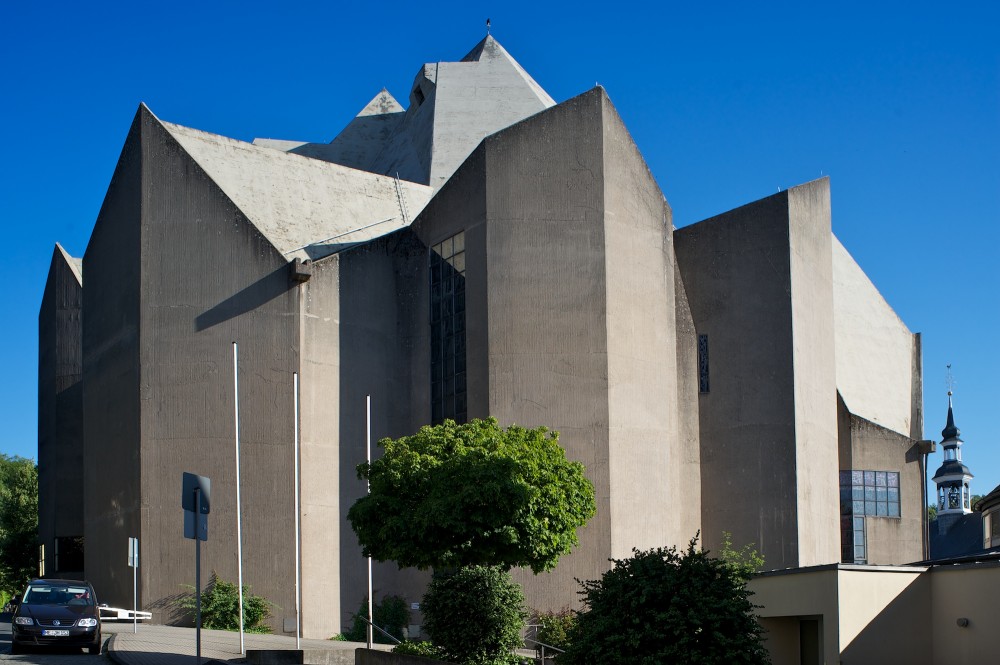
If the exterior reads as a concrete mountain, the interior feels like a cavern whose darkness is not emptiness but concentration. Light enters through high openings and stained glass, not to illuminate everything evenly, but to arrive in slivers and pulses, gathering attention and guiding movement. Conceived for major pilgrimage crowds, the church offers around 800 seats, with total capacity reported variously in the low thousands depending on counting methods and crowd density. The point is less the number than the premise: this is a sacred interior designed to receive collective presence.
Neviges is inseparable from the broader turn in Catholic liturgy and spatial thinking around the Second Vatican Council (1962–1965), which urged more active participation and a closer relationship between congregation and rite. In different ways across Europe, this shift encouraged architects to reimagine churches less as distant icons and more as communal rooms, where the ritual is experienced as shared presence rather than observed spectacle.
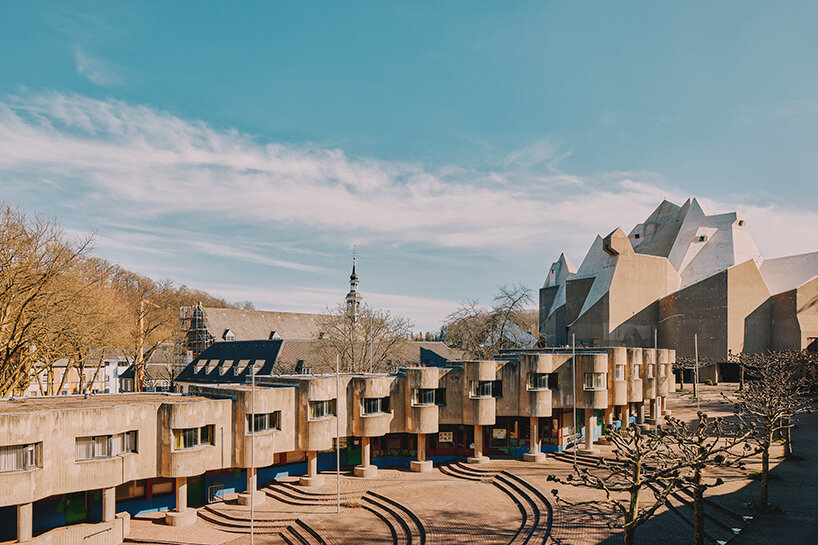
The making of Neviges was also, crucially, a matter of sequence and approach. Böhm did not treat the church as an isolated object on a hill. He embedded it into a choreography: the uphill route from the station becomes a formal pilgrims’ way, developed together with the perimeter buildings, leading to a vast forecourt and then continuing inside to the altar through the same paving that flows from exterior to interior. Architecture here is not only enclosure, but procession, threshold, and gradual intensification.

The narrative of how Böhm won the commission has become part of the building’s mythology. The Franciscans, responding to rising pilgrim numbers after 1945, sought a new church that could serve large gatherings and organized a competition in 1962–1963. The process unfolded in stages, with an initial anonymous round followed by revisions from selected architects. Böhm’s proposal was initially criticized for its expressive formal language, yet it ultimately prevailed. One oft-repeated anecdote describes Cologne’s Archbishop Josef Frings, nearly blind, approving the design after feeling the model with his hands. The story matters not for its romance, but because it captures something real about Böhm’s method: form understood as a tactile, sculptural argument, not simply a plan.

Critics have long wrestled with how to name the building’s intensity. Jonathan Meades, writing on the collision of Vatican II and uncompromising modernism, describes Neviges as an overwhelming hyperbolic expressionism that alludes to penitents’ hoods, with forms that turn zoomorphic and geomorphic. Whether one shares his skepticism or not, the description is accurate in one key sense: Neviges behaves like a physical metaphor. It is not a neutral container for worship. It asserts a world of weight, shadow, and pressure, then complicates that heaviness through light and movement.
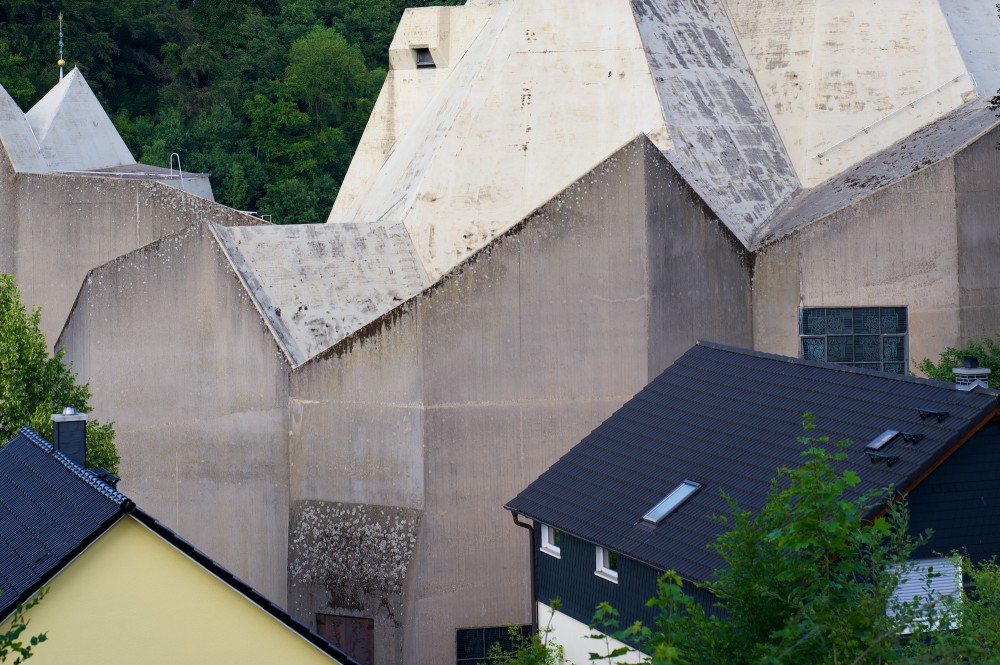
Seen this way, Neviges becomes the key that unlocks Böhm’s career, a career spanning more than seven decades in which architecture repeatedly works as a bridge between inheritance and invention, memory and reconstruction, ruin and civic continuity. Böhm himself preferred to be understood through the idea of creating “connections”: between old and new, between the world of ideas and the physical world, and between a single building and the wider urban environment, including the form, material, and color of a building in its setting.
Böhm was born in Offenbach am Main on January 23, 1920, into a family already shaped by Catholic church architecture. His father, Dominikus Böhm, was among Europe’s most respected designers of ecclesiastical buildings, and the architectural lineage extended further back through his paternal grandfather. Gottfried’s education, however, combined engineering discipline with sculptural training. He studied at the Technische Hochschule in Munich, receiving his degree in 1946, and then continued for another year at the Academy of Fine Arts in Munich studying sculpture. That sculptural training became fundamental to his process, especially his reliance on clay models to develop form through touch and volume rather than purely through drawings.

From 1947 to 1950 he worked in his father’s office and collaborated with the Society for the Reconstruction of Cologne under Rudolf Schwarz, at a moment when reconstruction was not simply technical but moral and cultural: the rebuilding of a city’s civic life through the redefinition of streets, institutions, and shared space. In 1951 Böhm traveled to New York, worked briefly in the firm of Cajetan Baumann, and used the journey to broaden his outlook, including meeting Mies van der Rohe and Walter Gropius. After returning to Germany and resuming work with his father, he took over the family firm following Dominikus Böhm’s death in 1955, entering an independent phase that would produce churches, city halls, museums, theatres, and urban interventions.
The postwar European context shaped not only Böhm but the entire generation that rebuilt the continent’s public life. Architecture was required to be urgent and economical, yet it was also asked to carry symbolic weight: to represent recovery without slipping into nostalgia, to acknowledge rupture without surrendering to despair. In that climate, the architectural languages that gained power often valued directness: structure made legible, materials left as found, and form allowed to carry ethical claims about honesty, collectivity, and endurance.
This is where Brutalism enters the story, both as label and misunderstanding. Brutalism is frequently reduced to an aesthetic of rough concrete, but its origins lie as much in a moral posture: a refusal of cosmetic finish, an insistence on clarity of construction and social intent. The term is commonly linked to Le Corbusier’s notion of béton brut (raw concrete) and to debates around New Brutalism in 1950s Britain. Yet in practice the movement was never singular. Brutalist work could be civic and hopeful, or bureaucratic and coercive, depending on context, patronage, and politics.

Böhm, notably, never accepted Brutalism as a total identity. Even when he built in exposed concrete, he resisted the coldness that the label sometimes implies. His concrete is rarely only a surface. It is a sculptural medium used to produce thresholds, compression, release, shadow, and narrative. In Neviges, the raw is not merely raw, it is tuned and staged, drawing the pilgrim through a sequence that oscillates between shelter and monumentality. The result is not a denial of the sacred, but a reinvention of it through the tools of modern construction.
Böhm’s architecture is therefore best read through continuity rather than rupture. He took from his father’s expressionist church tradition an understanding of emotional volume and spiritual atmosphere, and combined it with post-Bauhaus ethics of austerity and honesty. This hybrid is precisely what makes Neviges feel both ancient and modern at once. The building borrows from the logic of the mountain and the tent, from the cave and the market square, and yet it is unmistakably a product of its time, a postwar statement in a material that could be poured, folded, and scaled.
That idea of connection becomes even clearer when Neviges is placed beside Böhm’s civic work. Bensberg Town Hall in Bergisch Gladbach, built between 1962 and 1972, is among the most powerful examples of his ability to join new construction with historic residue. The building occupies the site of the ruins of an old medieval castle. Böhm did not erase the remains. Instead, he integrated them into the new complex, so that the town hall becomes both a contemporary civic machine and a continuation of the hilltop’s historical layers. A sculptural stair tower stands as a focal element, and glazing on the ground floor opens the complex to the public realm. Here, the connection is not metaphorical. It is literal: medieval stone and modern concrete meeting in a single civic figure, acknowledging time without imitating it.

If Neviges is a pilgrimage mountain and Bensberg a civic fortress reimagined, then the ZÜBLIN Haus in Stuttgart shows Böhm’s capacity to translate his thinking into corporate and infrastructural terms without losing the idea of spatial linkage. Built between 1983 and 1984 as an office headquarters, the complex is organized as two parallel wings connected by an atrium. The building is about 94 meters long, and the two wings stand roughly 24 meters apart. The glazed atrium, around 60 meters long, is covered by a saddle-shaped glass roof, turning the space between volumes into a communal interior street. This is connection as organizational principle: bridging divisions, making a climate-controlled public interior, and rendering the in-between as the project’s main architectural event.

This shift toward transparency in later decades should not be read as a rejection of concrete, but as continuity in method. Böhm repeatedly allowed the given conditions, the program, the urban role, the technical possibilities of the moment, to dictate material choice. He insisted that the future of architecture lies less in continuing to fill the landscape and more in bringing back life and order to cities and towns. The statement reframes his oeuvre as civic care rather than stylistic experimentation.
To understand Böhm’s relevance today, it is useful to look beyond the surface debates around Brutalism and ask what his buildings teach about continuity under pressure. Neviges is also an object lesson in technical stewardship. The church has required substantial roof refurbishment due to cracking and water ingress, and recent restoration work has tested new approaches to repairing complex concrete shells. Even here, Böhm’s legacy appears as connection, this time between architectural heritage and material research.
Böhm’s influence is not only formal. It is ethical and procedural. He modeled an approach in which architecture is simultaneously sculpture and urbanism, atmosphere and infrastructure, memory and renewal. It is telling that accounts of his work foreground projects built into ruins and urban seams, insisting that his true subject is not the isolated object but the relationship between a building and the world that surrounds it.
His later career also underscores the continuity of the Böhm family’s architectural practice, where projects are often collaborative across generations. The Hans Otto Theater in Potsdam, opened in 2006, is frequently credited to the Böhm office as a multi-author work involving Gottfried Böhm alongside Paul and Stephan Böhm, following a competition win in 1999. The theatre’s dramatic roof forms and waterfront presence translate the family’s sculptural instincts into a civic cultural landmark. Whether one emphasizes Gottfried’s authorship or the office’s collective work, the point remains: the connections concept extends to practice itself, architecture as a shared craft across time.


Gottfried Böhm died on June 9, 2021, at 101. He was the first German architect to receive the Pritzker Prize, in 1986, and his work continues to define a specific postwar German path: neither the smooth optimism of late modernism nor the ironic detachment of later postmodern gestures, but a more grounded, sculptural humanism. His buildings are not shy about mass or gravity, yet they repeatedly seek to reinstate civic and spiritual life where history has fractured it.
Neviges remains the clearest distillation of that ambition. It does not simply occupy a landscape. It remakes the act of arrival, turning the town’s slope into a ritual of approach, and turning concrete into a material capable of tenderness as well as weight. To stand before this concrete mountain is to see how architecture can be humble and monumental at the same time, not by retreating from history, but by binding it to the present through form, sequence, and care.
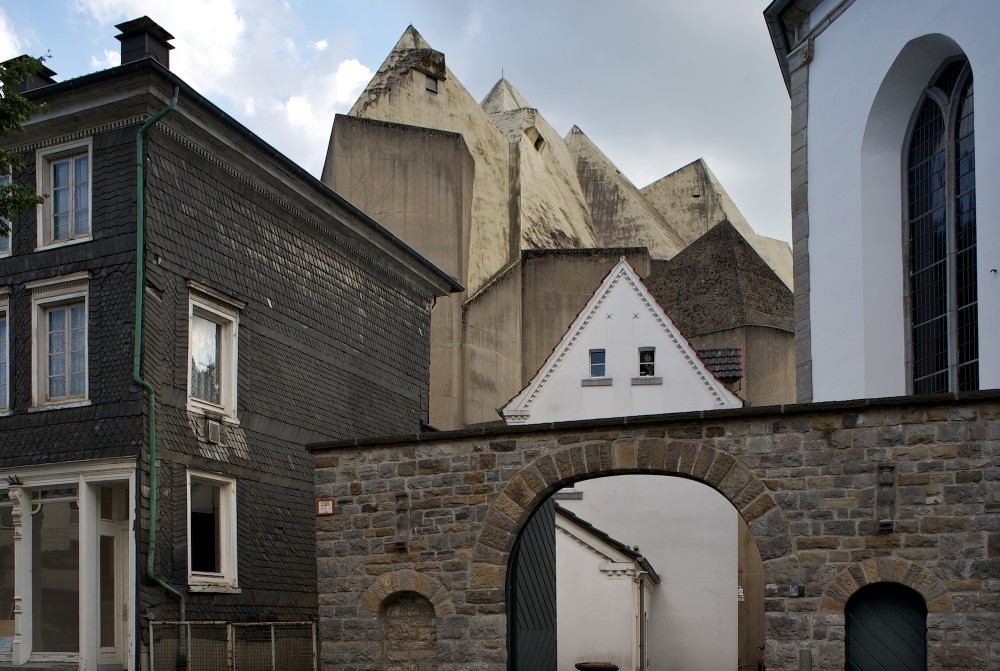
Gottfried Böhm’s enduring lesson is not that concrete can be beautiful, though Neviges proves it can. His lesson is that architecture gains meaning when it becomes connective tissue: between past and future, ruin and repair, private life and civic space, ritual and daily movement. In an era again defined by repair, adaptive reuse, and resource-conscious building, Böhm’s work feels newly contemporary. It demonstrates how power can coexist with humility, how monuments can still serve communities, and how the most uncompromising forms can remain, at their core, acts of connection.
REFERENCE
- Deutsches Architekturmuseum (DAM), BÖHM 100: The Concrete Cathedral of Neviges (press information, 2020).
- The Pritzker Architecture Prize, Biography: Gottfried Böhm (official biography).
- The Pritzker Architecture Prize, Gottfried Böhm, 1986 Laureate (biography PDF).
- Baukunst NRW, Pilgrimage Church Neviges, Maria Königin des Friedens (project entry).
- Baukunst NRW, Bensberg Town Hall (project entry).
- ZÜBLIN, ZÜBLIN Haus (project description and dimensions).
- RIBA, Brutalism (overview).
- Tate, Brutalism (definition and etymology).
- Jonathan Meades, Concrete Cuckoo, The Spectator Australia (2017).
- Architekturbüro Böhm, Hans Otto Theater in Potsdam (project page).
Photo Cover
Neviges Mariendom rising like a jagged concrete mountain from the green hills of Bergisches Land, Germany. Credit: David Altrath / Desigboom
Related Posts
Previous Post
Next Post
- The timeless elegance of domestic appliances: From the Iconic Braun KF 20 aromaster to the German design ethos

- Emilio Ferro on the light, sound and memory of a place
- At Maniwa, an architect’s family home opens to the neighbourhood
- What bronze remembers of the hand

- Caught in light: Moradavaga’s suspended shoal

- The making of Alex Chinneck’s impossible Dior windows