Now Reading: The enduring logic of Jean Prouvé: From a chair to a construction ethic
- 01
The enduring logic of Jean Prouvé: From a chair to a construction ethic

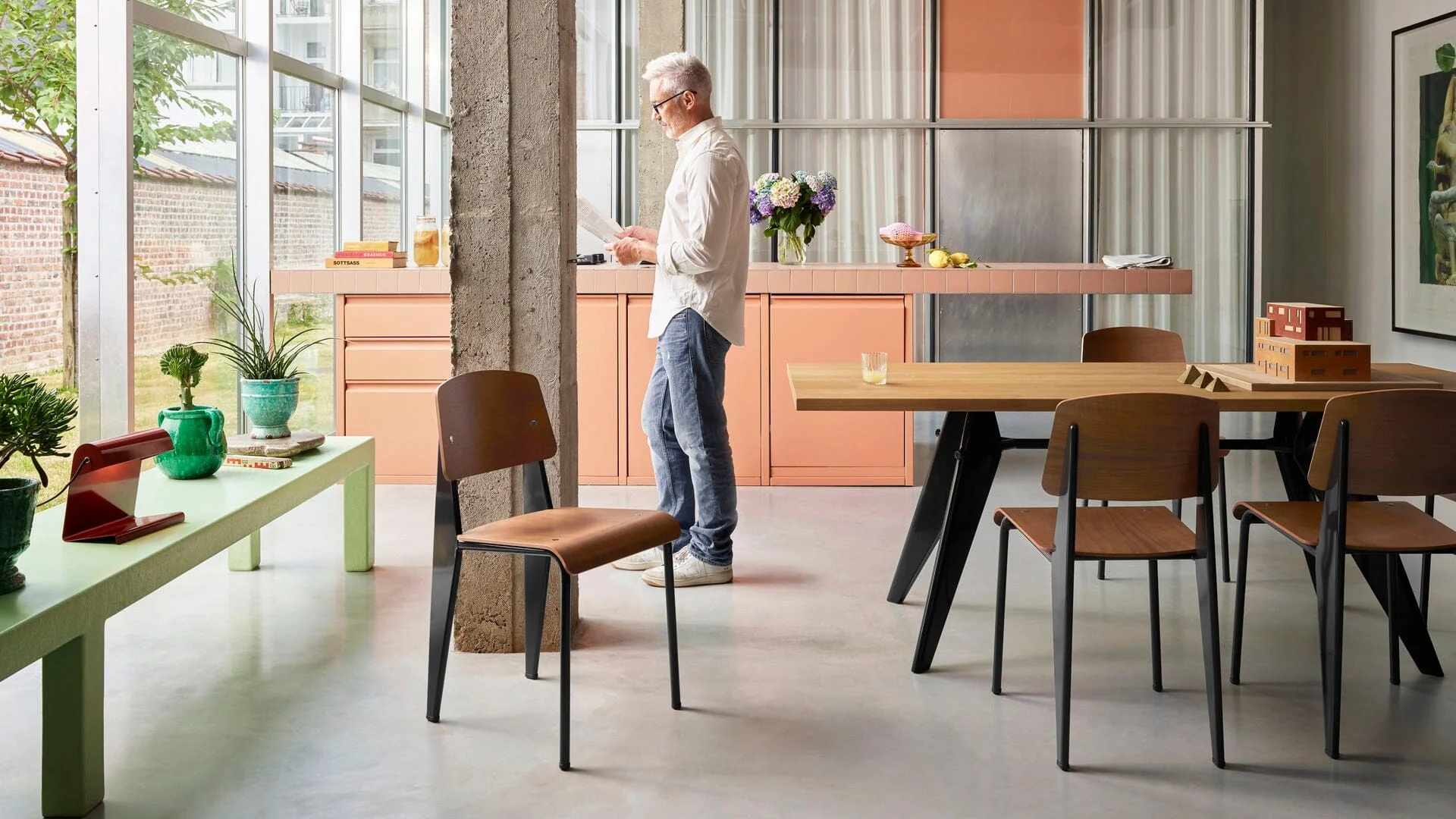

In Nancy, in the 1930s, Jean Prouvé made a chair that looks almost too plain to be a manifesto. And yet the Standard is exactly that: a small object that behaves like a building. It is not “minimal” as a style. It is minimal as a consequence.
Sit down and the chair explains itself. The rear legs take the real load, so Prouvé gives them mass and geometry: folded sheet steel, hollowed into a stiff profile, braced like a compressed beam. The front legs do less, so they remain slender tubes. Wood warms the touch where the body meets the object. Nothing is added to make it look designed; everything is there to make it work.
This was not a decorative idea dressed as engineering. It was a practical lesson in load paths, told in metal and proportion, the kind of clarity you find in bridges, cranes, and well-made tools. The Standard is often described as a “chair,” but it behaves more like a prototype for a method: identify stress, choose the honest material response, and accept the form that results.
CHAIR NO. 4, THEN STANDARD (1934/1950)
When Prouvé introduced the design in 1934, it was first presented simply as Chair No. 4 – a pragmatic label for an object built to be used, not mythologised. The name “Standard” came later, as the model evolved through versions and found its natural habitat in the places that test objects hardest: schools, offices, cafeterias, public institutions. The chair’s basic logic never changes, but the details do: the rear leg profile becomes even more explicitly structural in later iterations, and the design is refined in step with what fabrication can do well, most notably with the 1950 update that aligned the chair more cleanly with serial production.
Today, the Standard still reads with the calm authority of something that has survived real use. It looks right in a museum, but it was never conceived for reverence. It was made for repetition, repair, and time.

THE “CONSTRUCTEUR” AT WORK
To understand why the Standard matters, it helps to understand how Prouvé was seen by his peers and how he positioned himself. He did not treat furniture as the small, charming cousin of architecture. For him, there was continuity: a chair, a façade panel, a demountable house, a large civic project all belonged to the same family of problems.

This is why the word constructeur keeps returning around his name. Le Corbusier described Prouvé as an “engineer-architect” in a single man, exceptional, while Prouvé, speaking of himself, used the term “constructeur.” The distinction matters. It points to a maker’s identity: someone who brings things into being through structure, process, and responsibility, not through image.
The ethic is already present in the Standard. The chair is not an icon because it is pretty. It is an icon because it is correct.
FROM THE WORKSHOP TO MAXÉVILLE
Prouvé was trained in metalwork before he became widely known for architecture. He established a workshop in Nancy early in his career and formalised his practice as Ateliers Jean Prouvé in 1931. The timing matters: his work comes of age precisely when welding, sheet metal, and industrial fabrication begin to reshape what a “modern” object can be.
After the Second World War, the problem of housing in France was not theoretical. The country needed speed, economy, and repeatable construction. In 1947, Prouvé set up a major factory at Maxéville, scaling his ideas from workshop production to industrial output. The factory was not just a manufacturing site. It was a research engine for prefabricated components, modular building systems, and furniture built with the same discipline.

The story is also a cautionary one. In 1952–53, amid disputes with majority shareholders, Prouvé left the Maxéville enterprise that carried his name. It is one of the defining tensions of his career: the person who understood industrial production with rare intuition was never fully at ease inside industrial ownership.
NOMADIC ARCHITECTURE, DECADES BEFORE THE WORD BECAME FASHIONABLE
Prouvé’s best architectural ideas are often described as “prefab,” but that word can sound smaller than the ambition. His work was not about cheapness. It was about precision, transport, assembly, and adaptability.
During and after the war, he developed a series of demountable houses in compact formats, conceived to be erected quickly by small teams and moved if needed. These were not romantic cabins. They were systematic answers to urgent conditions: shelter that could be delivered at speed without surrendering to crude construction.


In these projects, Prouvé’s furniture logic becomes architectural: structure is explicit, joints are legible, panels are made to be handled, and the entire building is thought through as a kit of parts. The house becomes something you can assemble with the same decisiveness as a chair.
THE TROPIQUE HOUSE AND THE MAISONS TROPICALES (1949–1951)
If the Standard Chair is Prouvé’s smallest, cleanest statement, the Tropique House and the broader Maisons Tropicales story show his method under extreme climate and logistical pressure.
Designed and manufactured between 1949 and 1951 for West Africa, the Maisons Tropicales prototypes were conceived as lightweight systems tuned to heat, sun, and ventilation. Aluminium, shutters, layered skins, and carefully managed openings are not style here; they are survival strategies. The buildings read like machines, but the aim is human comfort: shade, airflow, a livable interior.

Only three prototypes were made. Their afterlife, however, became strangely emblematic of the late twentieth and early twenty-first century: neglected, displaced, later restored, and eventually reintroduced to the world as rare objects of intense desire, circulating through exhibitions and collections.
You can argue about the ethics of that journey. What cannot be denied is the clarity of the original intent: a house as an adaptable system, designed to move.
A HOME AS PROOF: MAISON JEAN PROUVÉ, 1954
In 1954, Prouvé built his own family house in Nancy, assembling it mainly from standard factory components produced by Ateliers Jean Prouvé. It is not a “signature” house in the expressive, sculptural sense. It is a home as a demonstration: compact, rational, and direct about how it is made.
Seen today, it feels less like a period piece than a quietly stubborn proposition. The house insists that everyday life deserves the same intelligence as a public commission.

LEGACY WITHOUT NOSTALGIA
Prouvé’s influence does not need to be exaggerated. It is visible in the way contemporary architecture talks about structure, prefabrication, and honesty of materials and in the way certain buildings choose to reveal how they work instead of masking it.

His afterlife is also concrete. Major institutions have studied and exhibited his work for decades. Manufacturers have reissued key designs in collaboration with his estate. And designers and architects continue to return to his objects not as vintage trophies, but as usable lessons.
The Standard Chair remains the simplest point of entry. It does not shout. It does not perform. It just stands there, doing what it was made to do, with a logic so clear it begins to feel like culture.

And perhaps that is Prouvé’s most durable revolution: the idea that what is truly modern is not what looks new, but what remains structurally and ethically convincing, year after year, under real weight.
Photo Cover
The Standard Chair today – simple, correct, and still in production after nearly a century. Credit: © Vitra