Now Reading: Carrying Home: Do Ho Suh’s Architectures of Memory and Migration
- 01
Carrying Home: Do Ho Suh’s Architectures of Memory and Migration


Home, in Do Ho Suh’s work, is never a stable address. It is an image you carry, a structure you fold, a set of thresholds that travel with the body. Over the last three decades, the Seoul-born, London-based artist has built an oeuvre from that deceptively simple premise: that architecture is not only shelter, but an emotional technology, storing the pressures of belonging, absence, and return.
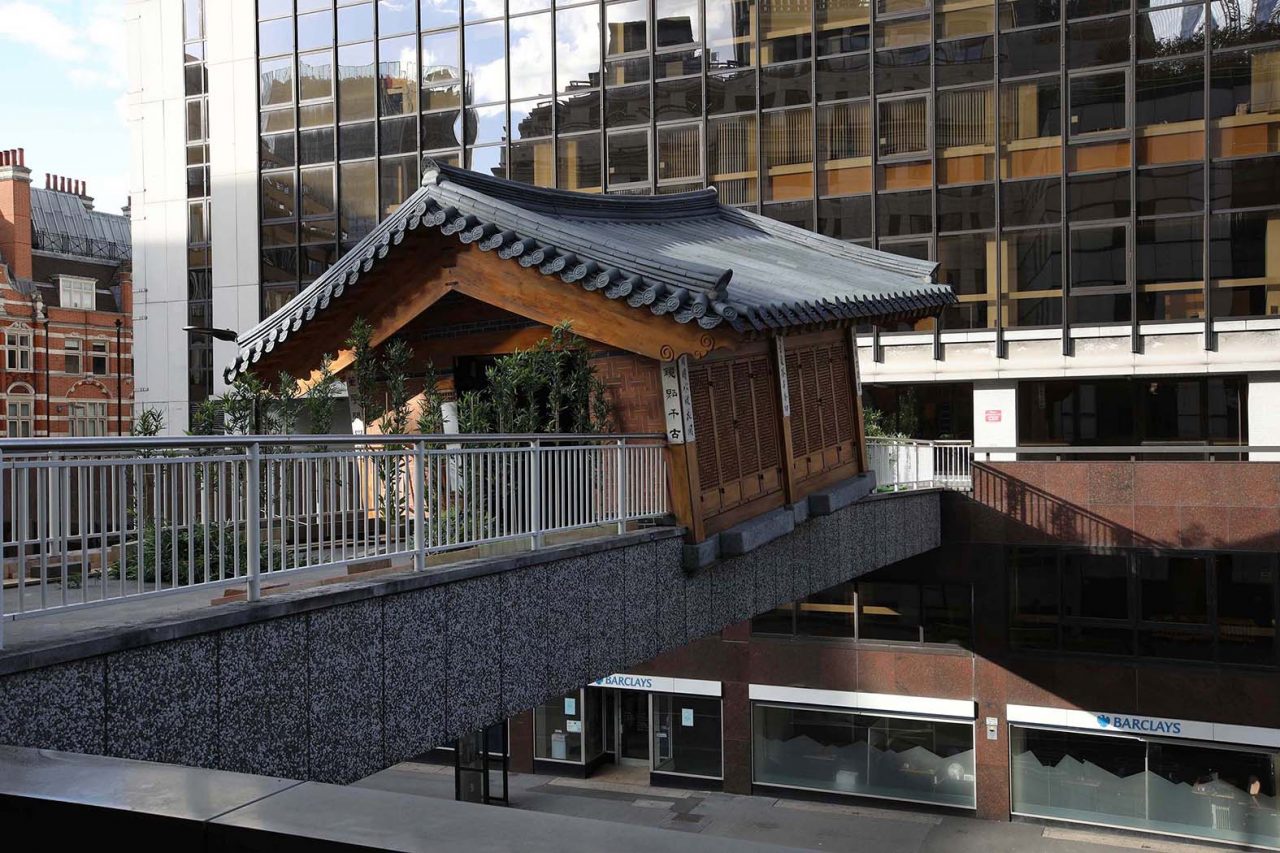
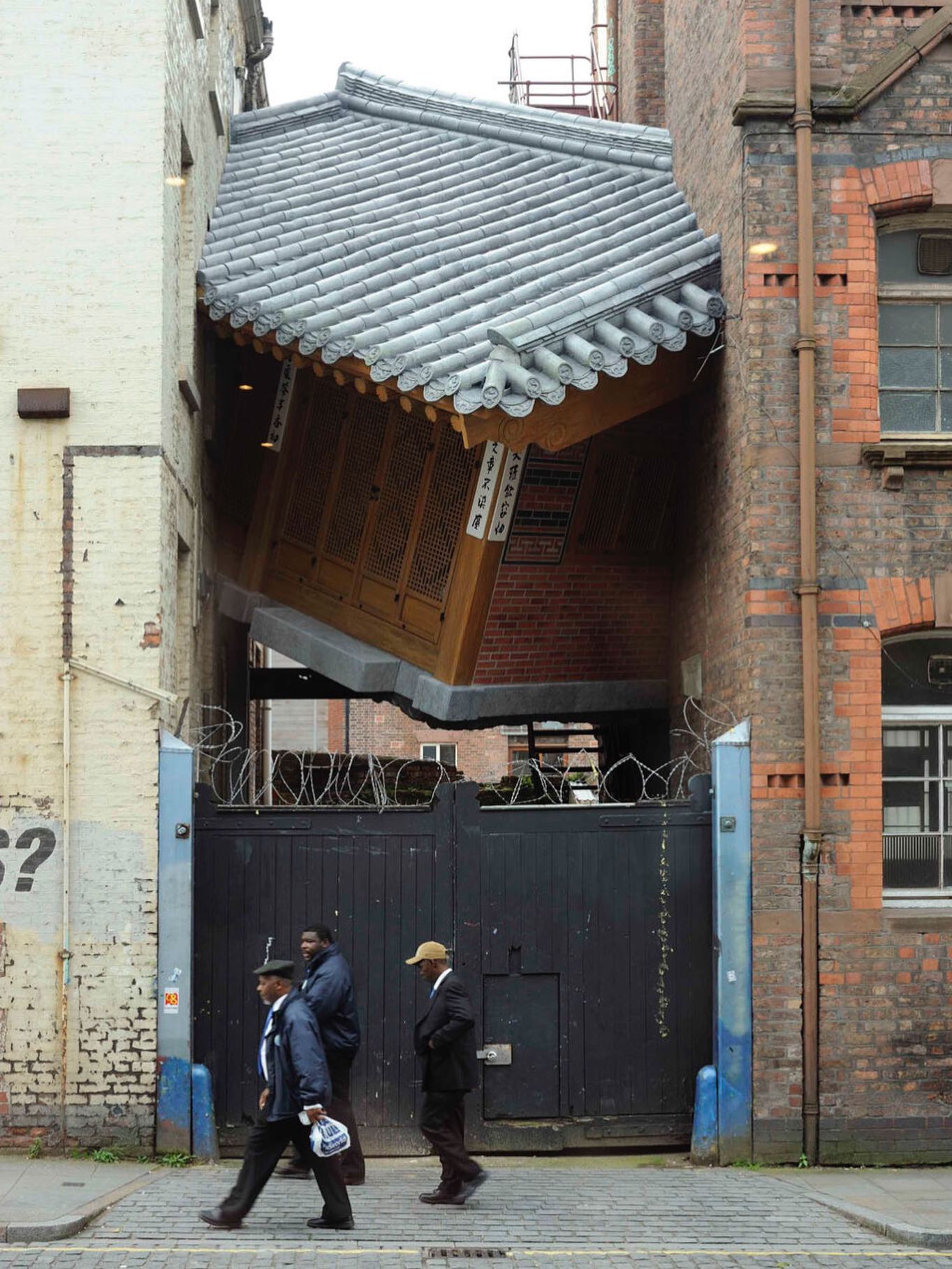
In the City of London, above Wormwood Street near Liverpool Street, Suh staged one of his most publicly legible propositions. Bridging Home, London (2018) suspends a fragment of a traditional Korean hanok roof from a pedestrian footbridge. The eaves thrust out over the street as if a remembered room has slipped its coordinates and come to rest, briefly and improbably, in another system of streets and histories. Presented as a major outdoor installation, the work was unveiled in September 2018 and remained on view into 2019, turning a utilitarian crossing into a site of encounter where the vocabulary of “home” is both literal and unsettled.

What makes Bridging Home feel sharp rather than sentimental is its refusal to resolve the collision it stages. The hanok element does not blend into the City. It does not translate itself into a decorative motif. Instead, it appears as a structural memory, precise, angled, and slightly off-balance, interrupting the everyday with a question that cannot be neatly answered: what does it mean to inhabit a place while carrying another inside it?
That question lands with particular force now, when displacement is no longer a marginal theme but a defining condition of the present. By the end of 2024, the United Nations High Commissioner for Refugees estimated that 123.2 million people worldwide were forcibly displaced. Suh’s practice does not illustrate statistics, nor does it lean on overt polemic. Instead, it operates through intimacy and scale: a roofline, a corridor, a stairwell, forms so ordinary they become quietly devastating when lifted out of place.
This essay takes Bridging Home as a point of entry into Suh’s wider project: his biography across Seoul, the United States, and the United Kingdom; his philosophy of impermanence and portability; his translucent material language; and the landmark works that have made him one of the most lucid artists working with the idea of “home” today. Suh does not build monuments. He builds conditions, spaces where the viewer is asked to feel the weight of what is carried, and to recognise that belonging is often assembled from fragments, held together by movement rather than arrival.
Do Ho Suh was born in 1962 in Seoul, into a household where artistic practice and cultural continuity were already entangled. His father, Suh Se-ok, was a central figure in postwar Korean ink painting, known for bridging calligraphic tradition with abstraction. The influence on Suh’s later work is not stylistic but structural. From an early age, he absorbed the idea that form could register movement, time, and breath, and that art could function as a record of lived experience rather than a fixed image.
Equally formative was the architecture of his childhood. Suh grew up in a traditional hanok compound, organised around courtyards and permeable boundaries. Sliding doors and paper screens allowed spaces to expand and contract, blurring distinctions between interior and exterior, private and communal. Architecture, here, was not an inert enclosure but a responsive system, one that shaped behaviour and perception as much as it provided shelter. This early experience would later underpin Suh’s understanding of space as something relational and mutable, inseparable from the body that moves through it.
Suh’s formal training began at Seoul National University, where he studied Oriental painting, completing his BFA in 1985 and MFA in 1987. The discipline emphasised gesture, material sensitivity, and an acceptance of impermanence, values that stood in contrast to the rigid spatial logics he would later encounter in the West. After completing mandatory military service, Suh moved to the United States in 1991, enrolling at the Rhode Island School of Design, followed by Yale University, where he completed an MFA in sculpture in 1997.

The transition was abrupt. Arriving in the United States, Suh has often described the sensation of dislocation as physical as well as cultural, a feeling of being “dropped from the sky”. American architecture, with its heavier materials and more absolute boundaries, felt alien. Yet it was precisely this friction that catalysed his practice. The question of how one inhabits space when familiar spatial codes collapse became central, transforming personal unease into an artistic inquiry.
New York, where Suh lived and worked for over a decade, provided both context and contrast. It was here that he developed the fabric-based reconstructions of domestic interiors that would bring him international recognition, and here that the idea of the “portable home” took shape. In 2010, Suh relocated to London, drawn to the city’s layered histories and its long-standing condition as a site of migration. The move did not resolve his sense of in-betweenness; instead, it extended it, reinforcing the idea that home, once displaced, remains perpetually in motion.
Throughout his career, Suh has resisted the narrative of departure and arrival. “I never felt that I left Korea,” he has remarked in interviews, suggesting that memory functions as a form of continuous presence. His biography, traced across continents, is less a story of relocation than of accumulation, each place adding another layer to an expanding internal architecture.
At the core of Do Ho Suh’s practice lies a philosophical position that challenges architecture’s traditional claims to permanence and authority. Influenced by Buddhist notions of impermanence, Suh approaches space as something provisional, an outer skin rather than a foundation. “As a Buddhist, I don’t believe that anything exists in a state of permanence,” he has stated, framing movement not as disruption but as the fundamental condition of existence.
This worldview reconfigures architecture as a psychological construct. Buildings, in Suh’s work, do not merely house bodies; they register memories, habits, and emotional residue. Migration, therefore, is not simply geographic displacement but a reorganisation of internal space. The self becomes a site of negotiation, continually recalibrated in response to new environments.
Suh’s concept of “home” resists nostalgia. Rather than idealising origin, he treats it as a mutable reference point, one that shifts with each act of remembering. In this sense, his work aligns with broader postcolonial discourses on hybridity and liminality, though he rarely foregrounds theory. Instead, he allows spatial experience to carry the argument. The tension between inside and outside, familiarity and estrangement, is enacted physically, often at full scale.

Memory plays a central role in this process. For Suh, remembering is not passive recollection but an active, almost tactile operation. He has described acts of rubbing architectural surfaces as “loving gestures,” ways of preserving what is disappearing without freezing it in time. Memory, in this formulation, behaves like architecture itself: it structures movement, frames perception, and defines what feels inhabitable.
The individual, in Suh’s work, is never isolated. Even when spaces appear intimate, they are shaped by collective histories and shared systems. This is evident in works that address crowds, anonymity, and power, where the individual body becomes a minimal unit within a larger social architecture. In an era marked by mass displacement and tightening borders, Suh’s philosophy affirms fluidity as a form of resilience. Home, he suggests, is not something one returns to intact, but something one continuously reconstructs.

MATERIAL LANGUAGE AND KEY WORKS
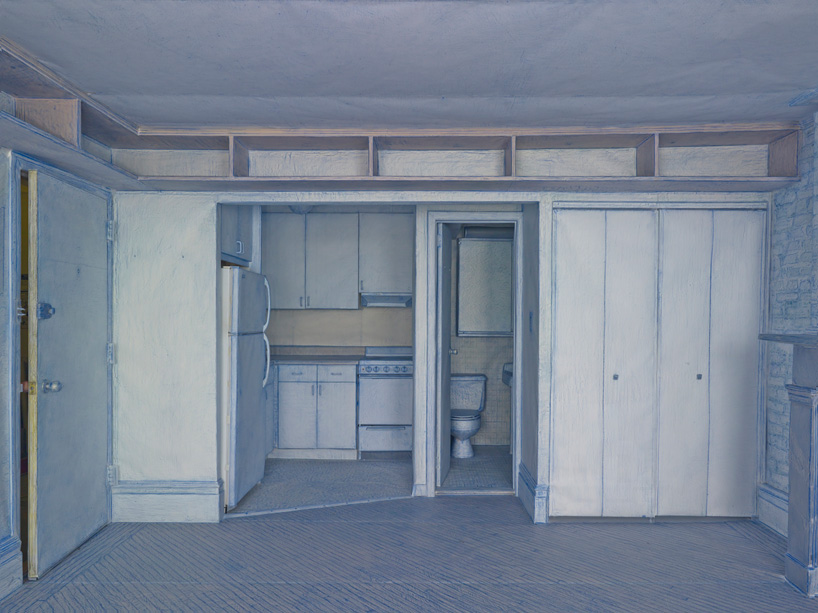
Suh’s material language gives physical form to these ideas through a careful balance of fragility and precision. Central to his practice is the use of translucent polyester fabric, chosen for its lightness, permeability, and capacity to hold detail without asserting weight. Rendered in muted hues, often pale blues, greens, or pinks, these fabric architectures evoke both skin and memory, allowing light to pass through while preserving the outlines of doors, windows, switches, and stair rails.
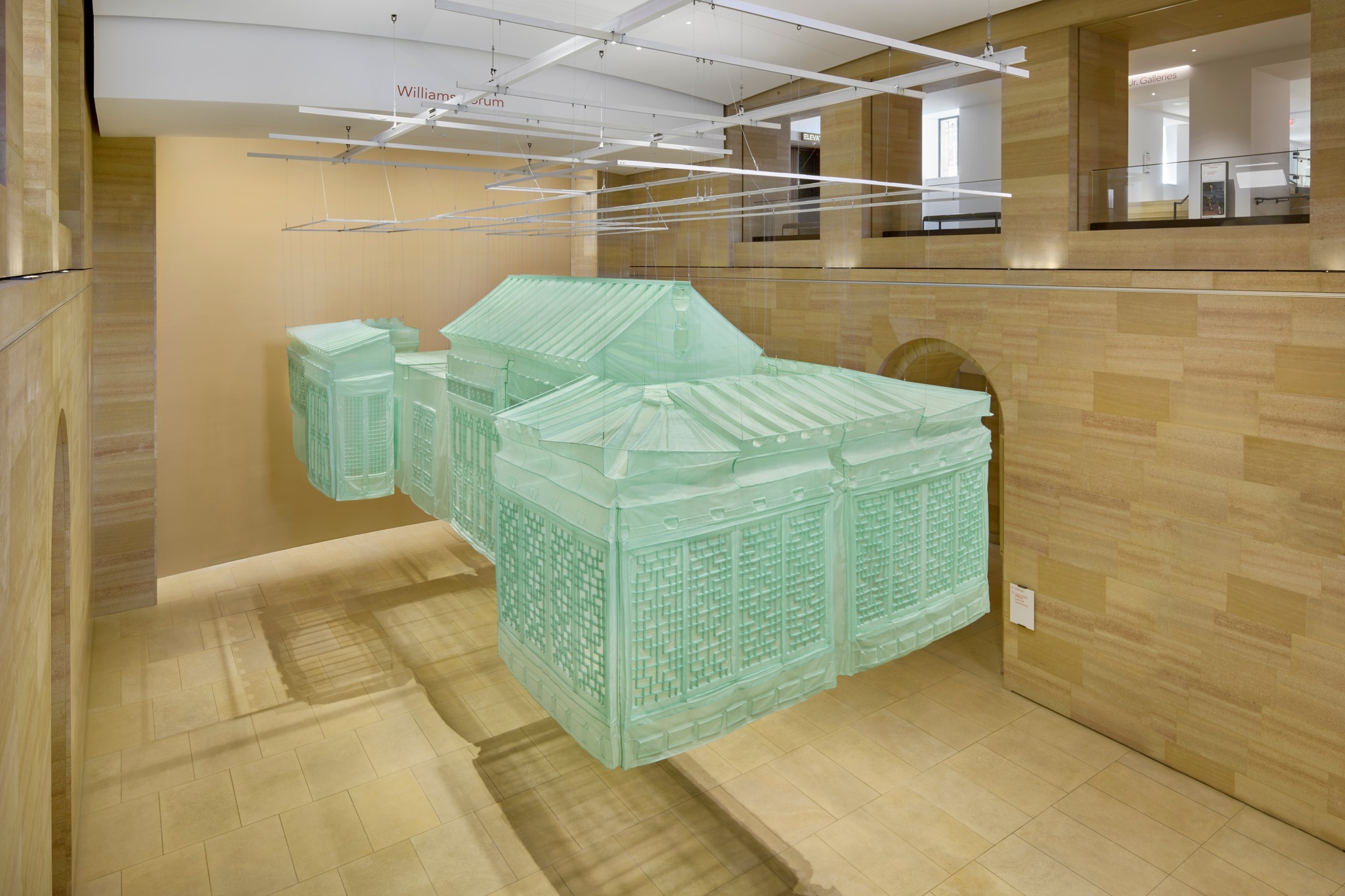

Unlike solid architectural replicas, Suh’s fabric works refuse closure. They are collapsible, transportable, and often reinstalled in new contexts, reinforcing the idea of home as something carried rather than anchored. Stainless steel armatures provide structural clarity without visual dominance, maintaining a tension between support and vulnerability.


One of the earliest manifestations of this approach is Seoul Home/L.A. Home/New York Home/Baltimore Home/London Home (1999), a series of full-scale fabric reconstructions of the interiors Suh inhabited over time. These works function less as documentation than as spatial memoirs, mapping the artist’s movements through a sequence of rooms that can be folded into suitcases and reassembled elsewhere.
In Fallen Star (2012), installed on the roof of a building at the University of California, San Diego, Suh extends the metaphor of displacement into architectural spectacle. A small house appears to have crashed onto the structure, its foundation skewed, its rooms visibly unsettled. The work literalises the sensation of being uprooted, transforming psychological disorientation into a physical condition.

The Rubbing/Loving Project series, developed over nearly a decade, marks a shift toward absence and loss. In these works, Suh covers architectural surfaces with paper and rubs them with graphite or coloured pencil, recording textures, seams, and imperfections. The resulting impressions function as traces of spaces that are often demolished or inaccessible, preserving not their image but their touch.
Bridging Home brings these threads together in the public realm. Unlike the interior fabric works, it employs traditional building materials and precise engineering, yet the logic remains consistent. The hanok roof fragment does not assert ownership over its site; it hovers, suspended between systems. It is neither fully Korean nor fully London, neither intact nor ruined. Instead, it occupies a condition of permanent transition, mirroring the experience of those who move between cultures without fully assimilating into any single one.
In Bridging Home, the suspended roof never settles. It remains poised above the street, held in place by engineering yet conceptually unresolved. This refusal of closure is central to Do Ho Suh’s legacy. His work does not offer solutions to displacement, nor does it attempt to stabilise the idea of home. Instead, it insists on attention, on the quiet, persistent labour of carrying what has shaped us into spaces that were never designed for it.
Suh’s architectures do not ask where home is. They ask how it moves, what it weighs, and how it changes the way we stand, walk, and remember. In a world defined by flux, his work suggests that belonging is not found in permanence, but in the careful negotiation of thresholds, those fragile, shifting spaces where memory and movement meet.
Follow Do Ho Suh at @dohosuhstudio
Photo Cover
Do Ho Suh, Bridging Home, London, 2018 – A traditional Korean hanok roof fragment suspended over Wormwood Street in the City of London. Credit: © Do Ho Suh, Courtesy of the artist; Lehmann Maupin, New York, Hong Kong and Seoul; Victoria Miro, London/Venice (photography by Gautier Deblonde)