Now Reading: Ruth Asawa: Weaving worlds
- 01
Ruth Asawa: Weaving worlds

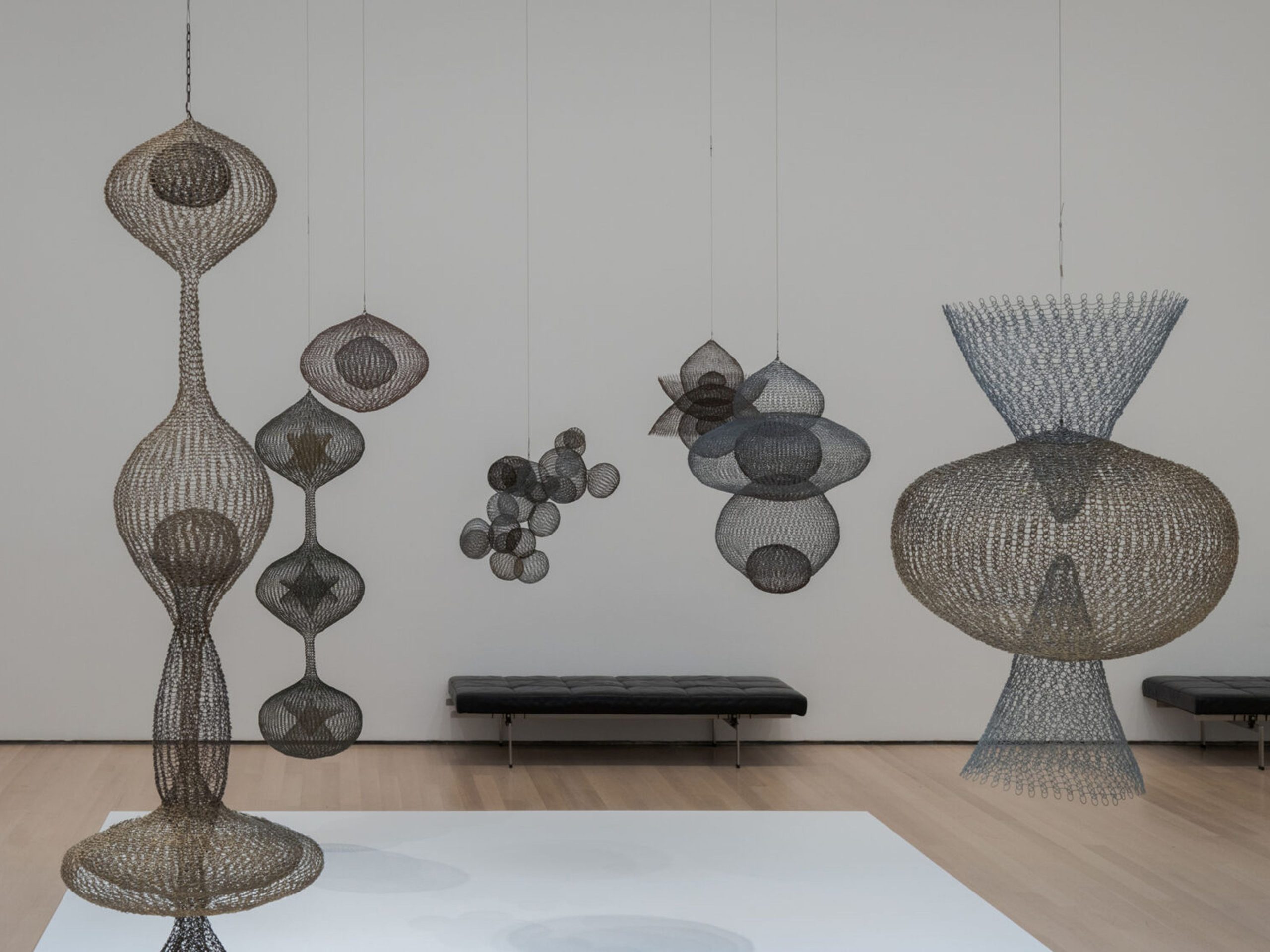

The most enduring longform writing on artists does not simply recount a career. It renders a way of living visible. It traces how attention accumulates over time, how decisions made in one material migrate into another, how a practice holds together under the pressures of history, family, and public life. Ruth Asawa’s work demands that kind of writing because her sculptures are not only objects. They are conditions. They reorganise space, redirect light, and recalibrate how the body moves through a room.
At the Museum of Modern Art, those conditions unfold with unusual clarity. Ruth Asawa: A Retrospective, on view from 19 October 2025 to 7 February 2026, brings together approximately 300 works spanning sculpture, drawing, printmaking, and models for public commissions. Organised by Cara Manes at MoMA and Janet Bishop at SFMOMA, the exhibition marks the first posthumous survey of the artist and the most comprehensive presentation of her work to date. It does not arrive as a rediscovery so much as a re-centering, positioning Asawa as a foundational figure in postwar American art rather than a peripheral one.

The experience of the exhibition is resolutely physical. Hanging at varied heights, Asawa’s looped wire sculptures invite a choreography of looking. Viewers circle, pause, lean forward, peer through latticed volumes that are simultaneously drawing and architecture. Shadow is not incidental here. It becomes a second structure, slipping across walls and floors, multiplying the work without adding mass. The sculptures seem to breathe, not because they imitate organic forms, but because they allow space to move through them.
What the exhibition makes immediately apparent is the coherence of Asawa’s practice. Sculpture and drawing, domestic life and studio labour, craft knowledge and modernist experimentation appear not as competing categories but as parts of a single system. Asawa did not seek to reconcile these divisions rhetorically. She worked as if they did not exist. That refusal, sustained over decades, is both formal and ethical.

To understand the depth of that position, it is essential to return to Asawa’s own voice. Her 2002 oral history for the Archives of American Art, recorded in two extended sessions with her husband Albert Lanier present, offers a rare account of how work and life were woven together in her San Francisco home. Robert Snyder’s 1978 film Ruth Asawa: Of Forms and Growth captures the same sensibility in motion, showing her hands looping wire with a fluency that appears effortless only because of its discipline. A later ARTnews feature, drawn from the oral history transcript, foregrounds her reflections on Black Mountain College and the persistent art–craft divide that framed the reception of her work for much of her career. Across these sources, Asawa does not speak of ideas imposed on material. She speaks of dialogue, repetition, and attention, of learning what materials can do by staying with them.

Asawa was born in 1926 in Norwalk, California, the daughter of Japanese immigrant farmers. Her early environment was agricultural, shaped by soil, vines, seasonal cycles, and the slow intelligence of growth. This origin is not incidental. Many of her forms feel grown rather than designed, branching and interlocking without rigid boundaries. Structure, in her work, rarely asserts itself through enclosure. It emerges through accumulation.
That sense of continuity was violently interrupted by war. After the bombing of Pearl Harbor, the United States government incarcerated Japanese Americans, including Asawa and her family. As a teenager, she was detained at the Santa Anita racetrack and later transferred to the Rohwer camp in Arkansas. The architecture of incarceration is an architecture of control, reducing life to regulated space. In her later recollections, Asawa described drawing during this period as a way to keep the mind active, a small but necessary act of persistence under conditions designed to narrow possibility. It is important not to reduce her later work to biography. Yet it is equally important to recognise that an understanding of space as something that can constrain or liberate sits quietly beneath her lifelong preoccupation with permeability.

After her release in 1943, Asawa pursued teacher training at Milwaukee State Teachers College. She was barred from completing student teaching because of anti-Japanese prejudice, an exclusion she later described as a “godsend” because it forced a redirection toward art. In 1946, she arrived at Black Mountain College in North Carolina, an experimental institution that would prove decisive. The college has often been mythologised as a crucible of American modernism. For Asawa, its significance was practical. It offered permission to work across materials, to test ideas through making, and to understand daily labour as inseparable from artistic practice.

At Black Mountain, influence operated less through style than through method. Josef Albers emphasised colour and perception as relational systems, demonstrating that what we see is contingent and that context itself can be shaped. Buckminster Fuller’s structural imagination offered models for thinking about form as an engineering of possibility. The presence of mathematician Max Dehn, alongside a broader ethos of interdisciplinary exchange, reinforced the idea that art could function as inquiry rather than category. Dance, music, mathematics, and manual labour coexisted as parallel ways of understanding structure and rhythm. Asawa later recalled that there was no clear separation between studying, chores, and art making. That lack of hierarchy would remain central to her practice.
A pivotal encounter occurred in 1947 during a trip to Toluca, Mexico, where Asawa learned a looped wire technique used in basketry. She did not treat this as a craft anecdote or a decorative borrowing. She recognised it as a structural principle, a way to draw in space. Returning to the United States, she adapted the technique to sculpture, translating a logic of weaving into a modern vocabulary. This was not quotation but transformation. The looped wire method allowed her to build volume without mass, enclosure without opacity. It also allowed her to maintain a direct relationship between hand and form, between gesture and structure.
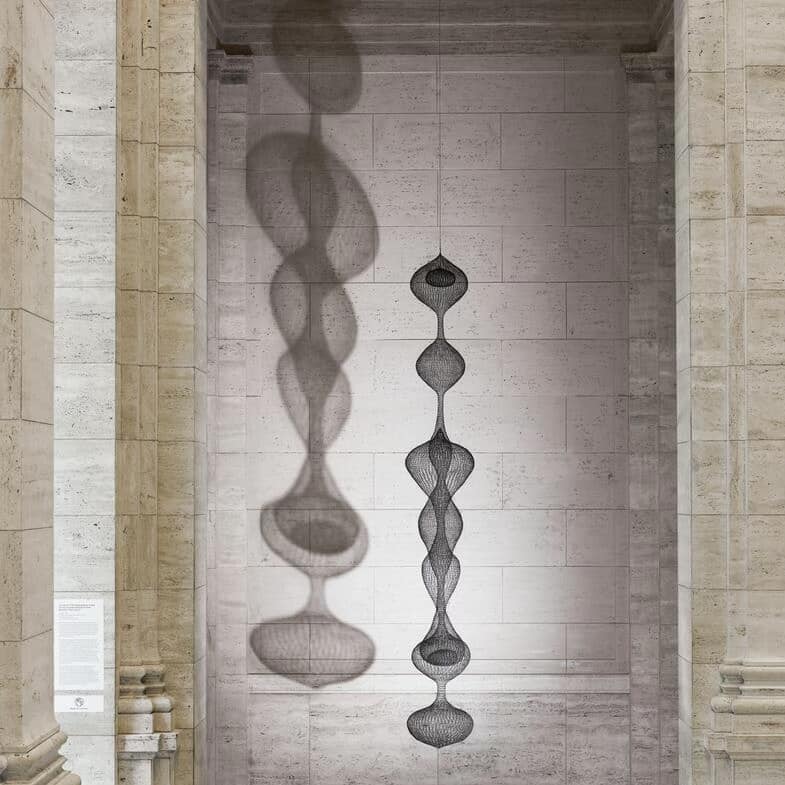
By the early 1950s, Asawa had begun to push this language with remarkable confidence. Her hanging wire sculptures from this period and the early 1960s establish a vocabulary of nested chambers, spiralling columns, and bulbous volumes that feel at once organic and architectural. Often described as biomorphic, these works are more precisely understood as investigations of interiority. You are always seeing inside the object, and always aware of the object as a framework rather than a surface. Negative space is not absence. It is the work’s most active dimension.
Wire’s transparency intensifies this effect. It collapses distinctions between inside and outside, between figure and ground. When light strikes a hanging form, the sculpture seems to multiply, becoming object and shadow, volume and diagram. In this sense, Asawa’s work is quietly architectural. Not because it imitates buildings, but because it structures experience. It teaches the viewer how to inhabit space differently.
The retrospective’s inclusion of drawings and prints is crucial to understanding this discipline. Asawa’s two-dimensional works are not ancillary. They reveal the persistence underlying the sculpture. Her drawings, often built through repeated lines and careful hatching, accumulate density through patience rather than gesture. Flowers, branches, and everyday objects become occasions for studying how structure emerges from repetition. What appears delicate is, in practice, rigorous. These works clarify that the logic of looping and layering operates across media.

Asawa’s material philosophy extended beyond wire. She worked in ink, lithography, clay, and bronze, especially for public commissions. In her oral history, she described an approach that is deceptively simple: choose a material you are curious about and see how far you can take it beyond its customary use. The interest lies in the movement from two dimensions to three, from surface to space. The material itself suggests the path, if one is willing to listen.

That willingness to listen also shaped Asawa’s relationship to public space. From the mid-1960s onward, she realised major civic commissions, particularly in San Francisco. These works did not represent a departure from the studio. They extended her material ethics into the city. Andrea, the mermaid fountain created for Ghirardelli Square between 1966 and 1968, is emblematic of this approach. Playful and accessible, it was conceived not as a monument to be admired from a distance but as a presence to be encountered in daily life.
The San Francisco Fountain near Union Square, completed between 1970 and 1973, deepens this civic logic. Developed through extensive community participation and cast into durable form, the fountain functions as both artwork and social record. Its surfaces carry the traces of many hands. What matters here is not only the finished object but the process by which it came into being. Participation is not decorative. It is structural, a continuation of Asawa’s belief that art is a shared capacity.
This belief also informed her commitment to arts education. In 1968, Asawa co-founded the Alvarado School Arts Workshop, advocating for the integration of art into public school curricula. In 1982, she played a central role in establishing San Francisco’s public arts high school, which was later renamed in her honour in 2010. Education, for Asawa, was not ancillary to artistic practice. It was a form of agency, a way to counter exclusion through skill, confidence, and access. Her politics, like her sculpture, operated through structure rather than declaration.

Recognition from major institutions arrived slowly. Asawa’s work was celebrated locally and admired internationally, yet often framed through the lens of craft rather than placed at the centre of modern sculpture. The retrospective does not attempt to correct this history through polemic. It simply presents the work with clarity. In 2024, Asawa received the National Medal of Arts posthumously, an official acknowledgement that followed decades of sustained influence across artistic and civic life.
What remains after moving through the exhibition is a sense of coherence. Asawa’s practice does not unfold as a sequence of stylistic shifts. It reads as a sustained inquiry into connection. Connection between line and volume, between object and shadow, between household and studio, between artist and community. Even her most complex forms feel unforced. They are not monuments to self-expression. They are structures of attention.

As MoMA’s retrospective draws to a close in February 2026, it leaves behind more than a survey. It offers a model of making in which mastery does not harden into authority, and generosity is not sentimental but engineered. Asawa’s sculptures are light, but they are not fragile. They carry weight without mass, strength without enclosure. Built from loops that hold one another up, they embody an ethics of making in which unity is not given but constructed, patiently, through repeated gestures.
In Ruth Asawa’s world, art is not confined to the studio or the museum. It extends into schools, fountains, and shared spaces. It becomes a way of living that refuses to separate making from belonging. The threads do not break. They continue, loop by loop, carrying light through wire and the possibility of connection through time.
Follow her work at @ruthasawaofficial
Photo Cover
Installation view from the MoMA retrospective – poetic light and wire
Credit: © 2025 The Museum of Modern Art / David Zwirner