Now Reading: Twisted brick shell library blends digital construction and vernacular material
- 01
Twisted brick shell library blends digital construction and vernacular material

Twisted brick shell library blends digital construction and vernacular material

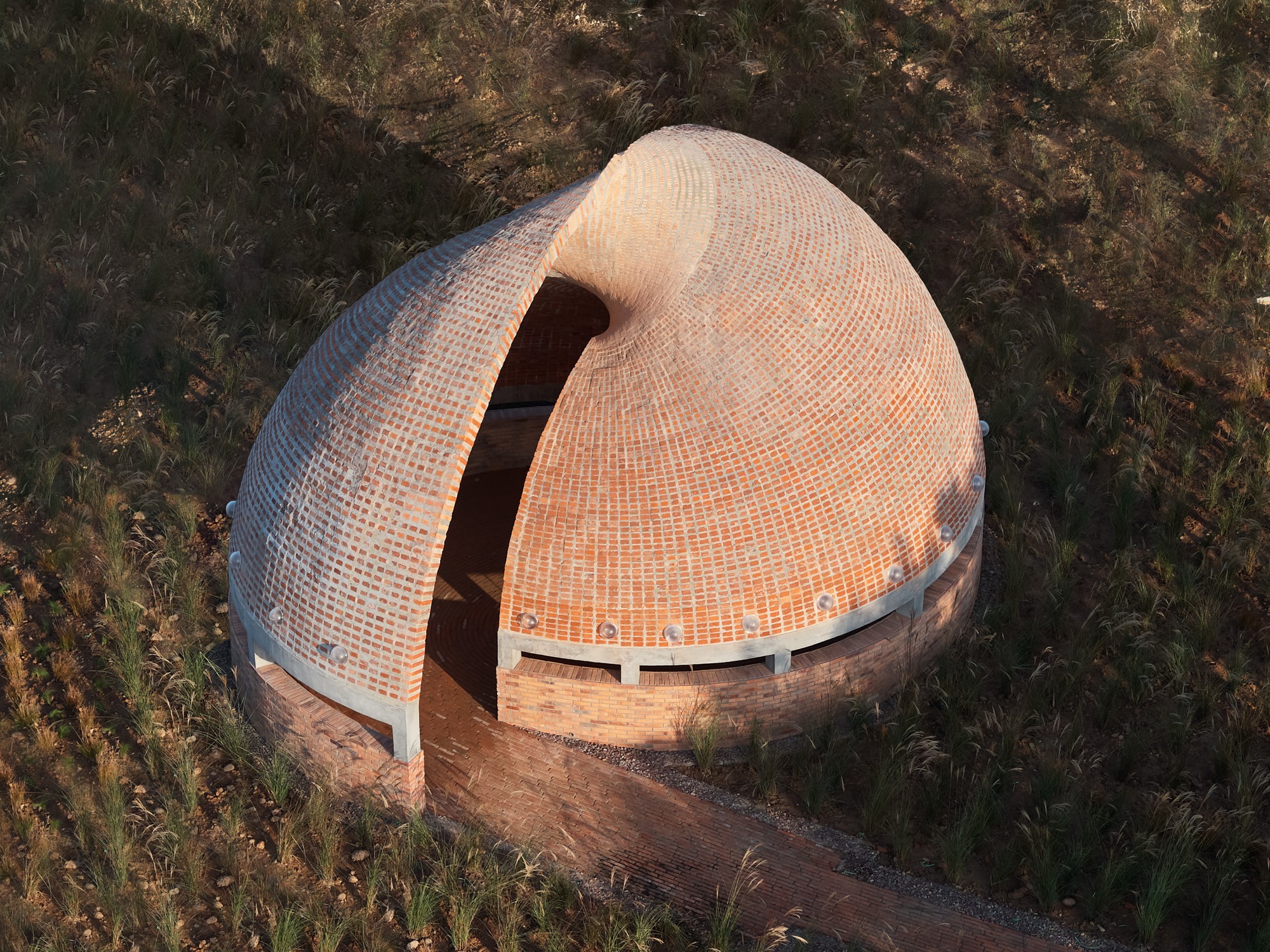
Set within a high grass field in rural Zhejiang Province, China, the Concept Library takes the form of a spiral shell that turns reading into a spatial act. The project tests a precise tension: how a contemporary, almost sculptural geometry can still feel grounded in vernacular material culture.

At roughly 10 metres in diameter and 5 metres high, the library is defined by a continuous surface generated through the sweep of two semicircles that roll into one another. The gesture collapses boundaries. Outside becomes threshold, threshold becomes interior, and the shell reads as both object and landscape condition, a form that seems to have emerged from the site as much as it was placed within it.


The architecture is entered not through a conventional doorway, but through a gradual invitation in the curvature itself. Light arrives from above, slipping in through an opening at the crown and falling into a dim interior where brightness is never fixed, but changes with time and weather. The resulting atmosphere is closer to a shelter than a room: intimate, quiet, and tuned for attention.


Reading here is deliberately slowed. Texts are held inside acrylic spheres and accessed through small apertures punctured in the brick surface. As visitors lean in, the act of looking becomes a kind of alignment between body and structure. Words and landscape overlap in the same field of vision, producing a brief, poetic connection between mind, terrain, and the present moment of perception.
Red brick is the project’s cultural anchor, yet its construction logic resists familiar brickwork. The shell is not assembled through masonry. Instead, it is cast in situ, using bricks as a visible matrix rather than a stacked wall. This shift is more than technical. It reframes brick from a unit of layering into an instrument of curvature, density, and surface continuity.


That continuity is also the core difficulty. Distributing bricks across a double curved surface becomes a construction problem as much as a design intention. The solution relies on perforated steel plates that act both as a positioning guide and as a reinforcing framework. High strength concrete is then poured to bind the assembly, allowing brick, steel, and concrete to operate as a single structural system.


The brick units vary across 12 widths and are distributed along a UV grid to maintain radial continuity. Up close, the surface reads like a pixelated matrix, where the thickness of the so called mortar continually shifts, because the joints are in fact concrete. The familiar tectonics of brick are subverted: instead of predictable courses and seams, the shell offers an interlocking logic that feels both digitally calibrated and materially direct.


While the library is rooted in a rural context, it avoids nostalgia. The project positions itself as a bold experiment in rural construction, merging digital industrialisation with traditional materials without reducing the countryside to a picturesque backdrop. Its ambition is experiential as well as structural: to build a contemporary refuge for reading and reflection, where the outside world is not excluded, but brought into the act of attention.


In that sense, the Concept Library becomes a quiet proposition. It suggests that a small building can carry a large idea: that contemporary form can emerge from local material culture, and that a rural site can host architectural research without losing its intimacy.
Project Credit
Design: HCCH Studio / @hcchstudio
Location: Longyou, Zhejiang Province, China
Period: Jun.2022 – Nov.2023
Photographs: Qingyan Zhu, Fangfang Tian
More Photos