Now Reading: Building Responsibly: Shigeru Ban and the power of Light Construction
- 01
Building Responsibly: Shigeru Ban and the power of Light Construction


In the aftermath of catastrophe, architecture is tested not by how it photographs but by what it restores: privacy, warmth, agency. Shigeru Ban’s work insists that the “temporary” is not outside the discipline, and that responsibility is a matter of systems as much as of form.
There is a moment in every mass shelter when architecture shrinks to its smallest unit. It is not the building, not even the room, but the boundary: a line that lets someone change clothes without turning their back to strangers; a corner that can be claimed as “ours” inside a hall of bodies; a partition that interrupts the steady exposure of communal living. After disaster, roofs and walls matter, but so does the thin membrane that separates one family from another. If the first violence is the event itself, the second is often the prolonged condition of being watched, overheard, unprotected.

Shigeru Ban has spent three decades treating those conditions as architectural rather than merely logistical. The popular version of his story is easy to admire: the “paper architect” who builds for displaced communities, the laureate who shows up where the profession is usually absent. Yet to stop there is to miss what is genuinely unsettling in his practice. Ban’s work is not simply a moral anecdote attached to an otherwise conventional career. It is a technical argument about light construction, about repeatable systems, and about the ethics of the interim. It asks what it means to design for the weeks and months in which governments move slowly, supply chains stutter, funding is uncertain, and the displaced are asked to accept indignity as normal.

The question has become harder to avoid. In recent decades, disasters linked to weather, climate and water hazards have multiplied dramatically, even as mortality has fallen with improved early warning and risk reduction. More events, more displacement, more rebuilding: the demand is not episodic but structural. Meanwhile, the built environment remains a major driver of the climate crisis. Recent global reporting continues to attribute roughly a third of global energy use and a large share of energy-related carbon emissions to buildings and construction. We are being asked to rebuild more often while building with radically less carbon. In that collision between recurrence and restraint, Ban’s insistence on doing more with less reads less like a personal quirk and more like a professional baseline the discipline has been slow to accept.
Ban does not present “responsibility” as a fashionable badge. In a wide-circulation interview marking a decade since his Pritzker Prize, he is matter-of-fact: his attitude did not change after the award; it simply encouraged him to keep working “particularly within disaster areas.” He offers a blunt diagnosis of disaster: earthquakes do not kill people, collapsing buildings do. For Ban, that is precisely the problem architects are responsible for solving. The line is often quoted as slogan. It is better read as an engineering and governance critique. Buildings collapse because of choices: materials, detailing, cost-cutting, enforcement, inequity. “Natural disaster” becomes a cover story for human decisions. Ban’s work insists that architects cannot wash their hands of those decisions—and that when systems fail, the interim conditions of survival are not outside architecture’s remit.

Ban’s materials are famous, but his method matters more. Paper tubes are frequently described as a poetic provocation against the seriousness of concrete and steel. Ban frames them as an available, repeatable component: inexpensive to produce, easy to transport, and, with careful detailing, far stronger than they appear. He traces their origin to exhibition staging in Tokyo in the 1980s, when cardboard tubes were used as substitutes for timber and proved structurally reliable enough to become a long-term research thread. The tube is not a metaphor. It is a beam. Its virtue is logistical: modularity, standard dimensions, fast assembly, minimal specialised labour. That last point is decisive in disaster zones, where people cannot afford to wait for perfect procurement or expert contractors.
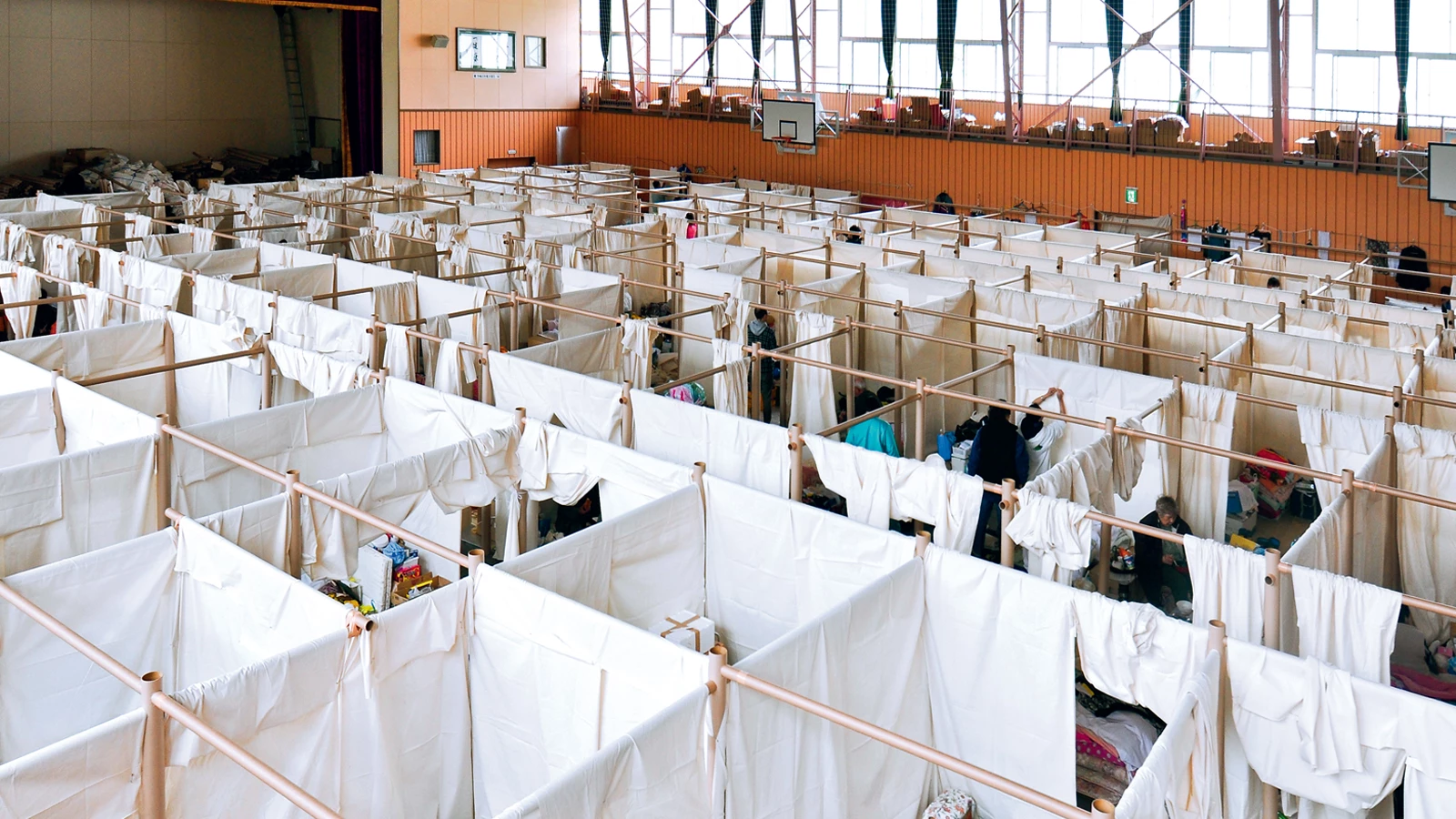
This is why some of Ban’s most consequential “projects” are not buildings but devices for making space. The Paper Partition System is almost offensively simple: paper-tube frames, fabric curtains, a room conjured inside a gymnasium. Yet its effect is disproportionate. After the Great East Japan Earthquake in 2011, Ban’s NGO, the Voluntary Architects’ Network (VAN), installed paper partition systems in dozens of shelters, reaching into the thousands. The aim was simple and urgent: to give families privacy and relieve conditions widely criticised as inadequate and psychologically punishing. Ban’s office has repeatedly described evacuees forced to live for months in dense shared facilities, suffering mentally and physically from the lack of privacy. Architecture begins here not with iconography but with dignity. A partition is not a luxury. It is a structural condition for sleeping, caring, grieving, dressing, speaking in a lowered voice.
There is also a lesson here about what counts as architectural intelligence. The profession is trained to celebrate uniqueness: the one-off detail, the singular form. Relief work depends on repetition. A solution matters only if it can be built again and again, by people with little time and less money, in places where everything is scarce. Ban’s accomplishment is not simply invention but persistence: the willingness to iterate small systems until they can be deployed at scale, and to treat the interim as a site of design rather than an embarrassment.

The Paper Log House, developed after the 1995 Kobe earthquake, makes the same point at the scale of a dwelling. The criteria are clear: an inexpensive structure anyone could build, with satisfactory insulation and acceptable appearance, easy to dismantle and recycle afterwards. The solution uses sand-filled beer crates as foundation, paper tubes as walls, and tent membranes as roof and ceiling. The ingredients read like improvisation; in fact they are a disciplined response to what circulates locally after disaster. A foundation without poured concrete. A wall that can be assembled by amateurs. A roof that can be sourced, replaced, removed. “Acceptable appearance” is the quiet radical phrase: even in crisis, Ban refuses the idea that people must live in structures that signal abandonment.

This insistence is also why Ban’s practice cannot be comfortably divided into “humanitarian” and “cultural” work, as though one were ethics and the other aesthetics. His major institutions are often where the logic of light construction is scaled and made legible to audiences who might otherwise treat his relief work as exceptional or anecdotal. Centre Pompidou-Metz, designed with Jean de Gastines, is anchored by a vast roof: a hexagon canopy of glued laminated timber, composed of repeated modules, likened in official descriptions to the cane-work of a Chinese hat, and supported by a small number of key points. The description is not merely formal. It is a structural argument: a system of repeated modules that becomes both canopy and identity, doing monumental work with a disciplined logic rather than with mass alone. The roof’s presence is undeniable, but its ethic is legible: spanning, sheltering, unifying, without defaulting to heavy construction as the only route to grandeur.

Pompidou-Metz also clarifies how Ban uses the envelope as a mediator between institution and landscape. The hovering canopy, largely self-supporting and carried on only a few points of contact, creates an open, breathable atmosphere. It reads less like a sealed object and more like a pavilion shaped by weather and time. One can read the project as a reversal of hierarchy: instead of rooms producing a roof, the roof produces rooms. The canopy is the primary civic gesture. It does not promise permanence through weight; it promises gathering through shelter.

If Pompidou-Metz demonstrates how light structure can become monument, Tamedia’s Zurich office building demonstrates how light structure can become atmosphere. The building’s main feature is a rigid frame system designed entirely in timber, with an emphasis on connections that lock into place without relying on the usual metal bracing logic. Accounts of the project stress how deliberately visible the structure is. Behind the glass skin, the timber frame reads like an enlarged lesson in joinery, offering a specific spatial pleasure: the calm that comes from inhabiting a legible skeleton. Timber is not a rustic cosmetic; it is the building’s grammar.
This is where Ban’s “responsibility” becomes more than a carbon claim. It becomes a question of reversibility and repair. A timber system assembled with a clear logic is, at least in principle, easier to understand, maintain, and dismantle than opaque assemblies of composite layers. That does not automatically make it responsible. Sourcing and lifecycle still matter. But it shifts the conversation away from superficial “green” branding and toward a deeper question: how buildings are put together, and whether they can be taken apart without turning into waste. Ban’s work repeatedly pushes the discipline toward that uncomfortable territory: responsibility is not just what a building performs; it is what a building leaves behind.
The Cardboard Cathedral in Christchurch remains the public project that most sharply exposes the interim’s cultural life. Completed after the 2011 earthquake damaged the original cathedral, Ban’s “transitional” A-frame is constructed from cardboard tubes and shipping containers, protected by a semi-transparent polycarbonate roof, with tubes coated for weathering and fire safety. Inside, repetition becomes a kind of calm. Light filters through a structure that does not pretend to be stone. The building shows how it stands. It offers a civic room for ritual and gathering when the monumental centre is lost.
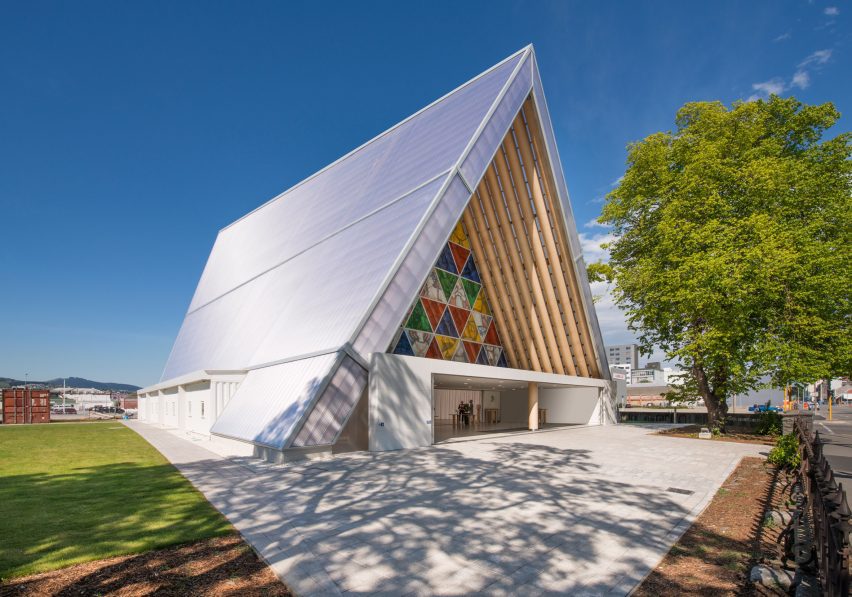
Christchurch also exposes a paradox at the core of responsible temporary building. The better a transitional structure works as public space, the more quickly it gathers memory, and the harder it becomes to treat it as disposable. Temporary architecture can become long-term by necessity, as reconstruction stalls under political and financial pressure. It can also become long-term by affection, simply because it works. Either way, the interim is no longer a pause. It becomes a form of life. Ban’s work asks whether the profession can design for that reality without normalising precarity, and without letting “temporary” become a polite name for permanent instability.


This is also where a second critique appears, one that an architecture culture magazine cannot ignore. The more photogenic the relief structure, the easier it is to aestheticise virtue. “Humanitarian architecture” can become a genre: a reassuring narrative that proves the profession still has a conscience while systemic causes of vulnerability continue unaddressed. Ban himself is wary of heroics; his projects are often framed as practical responses, not moral theatre. Yet the risk is not about his intent. It is about the cultural economy of architecture, which is quick to turn care into image. Responsible building has to survive its own publicity.
La Seine Musicale, on Paris’s Île Seguin, presents responsibility as an explicit mechanism. A mobile photovoltaic “sail” surrounding the classical music hall can follow the sun’s path, increasing solar yield while shading the lobby behind. Here sustainability is not an invisible technical appendix. It becomes movement, with an environmental device fully turned into architecture. The risk, again, is theatre: renewable energy as spectacle. But the device also reframes comfort as design: shade reduces cooling demand; solar tracking increases yield. The building suggests that environmental systems can be spatial ideas, not merely services.

Ban’s recent crisis work keeps the argument in the present tense. In Maui, after the August 2023 wildfires, official reporting described wind-driven fires that destroyed more than 2,200 structures and caused multi-billion-dollar damages, with Lahaina the most impacted area. Ban describes building a Paper Log House prototype with local partners, returning to the same system of sandbag foundations, wooden panels, and paper tubes to enable rapid, dignified enclosure. The prototype does not solve the political economy of post-fire housing, from land and insurance to labour and regulation. But it refuses the fatalism that treats tents and prolonged mass shelters as sufficient. It insists that the interim can be designed.
In Japan, the January 1, 2024 Noto Peninsula earthquake provides another reminder that the first architecture of disaster is often a school gym. Reporting described it as the strongest earthquake to hit Ishikawa Prefecture in well over a century. In such settings, privacy collapses immediately. Ban’s partitions and cardboard beds address the ordinary, repetitive failures of relief infrastructure: the assumption that exposure is unavoidable, the belief that dignity can wait.
In Ukraine, the ethical calculus shifts toward insulation and speed. Ban’s office has described a panel-based housing system using lightweight insulated elements, designed for assembly by non-skilled workers, and reported a prototype built in Lviv in 2023 for use as a classroom for children. Read through the lens of ideal sustainability, polystyrene raises immediate alarms; read through the lens of winter and displacement, the choice becomes triage. Ban’s practice repeatedly forces architecture into this uncomfortable truth: responsibility is not always purity. It is often the minimisation of harm under broken conditions.

What, then, endures in Ban’s legacy? Not paper as fetish. Not a single “signature” material elevated into brand. What endures is method: prototyping, repetition, systems that can be built by those who need them, structures that can be dismantled rather than fossilised as waste. It is also an insistence that architecture’s moral life begins where the discipline is most tempted to look away: in shelters, in evacuation centres, in the months after headlines move on.
The profession often speaks of resilience as if it were an aesthetic quality, something buildings can wear. Ban treats resilience as a social condition: the ability of a community to retain privacy, routine, agency. If architecture is to be responsible in a warming world, it will not be enough to design net-zero icons while the displaced sleep in exposed halls. Nor will it be enough to celebrate humanitarian projects as exceptions while the ordinary building industry continues to pour carbon into permanence.
Ban’s work offers a quieter proposition, and a harder one: that responsibility is not a posture but a discipline of construction. Build lighter so fewer resources are consumed. Build simply so more people can build and repair. Build with enough care that the interim does not become an architecture of humiliation. In an era defined by repeated disaster and accelerated decarbonisation, that proposition reads less like a personal manifesto than a minimum specification for the field.

Reference
- Aesthetica Magazine – “Building Responsibly” (interview with Shigeru Ban; published to mark the decade since his 2014 Pritzker Prize).
- World Meteorological Organization – reporting on trends in weather, climate and water-related disasters, 1970–2019.
- UN Environment Programme (UNEP) and GlobalABC – Global Status Report for Buildings and Construction 2024/2025 (energy use and energy-related CO₂ shares).
- The Pritzker Architecture Prize – Shigeru Ban laureate biography (VAN and the Paper Partition System scale after 2011).
- Centre Pompidou-Metz – official project/architecture descriptions (roof geometry and timber lattice system).
- Shigeru Ban Architects – project pages on Centre Pompidou-Metz, Tamedia Zurich, La Seine Musicale, and relief work.
- ArchDaily – coverage of the Cardboard Cathedral (structure, materials, and protective treatments).
- Architectural Record – reporting on Tamedia Headquarters Expansion (construction and structural visibility).
- U.S. Fire Administration (FEMA) – Preliminary After-Action Report: 2023 Maui Wildfire (damage and structures destroyed).
- NASA Earth Observatory – reporting on the 2024 Noto Peninsula earthquake.
Photo Cover
Paper Partition System in evacuation shelter after the 2011 Great East Japan Earthquake, providing privacy in dense communal spaces (© Shigeru Ban Architects).