
Now Reading: Pigment, Concrete, and Light: Memorial Brumadinho’s material ethics of Remembrance
- 01
Pigment, Concrete, and Light: Memorial Brumadinho’s material ethics of Remembrance

Pigment, Concrete, and Light: Memorial Brumadinho’s material ethics of Remembrance

In January 2019, a tailings dam at Vale’s Córrego do Feijão mine in Brumadinho collapsed, sending a torrent of mining waste through communities and waterways and killing 272 people. On 25 January 2025, the Brumadinho Memorial opened to the public on the very ground marked by Brazil’s dam collapse of 25 January 2019, when Vale S.A.’s Córrego do Feijão tailings dam failed at 12:28, releasing around 12 million cubic metres of mining waste and impacting 26 municipalities.

Now, the memorial’s lighting by Belo Horizonte studio Atiaîa has been named Architectural Lighting Design of the Year at the LIT Lighting Design Awards 2025, recognising a project that treats illumination as an ethical instrument rather than an atmospheric effect.

BUILT AS A JOURNEY CUT INTO THE TERRAIN
Designed by Gustavo Penna Arquitetos Associados, the memorial is structured less as a standalone object than as a sequence. The visitor is drawn from an entrance pavilion in concrete stained with mining waste into a landscape of pause points, grove, exhibition rooms, and water.

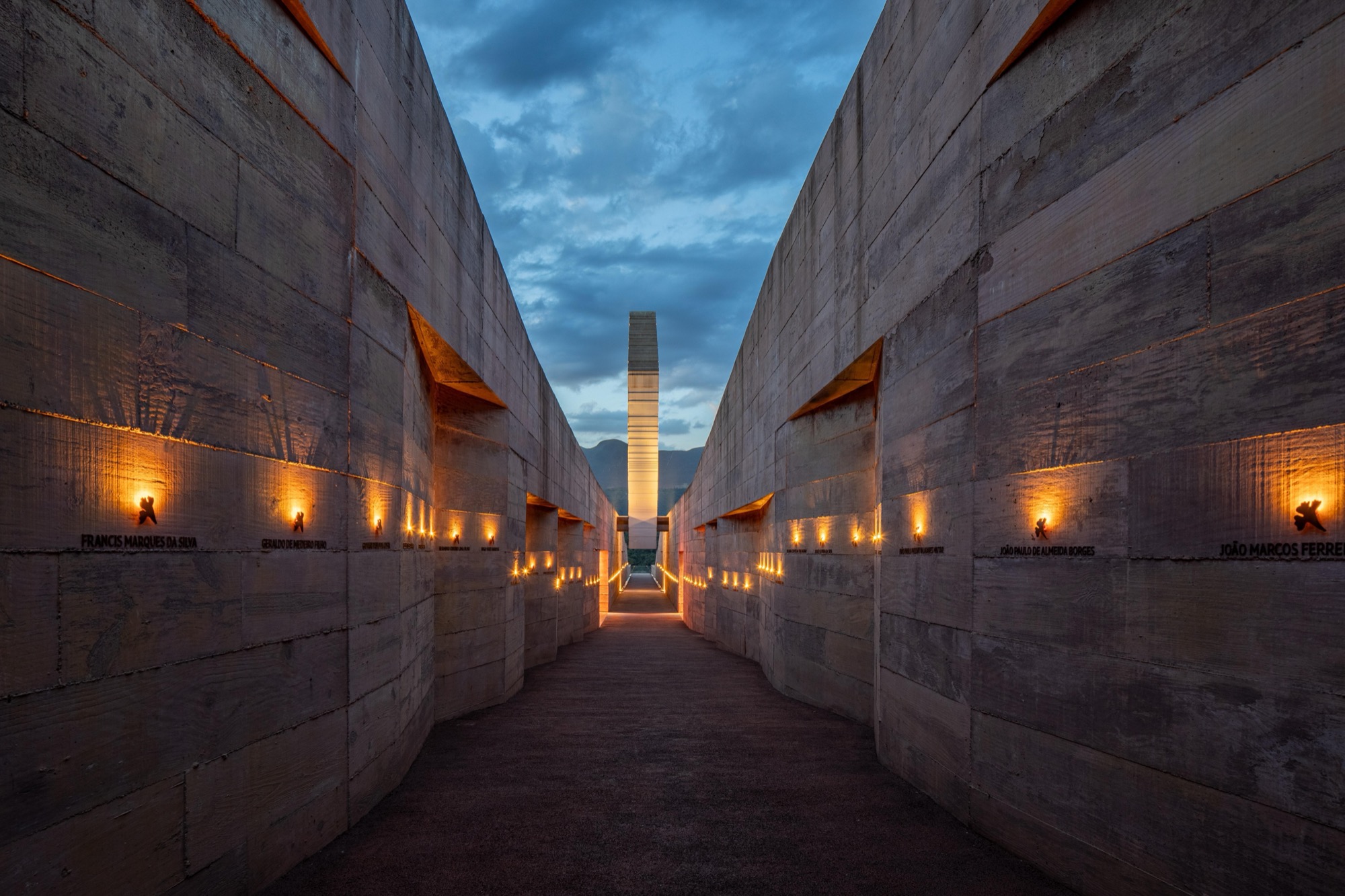
Its most defining gesture is a 230 metre rift carved through the ground and oriented toward the rupture site. Along the side walls, the names of the 272 victims appear one by one as you walk, turning distance into a measure of time, breath, and endurance.

LIGHT THAT GUIDES WITHOUT SPECTACLE
Atiaîa’s design works with restraint, using brightness and darkness as a reading device. It makes legible what must be read slowly: inscriptions, thresholds, and the edges of the trench, while allowing other moments to remain deliberately low, so the body senses where it is before the eye declares it.


This is not lighting that performs grief. It is lighting that supports attention, keeping the memorial from becoming a backdrop and insisting, instead, on presence.


SYMBOLS ACTIVATED BY ILLUMINATION
The memorial’s iconography is carried by light as much as by form. A crystal druse sits as an elemental core, recalling the “jewels” families use to speak of those they lost, and every year at the exact time of the tragedy a beam of light reaches it in tribute.

Elsewhere, the narrative returns to the count of 272 through a grove of 272 yellow ipê trees and through points of light in the lake, while the central suspended sculpture, often described as a weeping head, releases water over pigment stained concrete, moving mourning into a material cycle that ends at the reflecting pool.

MEMORY, TESTIMONY, AND WHAT CANNOT BE REPAIRED
Alongside the outdoor route, the memorial houses Memory and Testimony exhibition rooms and a space dedicated to the dignified safeguarding of victims’ corporeal segments. The programme makes explicit what the architecture suggests throughout: this is not symbolic in the casual sense. It is a public structure built from accountability, research, and collective care.


The memorial was commissioned by AVABRUM, the Association of Families of Victims and Those Affected by the collapse. Architecture and interior design are by Gustavo Penna Arquitetos Associados, with lighting design by Atiaîa Lighting Design led by Mariana Novaes. Landscape is by Medra Paisagismo, with project management by Olhar 360 Projetos, signage by Greco, exhibition design for the Memory and Testimony spaces by Júlia Peregrino, and exhibition lighting by Cesar de Ramires.


Project Credit
Project name: Memorial Brumadinho
Location: Brumadinho, Minas Gerais, Brazil
Architects and Interior Design: Gustavo Penna Arquiteto e Associados / @gustavopennaarq
Lighting Design: Atiaîa Lighting Design / @atiaia.lighting.design
Landscape: Medra Paisagismo
Photo: Pedro Mascaro, Leo Drumond/Nitro, Jomar Bragança