Now Reading: Seosomun Shrine History Museum in Seoul: Memory Built Underground
- 01
Seosomun Shrine History Museum in Seoul: Memory Built Underground


In Seosomun History Park, nothing signals a museum at first. People cut across the grass, pause in the shade, take the shortest line through the site. Red brick walls sit low and quiet within that ordinary scene, more like a boundary than an announcement. There is no façade performing for the street, no symbol asking to be decoded. The first real instruction is simple: go down. You leave the park’s daylight behind and descend into brick, shadow, and a silence that feels deliberately held.

The ground here is not neutral. Seosomun served as an official execution site during the Joseon Dynasty and later became a major martyrdom ground during nineteenth-century Catholic persecutions. The museum treats that history as the site’s underlying fact, but it does not narrow the place into a single story. It keeps the frame wide, letting the weight of what happened here sit behind the architecture rather than in front of it.
That attitude explains the project’s defining move. Instead of taking a position on the skyline, the museum is built beneath the park. For years, the park itself sat over an underground parking structure, an infrastructural layer that quietly shaped the site. A renewal effort transformed that condition into a subterranean museum, opened in 2019, without asking the surface to become theatrical.
The approach is a sloping path lined with curved red-brick walls that pull you under. The architecture does not chase a dramatic reveal. It works by narrowing your attention. As you move down, the park falls away. Light thins. Brick takes over as the dominant register, not as texture, but as mass and continuity.

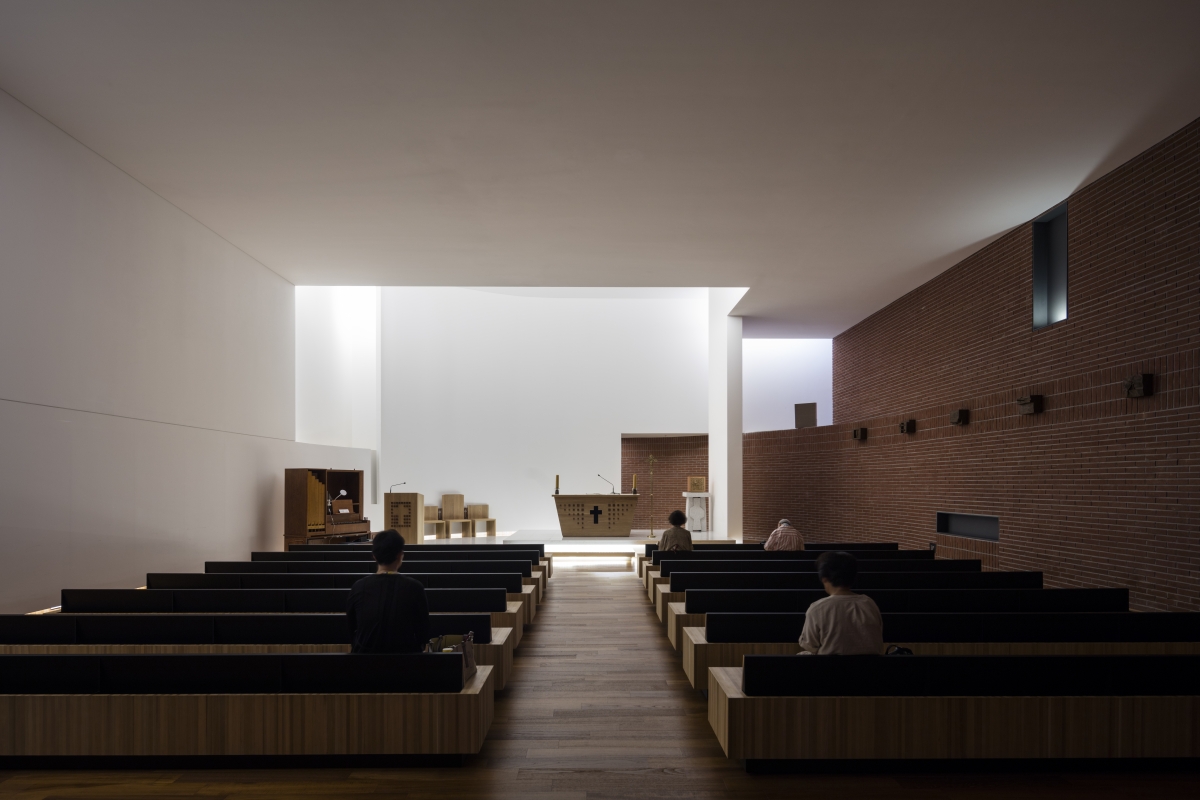
Inside, the museum avoids overt religious staging. Despite the Catholic history that anchors the site, there are few explicit signs such as stained glass or crosses. The tone is quieter than that. The spaces are set up for contemplation without telling you what, exactly, to feel. The aim reads less like a shrine with a fixed script and more like a place that can be entered with different beliefs, or none.

Brick is the tool that keeps the atmosphere steady. It appears not as nostalgia, but as control: long walls, dense surfaces, openings that feel measured rather than expressive. The experience comes in episodes as you move, with architecture and sculpture encountered in sequence. The building does not offer a single iconic image. It asks for accumulation.

The Consolation Hall is the room most people remember. It is a large brick-lined volume where a shaft of light drops from above, cutting into the darkness and sharpening the room’s stillness. Nothing here tries to “represent” tragedy. The space holds back. It lets silence do the work, and the light do just enough.

After that, Sky Square arrives like a reset. A blank brick void open to the sky, it brings daylight back without turning it into a climax. Air returns. Sound changes. The city is suddenly present again, but now framed by brick as a limit, not a façade.

The museum keeps repeating that relationship. Above and below remain in conversation. Ground and underground meet along a horizontal line, punctured by vertical voids that reintroduce the sky in fragments, as if the building is constantly checking its position against daylight.

The project is credited to Interkerd Architects in collaboration with VOID Architects and Less Architects, completed in 2019. It does not read as a signature object. It reads as a controlled piece of city-making: careful about what it shows, careful about what it refuses.
Seosomun Shrine History Museum is not a building you remember as a silhouette. You remember it as a route. The curve of brick as you go down. The long quiet. The room defined by light. The open sky that arrives without celebration. Above, the park keeps moving, almost indifferent. Below, the city’s memory is held in a set of spaces that never raise their voice.
Photo Cover
Seosomun Shrine History Museum: Descending into a subterranean memorial beneath the ordinary park surface, framed by curved red-brick walls. Credit: Photo from C3GLOBE
More photos by ©Jaeyoun Kim