Now Reading: The museum after the object: SANAA and the ethics of architectural withdrawal
- 01
The museum after the object: SANAA and the ethics of architectural withdrawal

The museum after the object: SANAA and the ethics of architectural withdrawal

In many cities, the museum has become a device for visibility: an institution required to perform simultaneously as landmark, brand, and civic emblem. Architecture responds predictably, thickening into frontality, signature form, and the choreographed threshold that announces, without ambiguity, that culture begins here. Taichung offers a deliberate counter-proposal. On the northern edge of Taichung Central Park, a 67-hectare landscape formed from a former airfield site, SANAA’s Green Museumbrary opened in December 2025 as a large, hybrid civic institution. Museum and library are held within a single architectural system. Its most emphatic gesture is not an image, but a refusal of the mechanisms through which museums traditionally claim authority.
The project is large, commonly cited at around 58,000 square metres, and programmatically ambitious. Yet its ambition does not lie in spectacle. It lies in re-engineering institutional space as a condition that is porous, distributive, and climatically mediated. Cultural authority is no longer delivered through the singular drama of arrival. Instead, it is negotiated through patterns of movement, occupation, and shared ground.
What Taichung offers is not a new museum icon. It asks whether the museum still needs to be an icon at all.
THE REFUSAL OF FRONTALITY
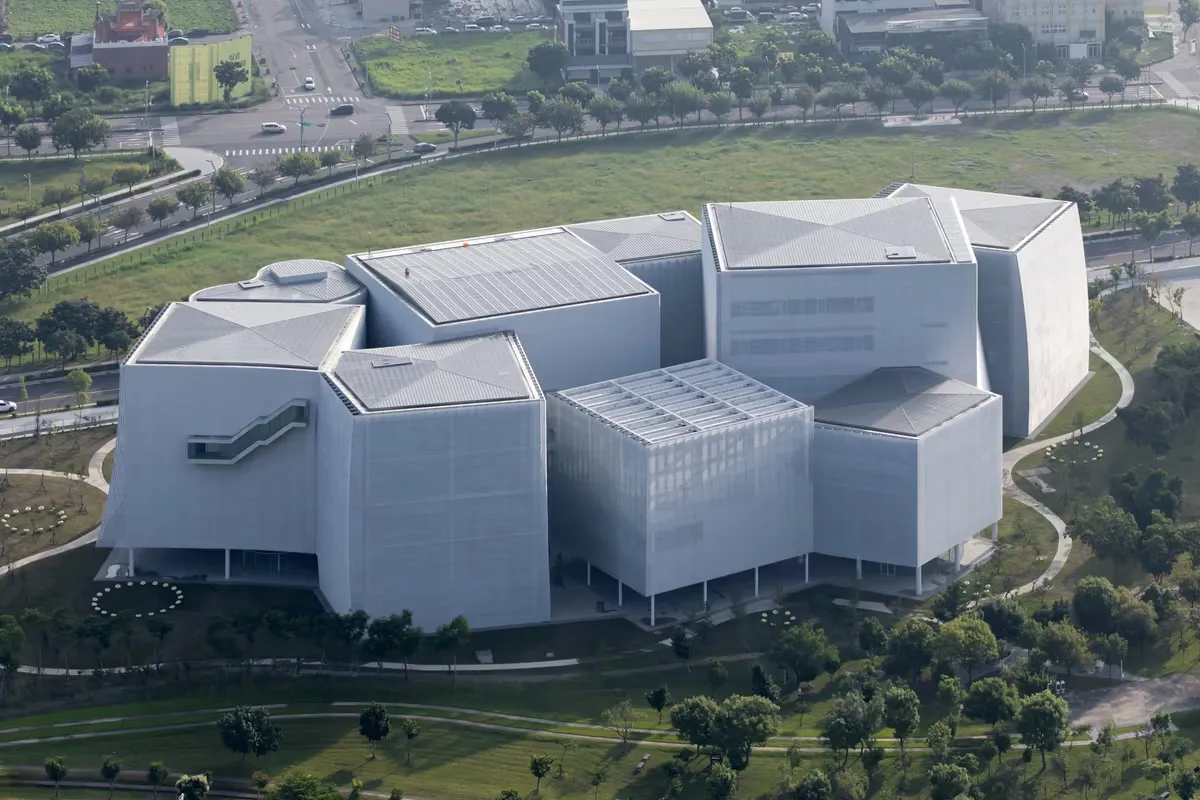
The building dismantles the museum’s most reliable instrument: frontality. Composed as a set of elevated, box-like volumes varied in size, the Museumbrary lifts much of its mass above grade so that public ground continues beneath. Entry is not staged as a ceremonial line drawn toward a privileged portal. Approaches are multiple, especially from the park, and the visitor is not placed into a single, pre-ordained sequence.

This absence is not a neutral aesthetic choice. Museums have historically used spatial hierarchy to enact cultural authority: to signal what is inside, who belongs, and what behaviour is expected. Frontality is a civic posture. To refuse it is to refuse a certain kind of gatekeeping. Taichung does not frame arrival as initiation. It frames arrival as drift, repeatable, lateral, and casual enough to feel almost unannounced.
For an Architecture Review readership, the point is not that the building is “open.” The point is that openness here functions as a redistribution of power. Spatial democracy is not declared. It is embedded in the refusal to tell you where to begin.
A CLOSE READING: WHERE THE BUILDING ACTUALLY HAPPENS
Taichung is best understood not as a diagram but as a temporal experience, as it modulates body, attention, and climate minute by minute.
Approaching from the park, the institution does not read as a terminus. Its outer screen, a silver-white expanded-metal mesh, softens the volumes into an atmospheric edge. It catches daylight and diffuses mass without resorting to the rhetoric of glass transparency. What registers first is not form but a shift in condition. Brightness thins into shade. The ground ahead begins to behave like a public interior without doors.

Under the lifted volumes, the building produces a civic underside: layered shade, multiple paths, pockets of lingering. The air feels different here, not through theatrical means but because the sun has been intercepted and breezes can move laterally rather than being stopped at a perimeter. This is not an entry hall. It is an inhabited threshold condition. There is no single “you have arrived” moment. Entry becomes a gradient. You can move sideways, stop, reverse, re-enter. The building does not insist on narrative. It allows discovery that institutional ground is also public ground, open-ended, repeatable, shared.
Only gradually do you encounter the recognisable apparatus of museum and library: controlled interiors, rooms of attention, zones of reading. Even then, transitions are not hard cuts. They are alternations between exposure and shelter, and between openness and concentration. This is staged through circulation that converges and disperses. The ethics of the building are performed not in a heroic space but in small decisions: understated thresholds that give agency to the visitor, shade deployed as civic gift, and permeability used as behavioural cue rather than aesthetic slogan.
This is architecture that works as a public instrument. It asserts itself by letting you linger.

If Taichung resists being read as an architectural object, it is because performance takes priority over representation. The dual-layer envelope wrapped in expanded-metal mesh is easy to describe in optical terms, as reflective, diffuse, and dematerialising. But its significance is operative. The mesh is not there to supply a signature pattern. It is there to mediate, by modulating brightness, softening edges, and registering weather and time.
Likewise, the lifted volumes are not poetic flotation devices. They are climatic infrastructure. They generate shade and protect a continuous network of public space beneath. These are not secondary niceties. They are the building’s primary content. Taichung’s most radical move is not a new form. It is the conversion of institutional mass into environmental work.

This matters because sustainability in cultural architecture is too often treated as an afterthought: systems added, façades optimised, performance measured after the fact. Taichung suggests a different ethic. Environmental work is embedded in spatial logic. Shade is not decoration. Permeability is not metaphor. Architectural restraint becomes a method of managing heat, light, and public comfort without staging spectacle.
Here, politics and climate become inseparable. The building refuses iconic frontality at the same time as it refuses the sealed museum box. Monumentality is replaced by modulation.
TRANSPARENCY AS SPATIAL POLITICS
SANAA’s work is often summarised as transparent, but transparency is frequently misread as glassiness, a visual trope rather than a disciplinary position. At Taichung, transparency is less optical than procedural. It is a way of distributing agency.
Who decides the route? Who controls pace? Where does one stop, read, look, wait? In many museums, architecture scripts these decisions through choreographed sequencing. At Taichung, the script is deliberately weakened. Routes are multiple. Thresholds are understated. Pauses are permissible in spaces not labelled as contemplative rooms. The institution offers a field of choices.

This is not a lack of design. It is an ethics of withdrawal. The building steps back so the visitor may step forward. But the consequence is not simply liberation. It is responsibility: curators cannot rely on architectural theatre to produce meaning; visitors cannot rely on prescribed routes to legitimise attention. The building offers conditions rather than commands.
Transparency becomes political precisely because it loosens the museum’s claim to be the singular author of experience. The museum becomes less stage than commons, and less sequence to be consumed than territory to be inhabited.
THE HYBRID CONDITION: MUSEUM AND LIBRARY AS MUTUAL CONTAMINATION
The “museumbrary” label risks sounding like marketing. Taichung’s hybridity is more unsettling than that. It is a disciplinary disturbance.
Museums and libraries embody different temporalities. The library privileges duration: repeated visits, slow accumulation, quiet occupation. The museum privileges event: curated attention, periodic renewal, the dramaturgy of exhibition. By placing them within one spatial system, one set of volumes, one shared underside, and one field of circulation, Taichung allows these temporalities to contaminate each other.

Micro-evidence matters here. Non-hierarchical circulation means that routes to reading are not cleanly separated from routes to display. Thresholds into quieter zones are understated rather than monumentalised. The result is not a museum wing plus a library wing, but a set of adjacencies in which behaviours leak. The museum is pressed to tolerate the slow time of reading; the library is asked to coexist with episodic intensity. Each programme becomes more vulnerable, and therefore more honest, through proximity.
For architects, the significance lies not in the diagram of two programmes, but in the alteration of institutional identity. Knowledge is no longer staged as precious rarity. It is encountered as daily practice.
THE RISK OF WITHDRAWAL
A critical essay cannot end at admiration. Withdrawal has risks, and Taichung makes them unavoidable.
A museum that weakens narrative control may also weaken curatorial clarity. When thresholds are understated and routes permissive, exhibitions must work harder to assert meaning. In a hybrid institution, everyday reading and lingering may compete with the museum’s demand for attention. The building’s generosity can produce ambiguity, and ambiguity complicates governance.
There are practical tensions too. A porous underside open to the park complicates security and crowd management. Diffuse circulation can work against concentration. Softened boundaries between inside and outside generate operational friction: climate, noise, and the subtle policing required to keep openness from tipping into disorder.
Taichung does not resolve these tensions. It accepts them. Withdrawal is not absence; it is governance by other means. Control is relocated into climate, behaviour, and calibrated thresholds. The hard authority of the portal is replaced by the soft authority of conditions.
NEUTRALITY AS ANOTHER FORM OF POWER
A sharper critique must also be entertained: neutrality itself can become a new aesthetic of authority. Architecture that refuses spectacle can still impose a worldview, one in which power operates through atmosphere rather than declaration. Openness can become brand; transparency can become moral alibi.
Taichung resists this drift by making withdrawal materially consequential rather than merely visual. The mesh is a mediator, not a veil. The lifted volumes are public and climatic devices, not formal tricks. The underside is civic ground that must be maintained, inhabited, negotiated. Here, restraint costs something. It produces responsibility and friction. That cost prevents the project from collapsing into neutrality as style.

AFTER THE OBJECT
If the twentieth-century museum was defined by the object, both the art object and the architectural object, Taichung suggests another future: the museum as condition. Not container, not symbol, but an environment in which cultural life occurs without being framed by monumental authority.
This is not a gentle proposition. It demands patience and tolerance for ambiguity. It demands institutions confident enough to let architecture step aside without collapsing into incoherence.
Taichung does not resolve the museum’s contemporary contradictions. It suspends them. And in that suspension, it opens a space, porous, climatic, deliberately non-coercive, within which culture may once again coexist with everyday life without architecture needing to shout in order to be heard.
Photo Cover
Exterior view of Taichung Green Museumbrary by SANAA, showing lifted volumes wrapped in expanded metal mesh, allowing public ground to flow beneath.
Credit: Photo © Iwan Baan, courtesy of Taichung Art Museum
Click here to view more photos about Taichung Green Museumbrary