
Now Reading: Belfountain House opens family living to its rural Ontario setting
- 01
Belfountain House opens family living to its rural Ontario setting

Belfountain House opens family living to its rural Ontario setting

Set within the steeply wooded landscape of Ontario’s Niagara Escarpment, Belfountain House transforms a 1970s chalet into a contemporary family residence shaped by topography, movement, and daily life. Designed for a philosopher, an artist, their children, and a dog, the 400-square-metre home occupies a 3.21-acre site where mature trees, dramatic slopes, and seasonal changes define the experience of living.


Rather than replacing the existing structure, the project preserves the northern portion of the original chalet while extending the southern half along its footprint. This strategy minimizes disturbance to the site while allowing the house to expand through reorganization rather than excess, creating a closer relationship between architecture and landscape.

A single elongated roof stretches across the hillside, unifying the house beneath one continuous form. Responding directly to the escarpment terrain, the architecture unfolds through shifting levels, changing perspectives, and carefully framed moments of compression and release.


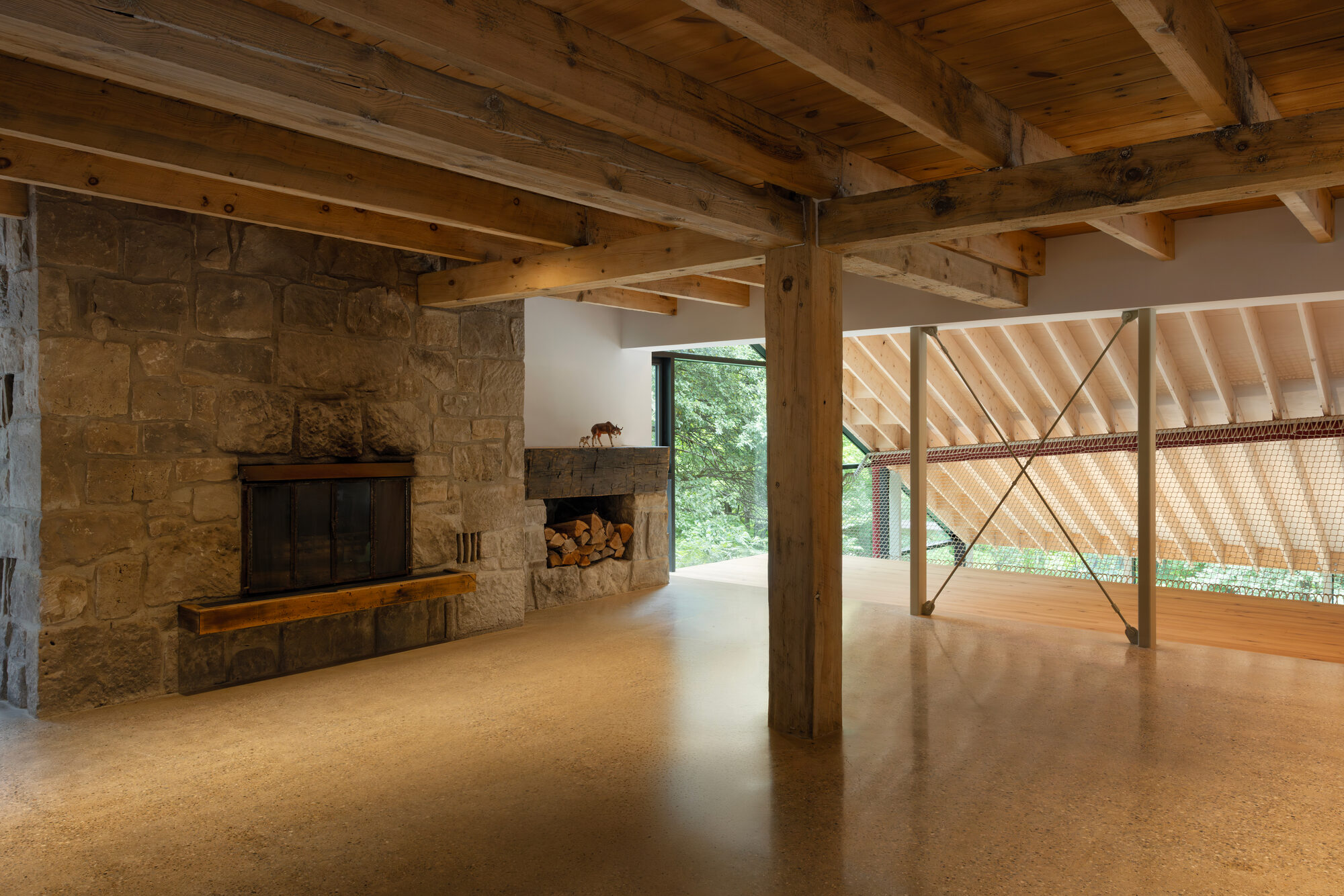
The sequence through the house echoes the experience of walking through the surrounding forest. Visitors approach gradually, passing the artist’s studio and outdoor pool before reaching the entrance. A compressed timber-lined mudroom opens unexpectedly into a soaring living room centered around a fireplace, where exposed rafters extend toward the surrounding canopy.


Diagonal red steel beams intersect the timber structure, introducing a bold visual counterpoint while stabilizing the long span. Suspended above the main living area, a large net functions simultaneously as play space, gathering platform, hammock, and lookout, reinforcing the house’s emphasis on informal family life.


Throughout the interior, expansive glazing and continuous timber surfaces strengthen the connection between house and forest. Seasonal light, weather, and sound become active elements of everyday experience, while reclaimed elm, local stone, stucco, and radiant concrete floors root the project materially within its setting.


As the house descends into the slope, it becomes increasingly embedded within the terrain. Two contrasting stair systems frame different encounters with the landscape: one carved directly into the hillside, the other suspended lightly above it. Together they create a sequence of movement that continuously negotiates between architecture and nature.


Lower levels accommodate spaces dedicated to retreat and recreation, including a gym, sauna, pool access, and a concealed guest suite wrapped in angled polycarbonate panels that emit a soft lantern-like glow after dark.


Designed around the evolving rhythms of family life, Belfountain House encourages constant movement between indoors and outdoors while maintaining visual connections across the site. Durable materials were selected to weather naturally and absorb the marks of everyday use, allowing the architecture to age alongside its inhabitants.


More than a renovation, the project becomes an inhabitable landscape. Through its sectional organization, continuous circulation, and deep engagement with the escarpment terrain, Belfountain House demonstrates how architecture can emerge from the logic of the land itself, creating a dwelling where movement, nature, and daily life remain inseparable.
Projetc Credit:
Project name: Belfountain House
Location: Belfountain, Ontario, Canada
Building area: 238 m2 /2,561 sf
Floor area: 430 m2 / 4,628 sf
Design firm: UUfie / @uufie_architects
Photo: Ema Peter Photography / @emaphotographi