Now Reading: Ice Garden at Jinshanling: Ephemeral architecture along the Great Wall
- 01
Ice Garden at Jinshanling: Ephemeral architecture along the Great Wall


Ice Garden at Jinshanling: Ephemeral architecture along the Great Wall
At the foot of the ancient Great Wall at Jinshanling, where a major hiking trail meets smaller mountain paths, Ice Garden unfolds as a temporary installation shaped as much by climate as by design. Set within the dry, subzero conditions of northern China’s winter, the project adopts ice not as spectacle but as structure, allowing architecture to emerge directly from natural forces.

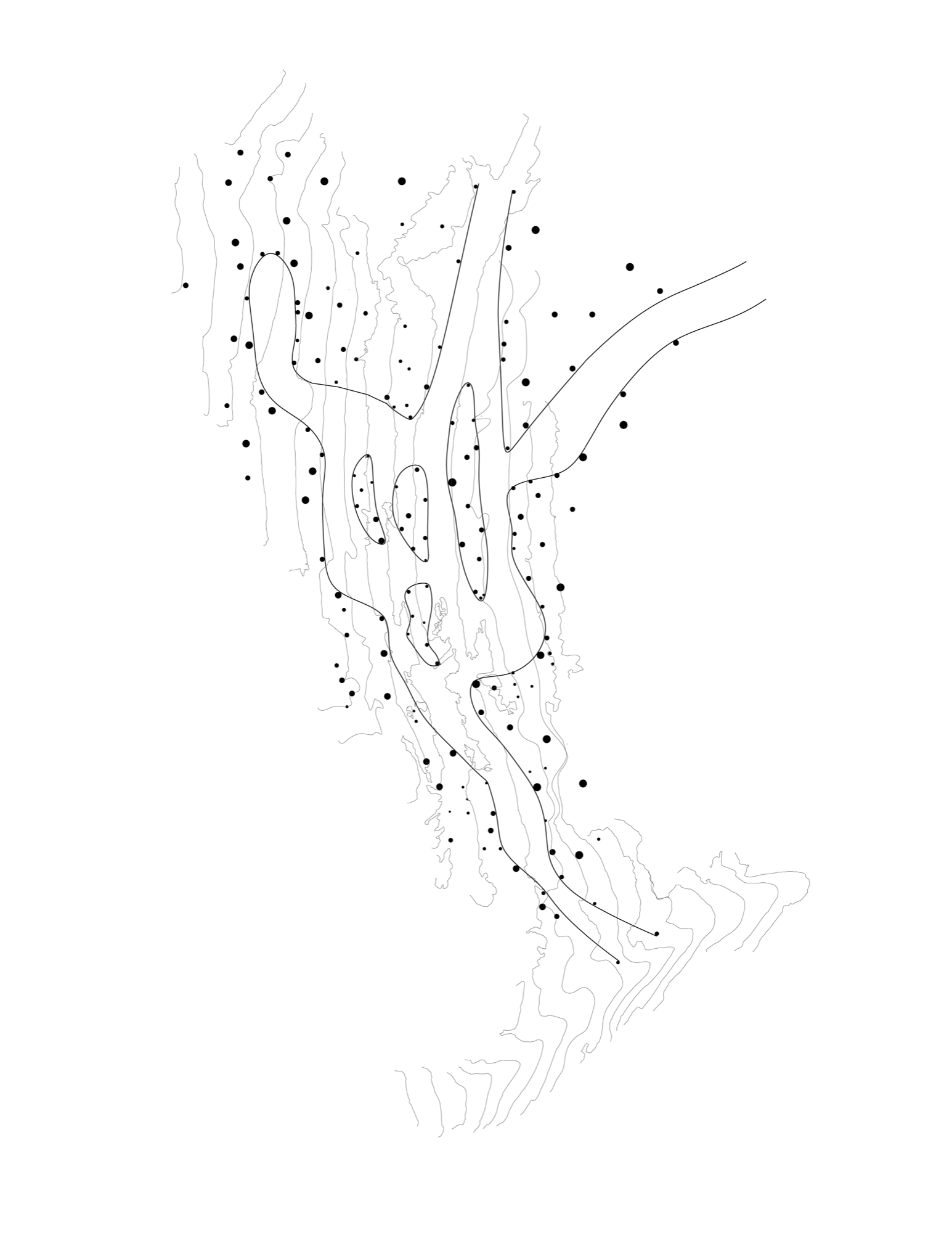
Rather than impose an autonomous geometry onto the forested slope, the installation traces the existing distribution of trees. A sequence of ice walls extends sinuously across the terrain, thickening where trunks gather closely and loosening where clearings open. In denser areas, the walls create moments of enclosure; in lighter patches, they yield passages that thread between trunks. Through this calibrated placement, the latent spatial order of the forest becomes newly legible.

On a larger territorial scale, the Great Wall at Jinshanling stretches across the mountain ridges as a continuous edge, binding topography and history into a single linear gesture. Ice Garden echoes this continuity in a material that is inherently temporary. Where stone asserts endurance, ice proposes seasonality. The dialogue between the two registers permanence against transience, mass against fragility.


ARCHITECTURE FORMED BY CLIMATE
Construction unfolds through collaboration between human action and environmental conditions. Agricultural fleece membranes are suspended between trees and sprayed with water. As temperatures drop, water freezes incrementally, forming thin shells of ice along both sides of the textile substrate. Layer by layer, semi transparent walls take shape, their thickness and texture determined by wind, humidity, and temperature fluctuations. The result is an architecture whose final form remains partially authored by the weather itself.


The completed walls possess a fleeting but distinct presence. They shimmer in low winter light, hovering between surface and atmosphere. Their translucency allows branches, sky, and distant slopes to remain perceptible, while subtly reframing them.
REFRAMING THE FOREST
As the walls weave through the woodland, they generate spatial conditions that oscillate between exterior and interior. Sunlight slants through stratified ice, casting blurred silhouettes of trees and visitors. Layers of frozen water compress the depth of the landscape, softening outlines and bending perception. The forest beyond appears momentarily suspended, its distances recalibrated through a thin crystalline filter.

Movement through the site shifts accordingly. What might otherwise be a casual crossing of terrain becomes a heightened passage. The spacing of trunks, the rhythm of light, the quiet persistence of the winter air all become newly perceptible. Ice Garden does not overwrite the site; it reveals it. Through a minimal intervention, the project renders the familiar unfamiliar again, inviting a renewed reading of landscape.
DESIGNED TO DISAPPEAR
Ice Garden is conceived without any ambition for permanence. Its existence is contingent on the precise meteorological conditions that make it possible. As temperatures rise and solar exposure intensifies, sublimation accelerates. Hairline fractures begin to appear, accompanied by faint sounds of splitting. Walls soften, buckle, and eventually collapse, returning water to the ground from which it was briefly borrowed.

When the thaw completes its work, the forest remains unchanged. No foundations, no scars, no residue of construction persist. The project embraces the fleeting nature of its own material, allowing space to form and then dissolve back into the terrain.

In the winter landscape of Jinshanling, Ice Garden demonstrates how architecture can be both present and provisional. By employing one of the lightest and most transient materials available, it constructs a spatial experience that exists only for a season, aligning design with climate and time. Here, architecture is not an imposition upon nature but a temporary crystallization of it, a fragile edge drawn briefly across the forest before yielding once more to the mountain air.


Project Credit
Design firm: ELSE / @design_by_else
Location: Aranya golden mountain, China
Year: 2025
Photo: Tree Studio
Related Posts
Previous Post
Next Post
- The timeless elegance of domestic appliances: From the Iconic Braun KF 20 aromaster to the German design ethos

- Emilio Ferro on the light, sound and memory of a place
- At Maniwa, an architect’s family home opens to the neighbourhood
- What bronze remembers of the hand

- Caught in light: Moradavaga’s suspended shoal

- The making of Alex Chinneck’s impossible Dior windows