
Now Reading: Ascending to Eternity: Hiroshi Sugimoto and the Architecture of Perception
- 01
Ascending to Eternity: Hiroshi Sugimoto and the Architecture of Perception

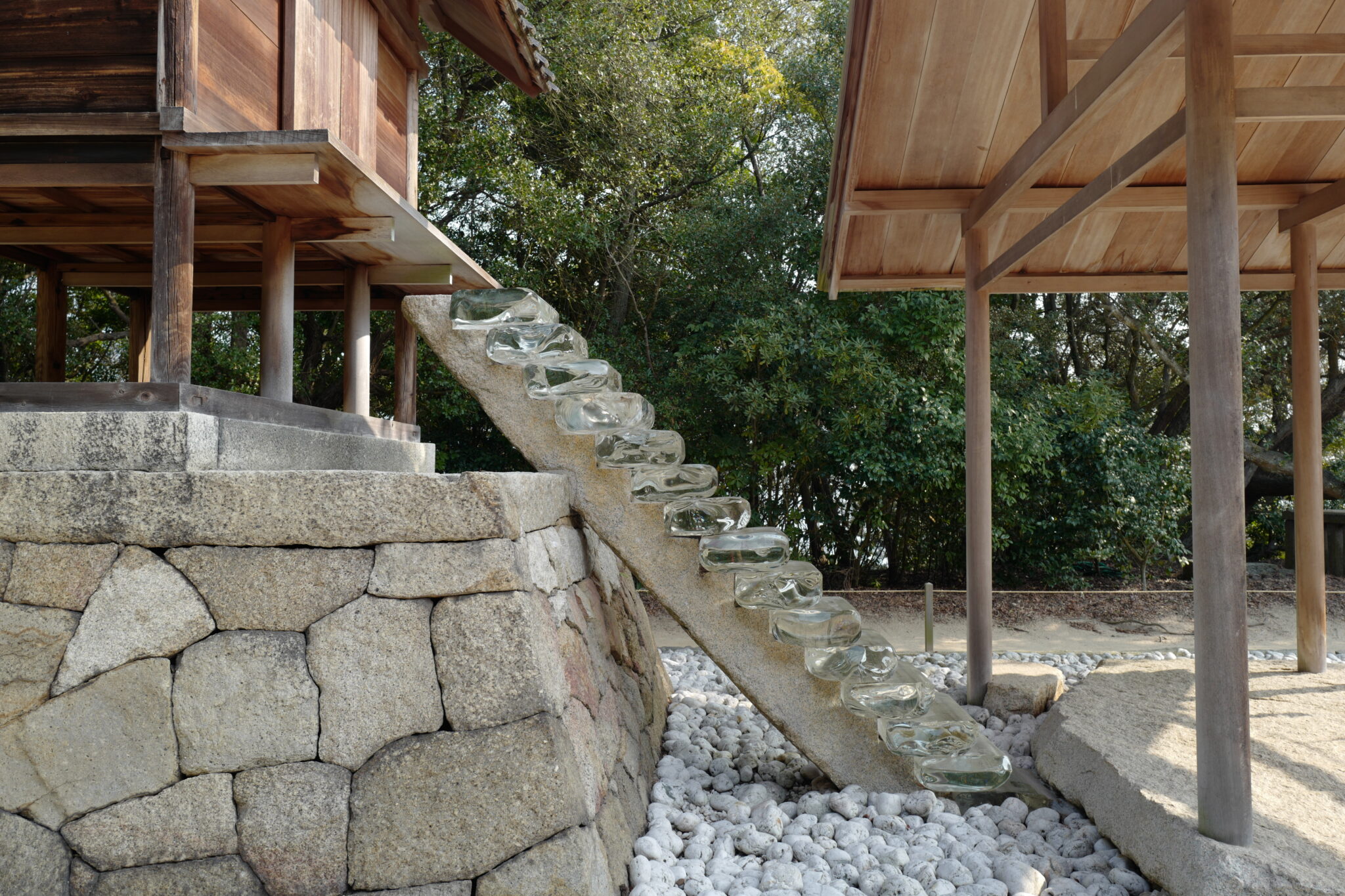

In the muted light of Naoshima Island, where the Seto Inland Sea meets a landscape quietly shaped by contemporary art, an optical glass staircase emerges from the earth at the Go’o Shrine.
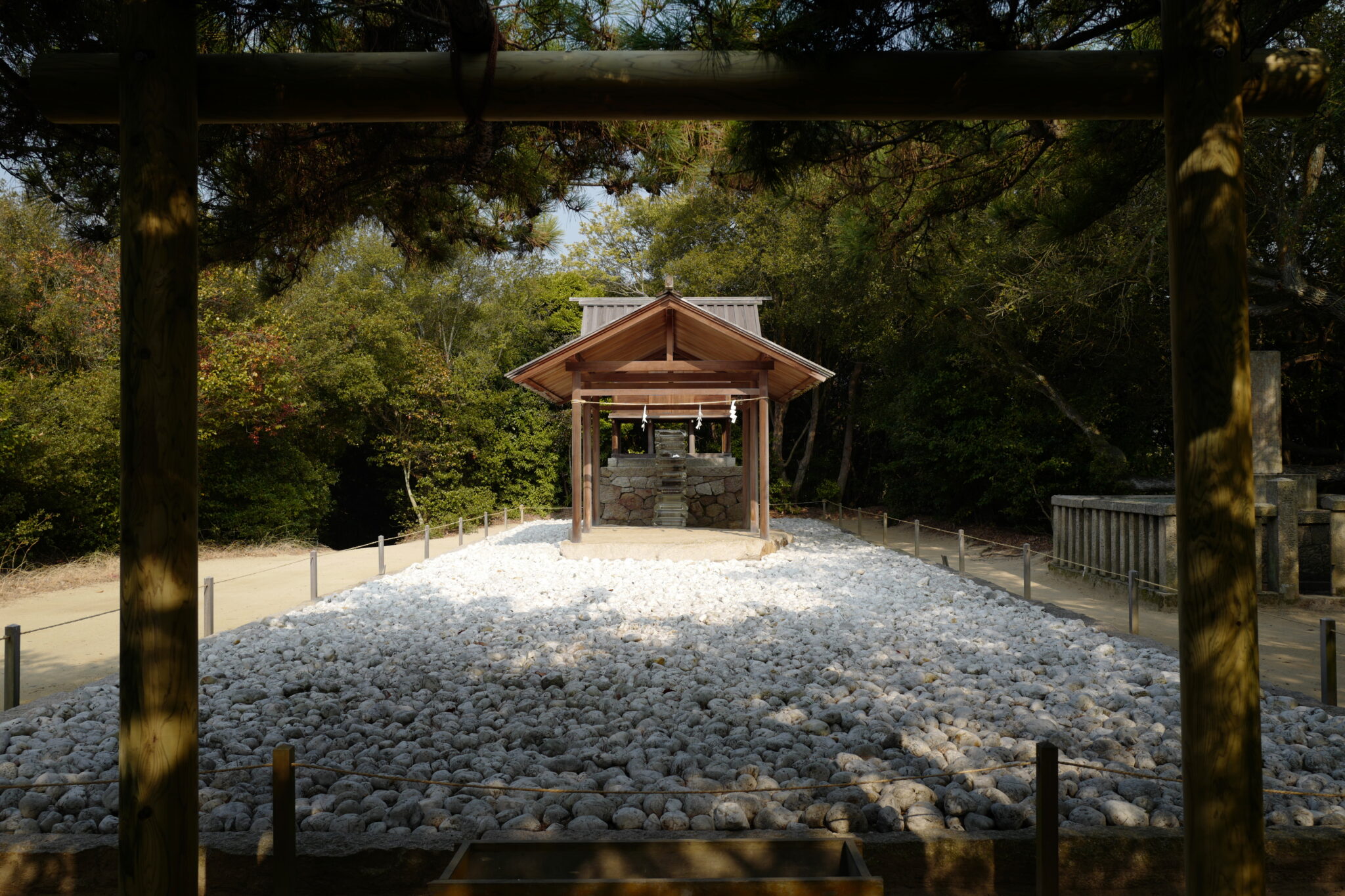
Designed by Hiroshi Sugimoto and completed in 2002 as part of his restoration of the seventeenth century Shinto site, the staircase rises from a subterranean stone chamber toward a modest wooden pavilion above. Each step, carved from solid optical glass, refracts daylight into shifting bands of colour. The effect is neither monumental nor decorative. It is deliberate, restrained, and quietly disorienting.
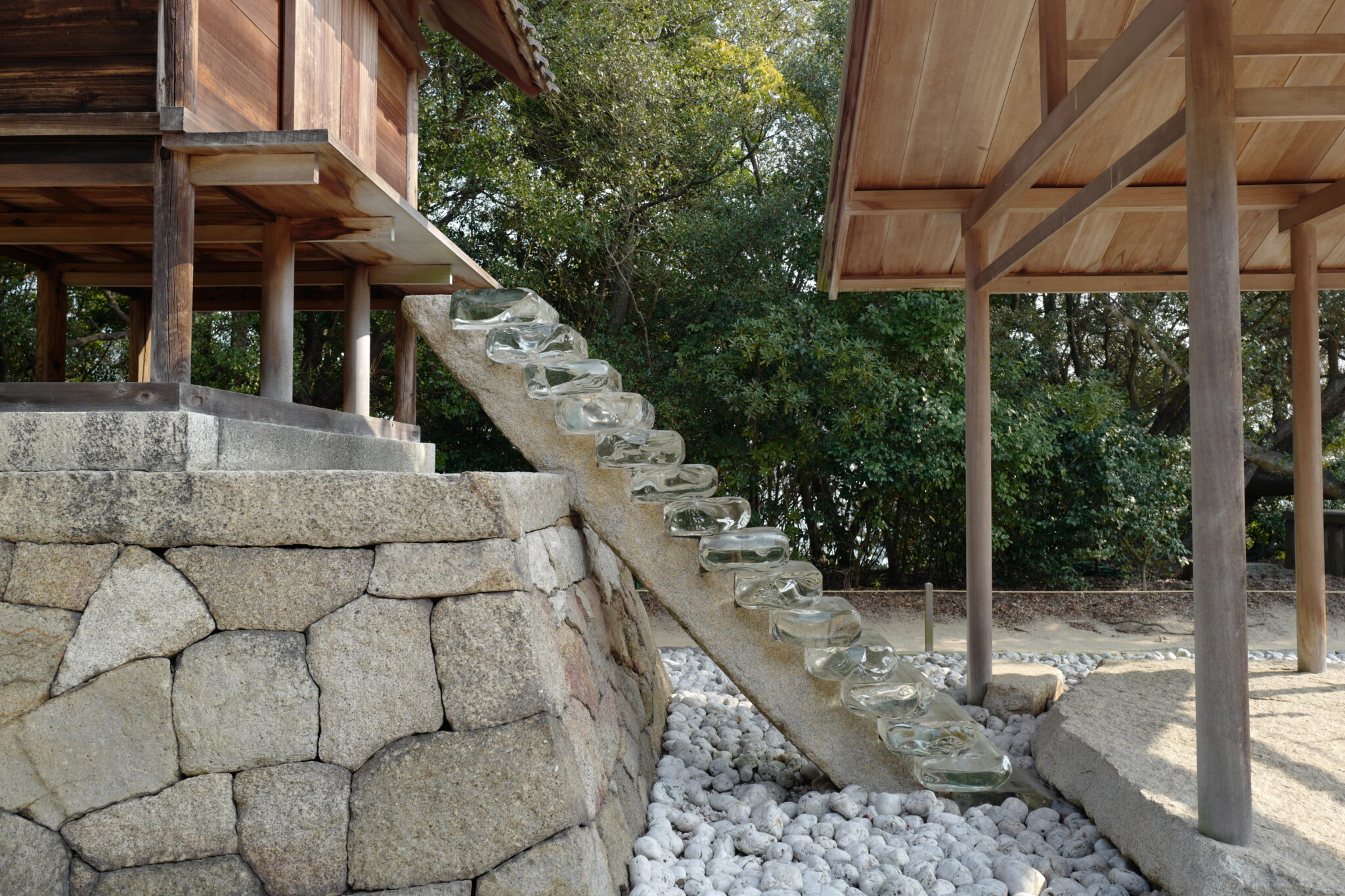
The staircase is not simply a passage between two architectural levels. It functions as a perceptual device. Light fragments and recomposes with every movement, altering the visitor’s sense of depth, weight, and orientation. The ascent slows the body. Vision adjusts. What begins underground, in a space recalling ancient burial mounds, culminates in open air, where the shrine returns the visitor to the present landscape. Sugimoto has spoken of his belief in an enduring spiritual presence within nature, rooted in Shinto cosmology. Here, that belief is not illustrated but enacted. The work transforms a roadside shrine into a site where perception itself becomes ritual.
Born in Tokyo in 1948, Sugimoto resists categorisation. Although he studied economics at Rikkyo University, his artistic formation began after moving to New York in the 1970s, where he encountered Minimalism and Conceptual art. Photography became his primary medium, but never his sole concern. Over time, his practice expanded to include sculpture, architecture, performance, and experimental theatre. What unites these fields is not technique, but an enduring inquiry into time, perception, and the conditions under which meaning emerges.

Naoshima, reimagined as a cultural landscape through the vision of Soichiro Fukutake and the Benesse Art Site, offered Sugimoto an opportunity to extend these inquiries into architectural form. His involvement with the Go’o Shrine began in 1996 with its restoration. The later insertion of the glass staircase marked a shift from conservation toward philosophical articulation. The work does not imitate tradition, nor does it oppose it. Instead, it introduces a contemporary material into an ancient spatial logic, allowing each to sharpen the other.

Sugimoto has often spoken of blood memory when describing his attraction to elemental landscapes. As a child, he recalls watching the sea from a train window, sensing a familiarity that felt older than personal experience. Seascapes would later become one of his most enduring photographic series, capturing horizons that appear unchanged across centuries. At Go’o Shrine, that same sensibility is embedded in space. The underground chamber opens toward the sea through a narrow passage, aligning geological depth with distant horizon. The staircase mediates between them.

At the core of Sugimoto’s practice lies a sustained meditation on time. He does not treat time as linear progression, but as accumulation and compression. Photography, for him, functions as a form of fossilisation. Long exposures do not freeze a moment so much as condense duration into a single surface. He has compared the camera to a premodern time recording device, akin to fossils or meteorites, objects that carry temporal information without narrative.

This conception extends beyond photography. In conversations with physicists, philosophers, and historians, Sugimoto has questioned whether time itself is an objective structure or a cultural construct. Human consciousness, he suggests, emerges from an awareness of temporal passage. Animals inhabit a continuous present. Humans remember and anticipate. That distinction produces reflection, anxiety, and ultimately art.
The glass staircase at Go’o Shrine stages this transition. Movement begins below ground, in a space associated with burial and origin. As the visitor ascends, light becomes increasingly present, fractured, and unstable. The act of climbing mirrors a cognitive shift, from instinctive perception toward self awareness. The work does not propose transcendence as escape, but as heightened attention.
Sugimoto’s thinking also carries an ecological dimension. He has spoken critically about humanity’s estrangement from natural forces, and about environmental crisis as a consequence of forgetting the presence embedded in nature. While he avoids didactic gestures, his work often implies endurance rather than salvation. What will remain, he asks, when human systems collapse. Which forms, materials, and ideas are capable of surviving deep time.
This concern informs his design language. Sugimoto favours restrained forms and materials that age visibly. He avoids finishes that resist time, preferring surfaces that accumulate patina and irregularity. Optical glass, despite its technological precision, is used here not to signify modernity, but to reveal light as material. Stone anchors the work in geological time. Glass registers fleeting change. Their coexistence produces tension rather than harmony.


Light occupies a central role across Sugimoto’s work. His black and white photographs, produced with large format cameras and gelatin silver prints, treat light not as illumination but as subject. In his Theaters series, entire films are collapsed into a single exposure, leaving the screen radiant and empty. Narrative dissolves into duration. In the Opticks works, colour emerges from controlled experiments with refraction, echoing Newtonian optics while resisting scientific closure. The staircase at Go’o Shrine belongs to this lineage. It is an optical instrument embedded in architecture.


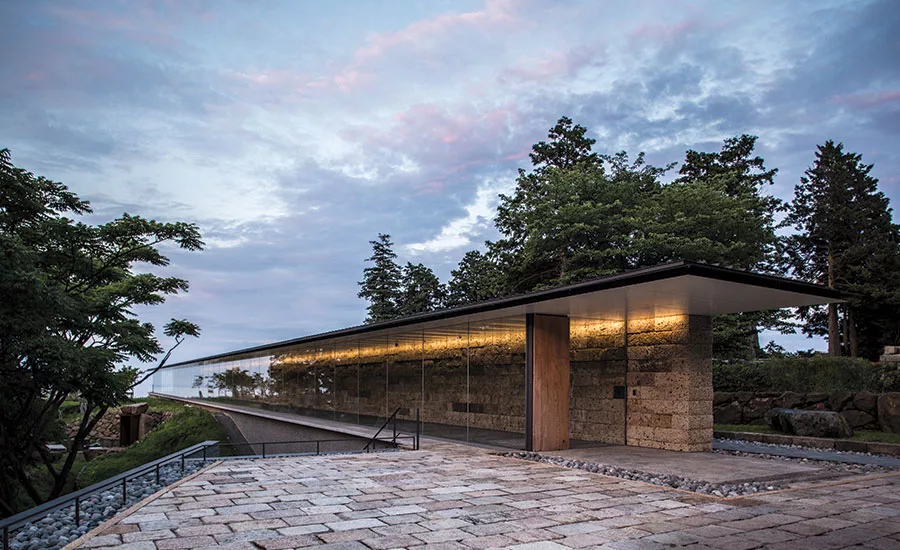
Sugimoto’s methods emphasise slowness. Long exposures require patience. Architectural interventions are conceived over decades. At the Enoura Observatory, begun in the early 2000s, he constructed a sprawling site aligned with solstices and equinoxes, incorporating Noh stages, stone corridors, and viewing platforms. He has described it as a structure designed to exist for thousands of years, even as ruins. The intention is not permanence in the conventional sense, but legibility across time.
His sculptural works extend similar questions into abstract form. Mathematical models are rendered at human scale, allowing equations to be encountered physically. Lightning Fields capture electrical discharges, producing images that resemble natural phenomena. Throughout, illusion is not deception but a tool. Sugimoto has noted that viewers often accept what they see as real, even when it is clearly constructed. That acceptance reveals how fragile perception can be.


Across these projects, the Go’o Shrine staircase appears modest. Yet its clarity gives it particular force. It does not attempt to summarise Sugimoto’s philosophy. Instead, it condenses it into an experience that unfolds step by step. The visitor does not receive information. They undergo adjustment.
In an era marked by acceleration and distraction, Sugimoto’s work insists on duration. It asks viewers to slow down, to notice how light changes, how materials respond, how perception shifts with movement. Time, in his work, is neither defeated nor denied. It is observed, compressed, and allowed to speak.
Ascending the glass staircase at Go’o Shrine is not a symbolic gesture so much as a perceptual one. The body moves. Vision recalibrates. Light fractures and recombines. What remains is not revelation, but attentiveness. In that attentiveness, Sugimoto locates a quiet form of endurance. Art does not halt entropy. It makes its passage visible.
Photo Cover
The iconic optical glass staircase at Go’o Shrine, Naoshima, refracting light in Sugimoto’s masterful design. Credit: Randomwire.