Now Reading: YokYok and the poetics of spatial experience
- 01
YokYok and the poetics of spatial experience

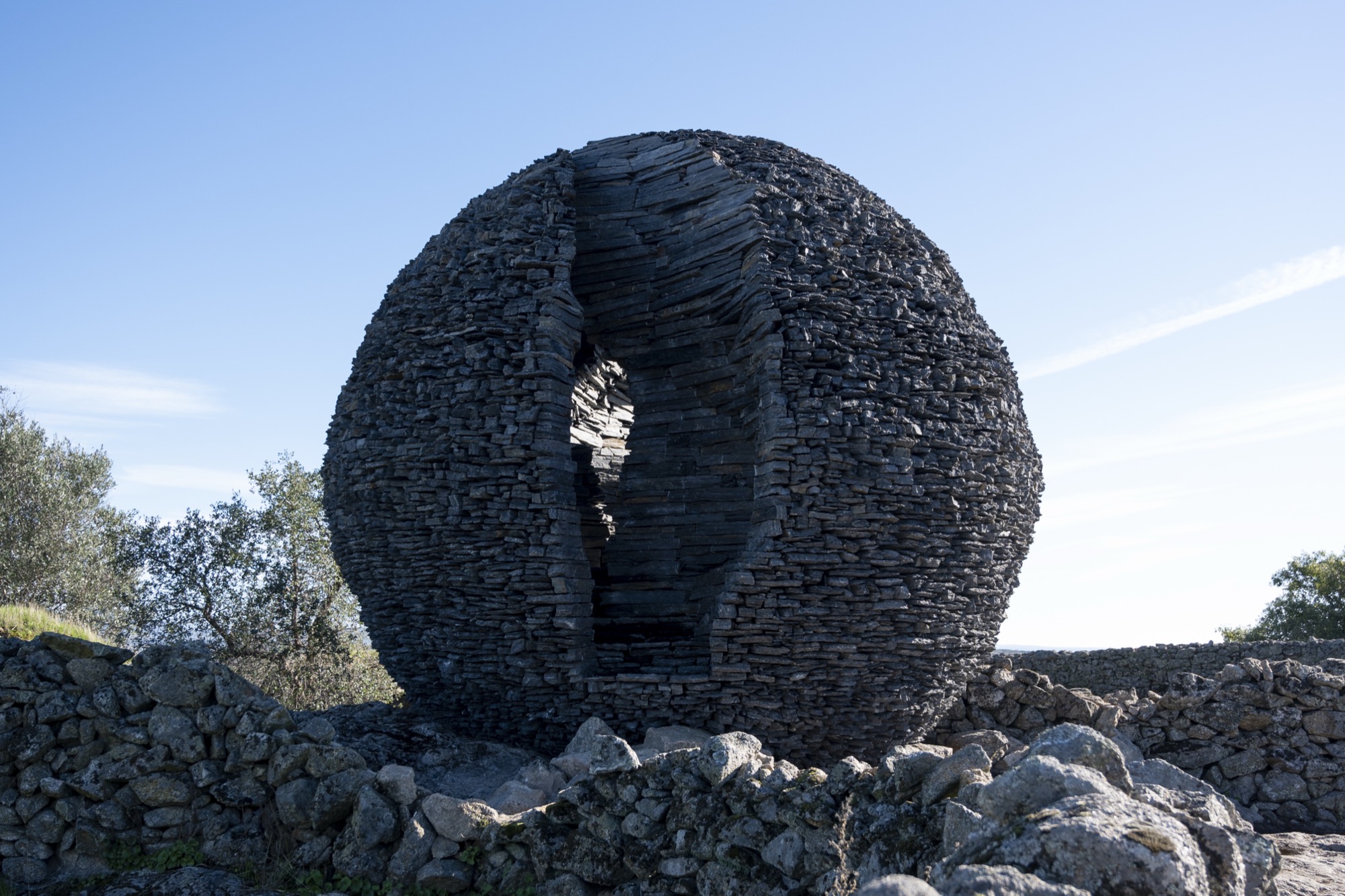

Set within the windswept border landscape of Salvaterra do Extremo in central Portugal, Ninho Globo emerges as a monumental, hand built stone sphere that resonates with both geological depth and symbolic intensity. Constructed entirely from local black schist, the work evokes at once a celestial body, a protective nest, and a fragment of the land’s deep mineral memory. More than an object to observe, it invites a direct physical encounter, questioning how we inhabit the world, how we share common ground, and how architecture and art can register the passage of time.


A BORDER LANDSCAPE SHAPED BY HISTORY
Salvaterra do Extremo lies along Portugal’s eastern frontier, where centuries of exchange with neighboring Spain have shaped both territory and culture. The site occupies a singular position between a rocky promontory and a former defensive outpost overlooking the Iberian plateau, carved over millennia by the gorges of the Rio Erges.


The artwork is situated within a cluster of abandoned furdas, dry stone enclosures once used for pig farming. Built on a granite base eroded by wind and rain, these low walls and small shelters form a micro landscape marked by human labor, heritage value, and archaeological significance. Open to the elements, the site offers expansive views east toward Spain and the Castelo de Peñafiel, and west toward the Portuguese interior. Conceived directly on site, Ninho Globo responds to a place in constant transformation, shaped by wind, sun, and the slow movement of celestial bodies across a borderland terrain.


THE SPHERE AS FORM AND IDEA
The sphere is invoked as an essential geometric figure, recalling planetary bodies and an awareness of the Earth as a shared habitat. Rooted in mineral origins, it represents an equilibrium between matter and space, stability and latent movement, gravity and balance. Its form suggests permanence, yet it is experienced through the body, requiring proximity, touch, and movement to be fully understood. In this way, the work operates at once as a symbol and as a spatial condition.


ENTERING THE CANYON
A narrow fissure cuts through the stone mass, inviting visitors inside. This opening evokes both the trace and the absence of water, a precious element whose role in shaping the surrounding landscape is evident in the Rio Erges canyon nearby. Moving through the hollowed interior recalls natural cavities and rocky shelters, primitive architectures where life finds protection and the conditions to endure.
The ambiguity of scale becomes central. Is this space a nest or a planet. Who is it for. Can it be used, and if so, how. These questions extend beyond form, challenging our relationship to the common good and our responsibility toward what we inherit and what we leave behind.


MATERIAL, TIME, AND COLLECTIVE MAKING
Layered Portuguese black schist establishes a dialogue between geological time and human construction. Drawn from the land that defines much of central Portugal’s identity, the stone contrasts with the granite base while reinforcing a deep connection between material, territory, and community.

With a diameter of five meters, the sphere was conceived and realized through several residencies in Salvaterra do Extremo. These stays fostered exchanges and workshops with local residents, embedding the project within the social fabric of the village. Built by the artists together with local workers, the process relied on simple, low technology methods chosen to respect the site and encourage collective participation.


Through patience, shared curiosity, and accumulated gestures, Ninho Globo took shape as a work that is both monumental and timeless, rooted in place while speaking to broader questions of habitation, memory, and continuity.

Project Credit
Project name: Ninho Globo, YokYok , 2026
Design firm: Atelier YokYok / @atelieryokyok
Material: Black schist stones, stone & reinforced concrete
Location: Salvaterra-do-Extremo, Portugal
Dimension: 5 × 5 × 5 m
Curation: MAG – Marques de Aguiar & Experimenta Paisagem Museum
Co-funding: European Union (Creative Europe)
Complementary support: Institut Français à Paris

YokYok is a creative studio founded in 2015 by architects Samson Lacoste and Luc Pinsard, together with literature teacher Laure Qarémy. Working at the intersection of art and architecture, the studio develops immersive installations that explore relationships between body and space, material and movement, geometry and landscape. Conceived as sensory experiences, YokYok’s projects question how we inhabit, perceive, and emotionally engage with both built and natural environments. Whether site specific or nomadic, their installations enter into dialogue with architecture by playing with scale, reinterpreting its codes, and subtly reframing its essence. Operating across festivals, museums, gardens, public spaces, cultural institutions, and private commissions, YokYok’s practice is driven by storytelling and imagination, offering a poetic lens through which spaces can be seen and felt anew.