Now Reading: Krups: When small details shape a culture of precision
- 01
Krups: When small details shape a culture of precision


KRUPS began in 1846 with an object rarely noticed until it fails: the scale. Robert Krups founded the company as a manufacturer of high precision balances at a moment when measurement was becoming a defining language of modernity. Accuracy was not a neutral technical requirement but a cultural value, tied to trust, reliability, and the emerging logic of industrial society. From the outset, KRUPS positioned precision not as spectacle but as discipline.
Over the following decades, the company expanded its expertise in measurement into a broader understanding of everyday mechanics. By the mid twentieth century, KRUPS had redirected its technical rigor toward domestic life, translating industrial exactitude into tools for the kitchen. Today, as part of the Groupe SEB family, the brand is widely associated with compact household appliances, particularly in coffee preparation and food processing. Yet beneath that contemporary image lies a continuous design ethic: the belief that small details govern the quality of daily experience.

This text reads KRUPS not as a lifestyle brand, but as a long term design practice focused on the intimate scale. It examines how precision, restraint, and attention to use have shaped a coherent language across decades, turning ordinary appliances into quiet instruments of order.
PRECISION IN SERVICE OF EVERYDAY RITUALS
KRUPS’ design philosophy has remained remarkably consistent. From its earliest scales to its modern coffee machines, the company has treated precision as a form of care. Engineering accuracy is never an end in itself but a means to reduce uncertainty for the user. This approach gained particular relevance in the postwar period, when domestic appliances became central to rebuilding everyday routines.

The late 1950s marked a decisive shift. KRUPS entered the consumer market with products designed not only to perform reliably, but to integrate seamlessly into daily habits. The introduction of the 3Mix hand mixer in 1959 signaled this transition. Rather than presenting the kitchen as a site of technological display, KRUPS framed it as a space of controlled effort, where tools should amplify confidence rather than demand attention.

This attitude distinguishes KRUPS from more overtly expressive strands of modern design. Innovation is understood as refinement rather than disruption. Improvements appear incremental, sometimes barely visible, but they accumulate over time. Handles feel balanced, controls respond predictably, attachments connect without ambiguity. The success of such decisions is measured not by novelty, but by longevity.
In coffee making, this philosophy becomes especially evident. Brewing is a daily ritual, sensitive to time, temperature, and repetition. KRUPS’ long engagement with coffee equipment reflects an understanding that precision here is inseparable from mood and rhythm. A machine that performs consistently allows the user to focus on taste, conversation, or silence. In this sense, precision becomes a form of emotional stability.

CLARITY, RESTRAINT, AND TACTILE INTELLIGENCE
The visual language of KRUPS products is characterized by clarity rather than signature form. Across decades, the brand has favored readable geometries, durable materials, and interfaces that communicate function without explanation. This is not minimalism as aesthetic posture, but as operational logic.

Surfaces are typically smooth and controlled, avoiding unnecessary articulation. Where contrast appears, it serves orientation rather than decoration. Buttons are sized and positioned according to use, not symmetry. Weight distribution is carefully calibrated, so objects feel stable in the hand and secure on the counter. These decisions create a sense of calm authority, an impression that the object will behave as expected.

As domestic interiors evolved through the late twentieth century, KRUPS adjusted its language without abandoning its core principles. Finishes became more refined, interfaces more compact, but the underlying grammar remained focused on legibility and trust. Even when adopting contemporary materials or digital displays, the brand maintained a preference for restraint. The object never competes with the space it inhabits.

In coffee machines, this restraint is particularly critical. The appliance functions as a small architecture of habit. Its front face must guide the user intuitively, transforming a sequence of mechanical actions into a smooth routine. KRUPS designs prioritize this choreography, ensuring that each step feels natural and repeatable.

OBJECTS AS NARRATIVES OF EVERYDAY LIFE
KRUPS communicates its values primarily through use. The brand does not rely on overt storytelling, but on the accumulation of small experiences that shape memory over time. A mixer that performs reliably for years becomes part of family routines. A coffee maker that delivers consistent results anchors mornings and conversations.
This narrative through utility reflects a specific vision of modern life. Efficiency is important, but it is never aggressive. Technology is present, but it remains discreet. The appliance acts as an intermediary between human intention and mechanical force, translating effort into outcome with minimal friction.

Such objects rarely attract attention in design discourse, yet they exert significant influence on daily behavior. KRUPS products encourage a form of quiet competence. They allow users to feel in control without requiring expertise. Over time, this builds trust, and trust becomes the foundation of brand loyalty.
Introduced in 1959, the 3Mix established KRUPS as a serious presence in the domestic appliance market. Its design emphasized balance, modularity, and ergonomic clarity. Multiple attachments expanded functionality without complicating the core object. Power was sufficient but controlled, ensuring predictable performance rather than excess.

What made the 3Mix influential was not its appearance, but its interface logic. It demonstrated how a single tool could support a range of tasks while remaining easy to clean, store, and maintain. Over successive iterations, this logic remained intact, reinforcing the product’s reputation as a reliable benchmark.

In the early 1960s, KRUPS introduced coffee makers that reflected a growing cultural focus on domestic coffee consumption. These machines emphasized consistency and ease of use, translating principles of measurement into the sensory domain. Heating elements, water flow, and filtration were engineered to minimize variability.

The importance of these products lies less in specific models than in the shift they represent. Coffee became a central category for KRUPS, one in which precision and pleasure converged. The coffee maker evolved into a daily companion, valued not for novelty, but for dependability.


CAPSULE SYSTEMS AND GLOBAL STANDARDIZATION
The partnership with Nestlé in the early 1990s marked another transformation. Capsule based coffee systems introduced a new level of standardization, requiring machines capable of delivering consistent extraction with minimal user input. For KRUPS, this challenge aligned naturally with its historical strengths.
Designing for capsule coffee demanded tight tolerance control and intuitive interfaces. The machine became a gateway into a larger system of taste and distribution. KRUPS’ role was to make that gateway feel accessible and reliable, reinforcing the ritual rather than overshadowing it.
CONTINUITY AND FUTURE RELEVANCE
Since becoming part of Groupe SEB, KRUPS has maintained its identity as a brand defined by precision and detail. The challenge today lies in extending this ethic to issues of sustainability, durability, and long term use. Precision must now address not only performance, but lifecycle and responsibility.
The brand’s historical commitment to reliability provides a strong foundation for this transition. Products designed to last, to remain intuitive over time, and to resist obsolescence align naturally with contemporary expectations. Here again, small details matter.

KRUPS’ legacy is not built on spectacle. It is built on repetition, trust, and the quiet authority of objects that work as intended. From precision scales to coffee machines, the brand has consistently treated design as an ethical practice, one that respects the user’s time, effort, and attention.
In the architecture of everyday life, such objects rarely announce themselves. Yet they shape routines, moods, and habits with remarkable persistence. KRUPS reminds us that design excellence often resides at the smallest scale, in the details that disappear precisely because they are right.
Photo Cover
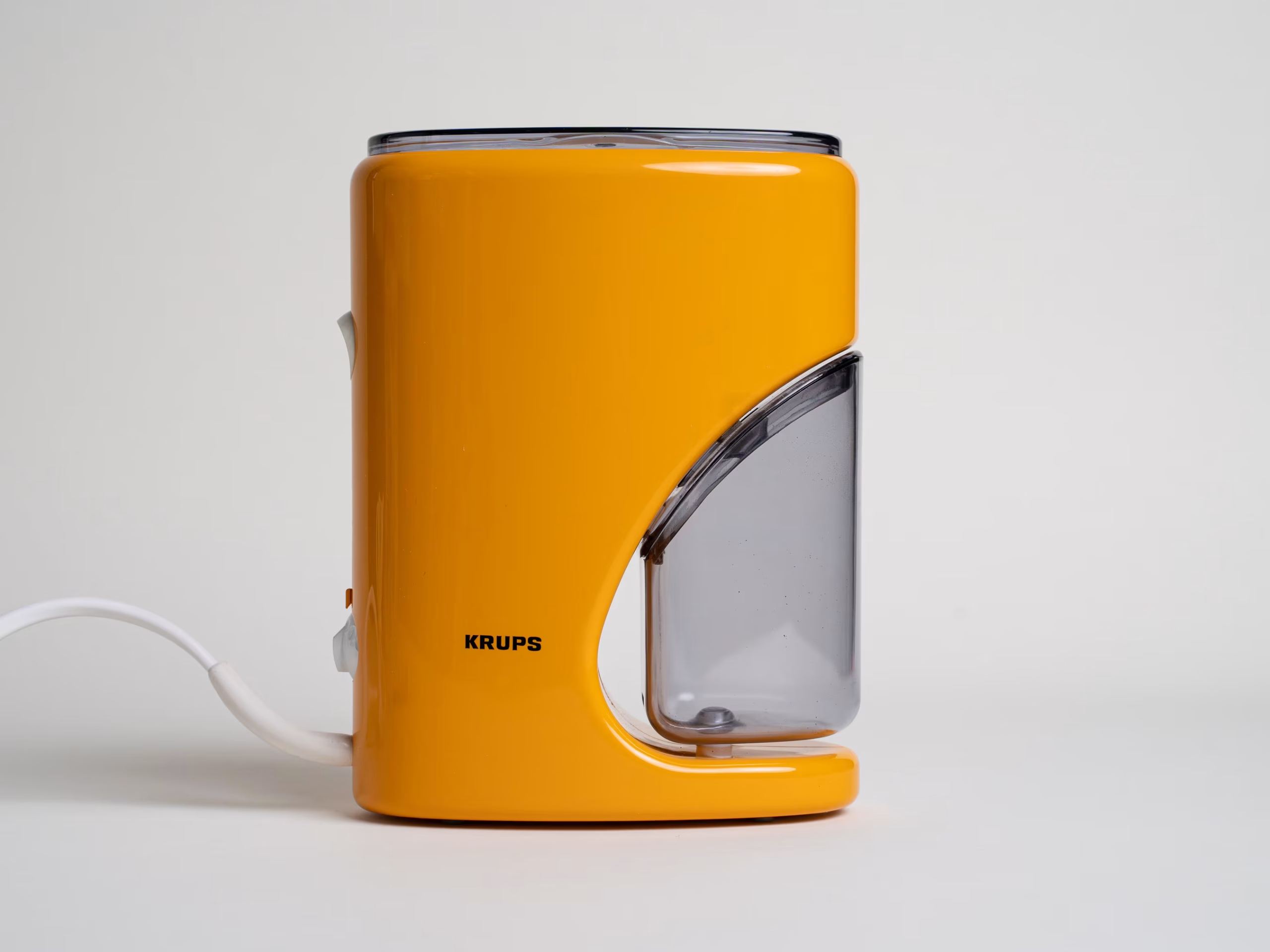
Vintage KRUPS Coffina L coffee grinder (1970s), iconic space-age orange design emblematic of the brand’s precision heritage. Credit: Etsy Vintage Seller