Now Reading: BIG carves rammed earth villas into japan’s setouchi hillside for NOT A HOTEL
- 01
BIG carves rammed earth villas into japan’s setouchi hillside for NOT A HOTEL

BIG carves rammed earth villas into japan’s setouchi hillside for NOT A HOTEL

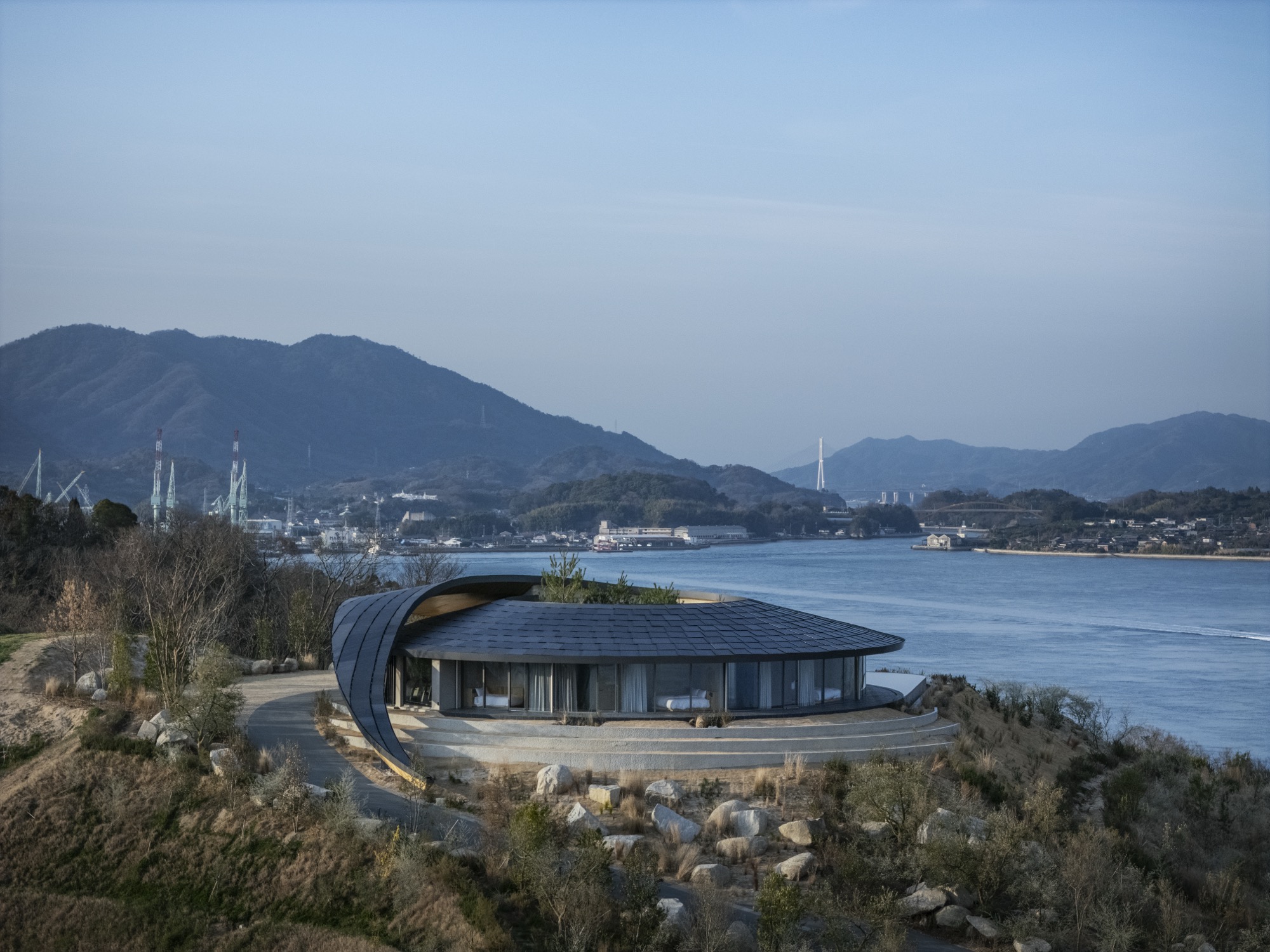
Set against the quiet expanse of the Seto Inland Sea, NOT A HOTEL Setouchi introduces a new model of hospitality that moves between landscape, architecture, and ownership. Designed by BIG on the remote island of Sagishima, the project unfolds as a series of three villas embedded into the hillside, where terrain is not a constraint but the primary generator of form. Rather than imposing a figure onto the site, the architecture traces the contours of the land, allowing the experience of movement, horizon, and topography to shape spatial organization.

This is BIG’s first completed project in Japan, and it reflects a deliberate convergence of cultural references. Scandinavian clarity meets Japanese spatial sensibility, producing an architecture that is at once open and introspective. The villas operate as inhabited viewpoints, framing the surrounding archipelago while maintaining an internal logic of enclosure and retreat. The result is a built environment that oscillates between exposure and protection, landscape and interiority.


The masterplan is guided by a careful restoration of the existing terrain. Vegetation removed during construction was reintroduced, and the site was replanted with olive trees, lemon trees, and native species. The villas are distributed along the natural elevations, aligning with existing access routes and unfolding as a continuous ribbon across the hillside.

Each villa is defined by its relationship to the horizon. The circular 360 villa occupies the highest point, offering panoramic views in all directions while enclosing a central courtyard. The 270 villa frames a wide arc of the surrounding islands, integrating outdoor spaces such as a sauna and firepit into a sequence of terraces. At the edge of the peninsula, the 180 villa follows the curvature of the coastline, where an internal garden mediates between architecture and landscape.


Materially, the project is grounded in the site itself. Load bearing walls are constructed using rammed earth made from local soil, revealing layered textures that recall geological strata. Glass façades reinterpret traditional Japanese screens, dissolving boundaries between inside and outside, while floor patterns reference tatami layouts. The architecture does not replicate tradition, but translates it into a contemporary language rooted in material presence and spatial continuity.


Internally, each villa is conceived as a unified, flowing space. Functional elements such as bathrooms and storage are contained within discrete pods, allowing the main living areas to remain open and continuous. Skylights above these volumes maintain a constant visual connection to the sky, reinforcing a balance between openness and solitude.


The architecture is defined by a series of calibrated transitions. From enclosed entry points to expansive sea views, from shaded interiors to sunlit terraces, each movement through the space is choreographed to heighten awareness of the surrounding environment. Traditional Japanese baths, outdoor firepits, and infinity pools extend the domestic realm outward, blurring the line between habitation and landscape.


Technologically, the project integrates contemporary environmental strategies. Roofs are clad in low reflective solar tiles, while operable façades and deep overhangs enable passive cooling. Rainwater collection systems support the landscape, embedding sustainability within the architectural logic rather than treating it as an add on.


NOT A HOTEL Setouchi is not simply a resort but a spatial proposition about how architecture can mediate between cultures and scales. It brings together Danish design thinking, Japanese craftsmanship, and the specificity of a singular landscape. The villas embody a set of apparent contradictions: open yet protected, traditional yet contemporary, monumental yet embedded.


In this sense, the project operates as both macrocosm and microcosm. It reflects a broader dialogue between global architectural practices while remaining deeply anchored in its immediate context. What emerges is not an object in the landscape, but a continuation of it, where architecture becomes a medium for experiencing place rather than defining it.
Project Credit
Project name: NOT A HOTEL Setouchi
Location: Sagishima, Setouchi, Japan
Design firm: BIG / @big_builds
Size: 2,350 sqm
Photo: Kenta Hasegawa / @kentahasegawa