Now Reading: Invernáculo: Madrid turns exhibition promotion into urban furniture
- 01
Invernáculo: Madrid turns exhibition promotion into urban furniture

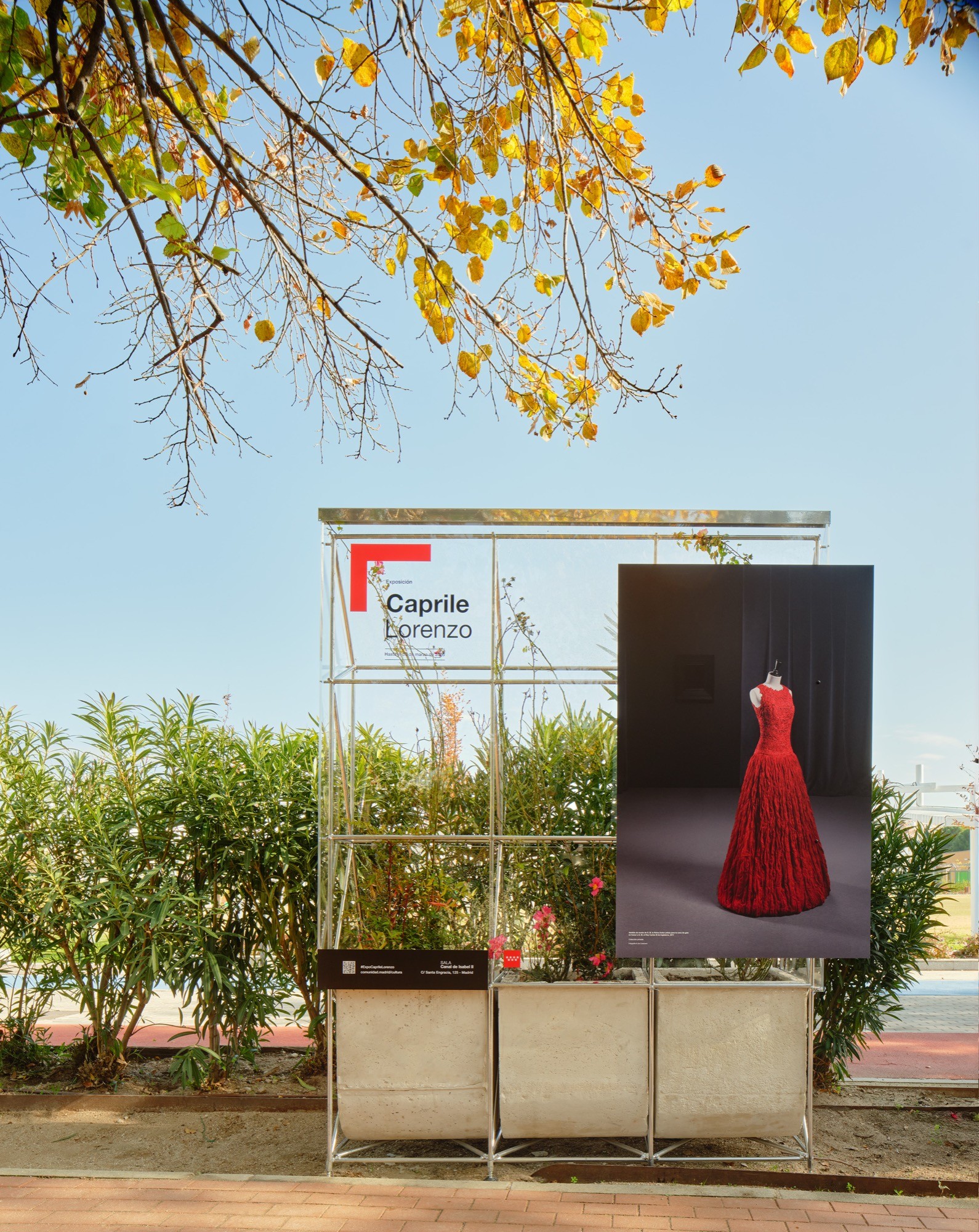

Invernáculo replaces street advertising with a transportable greenhouse that displays artist-commissioned images, turning exhibition promotion into a piece of urban furniture in Madrid.

Invernáculo is a new initiative from the Madrid Regional Government that asks a pointed question: what if cultural communication in the city stopped behaving like advertising. Developed to reach audiences beyond the usual museum circuit, the project rejects the familiar toolkit of posters, banners, MUPIs, and illuminated street media, and instead tests a different relationship between institutions and the public realm. It continues a line of research that includes earlier experiments such as Exedra and Three Landscape Essays, where the city itself becomes an interface for culture.


Rather than installing yet another surface for messaging, Invernáculo adopts the logic of urban furniture. Its core device is a compact greenhouse that supports large-format images linked to current exhibitions. Commissioned from photographers and artists, these works interpret what is being shown inside, producing an open-air parallel narrative: an exhibition about the exhibition. The result is both display and infrastructure, a piece of street-scale architecture that invites curiosity without demanding attention.


The prototype is set between the Canal de Isabel II Exhibition Hall and Madrid’s Third Reservoir Park, a context that reads as a manual for contemporary ground conditions. The park sits above one of the water reservoirs managed by Canal de Isabel II, functioning like a roof more than a landscape. It mirrors the hidden, layered city beneath our feet: parking decks, service corridors, networks, access points. Invernáculo uses this site as a calibration exercise for how such a system might perform elsewhere in Madrid.


To hold the images, the project introduces metal frames shaped by the roof condition they occupy. Their silhouette references the fencing along the rooftop of the Colegio Maravillas by Alejandro de la Sota, translating an iconic piece of Madrid modernism into a new civic apparatus. Wrapped in transparent methacrylate, these structures operate like transportable greenhouses or Wardian cases, controlled environments capable of hosting delicate plant species alongside the images.


Stability comes from below. A modular base of prefabricated concrete planters provides substrate for roots and reserves for water, while adding the mass needed to anchor the assembly. The result is a system that can be moved and re-sited without losing its architectural coherence, combining portability with the calm assurance of something meant to last longer than a campaign.
Invernáculo sits somewhere between a compact greenhouse and a museum wall stripped back to its skeleton. It resembles an architecture that never fully arrives, like a curtain wall rehearsal or the outline of a building still to be imagined. And yet it is precisely this in-between quality, part display structure, part urban fragment, that gives the project its charge: communication as a living installation, where culture is not posted onto the city, but grown into it.
Project Credit
Project name: Invernáculo
Location: Madrid, Spain
Design: Lluís Alexandre Casanovas Blanco
Completed: 2025
Photo: José Hevia