Now Reading: Housing as a climatic device in central India
- 01
Housing as a climatic device in central India

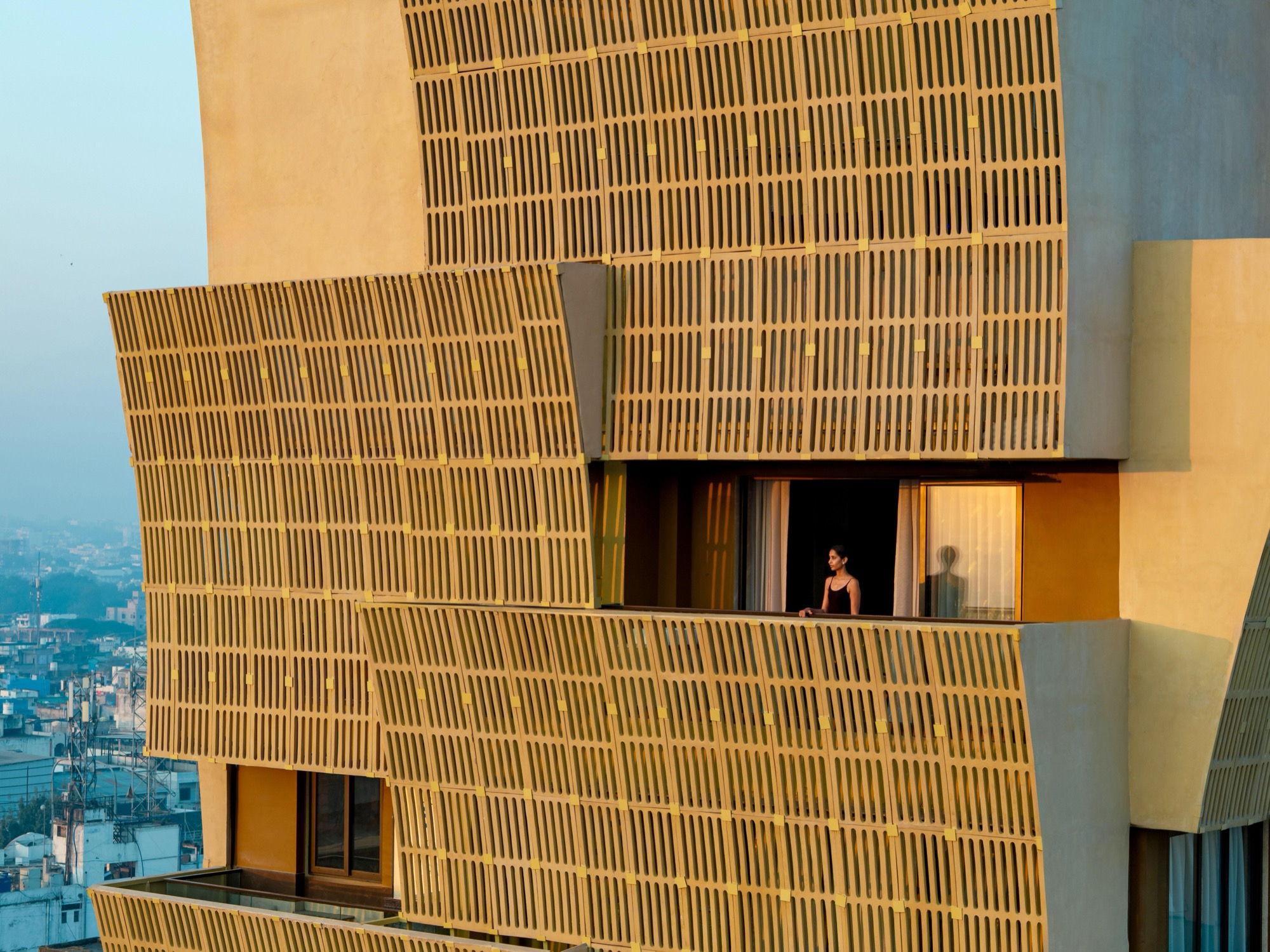

In Nagpur, a city defined by prolonged summers and extreme heat, Cielo proposes a residential architecture in which climate is not mitigated after the fact but inscribed directly into form. Designed by Sanjay Puri Architects, the twelve storey building occupies a compact urban plot and transforms regulatory limitation into a disciplined spatial and environmental strategy.

Nagpur lies close to the geographic centre of India and experiences temperatures exceeding forty degrees Celsius for much of the year. On a site of nine hundred square metres, mandatory setbacks compress the buildable footprint to just two hundred and seventy square metres per floor. Rather than pursuing density through repetition, the project adopts a singular gesture repeated vertically, establishing one dwelling per level.

A VERTICAL SEQUENCE OF SINGULAR HOMES
Each floor contains a single three bedroom apartment, ensuring privacy while allowing the plan to open fully to light and air. The bedrooms are placed at three corners of the building, with the kitchen occupying the fourth. At the centre, the living and dining spaces act as a social core, anchoring domestic life while mediating between the peripheral rooms.

This configuration allows every principal space to benefit from cross ventilation, a fundamental requirement in a climate where passive cooling remains the most effective form of comfort. The organisation is compact yet generous, prioritising environmental performance over formal excess.


THE FACADE AS ENVIRONMENTAL ARCHITECTURE
The defining architectural element of Cielo is its layered envelope. Each primary room opens onto two balconies, one fully open and the other filtered through a curved screen. These screened bays are conceived as sectional devices, functioning simultaneously as shading elements, spatial extensions, and environmental buffers.

At lower levels, the curved elements operate as vertical screens. Above, they project outward to form sheltered balconies. This alternation unfolds both horizontally and vertically across the façade, producing a shifting rhythm that dissolves the perception of a monolithic tower. The building reads as a field of inhabitable layers rather than a singular mass.

These screens recall the long tradition of architectural filters in the region, where perforated and shaded interfaces have shaped domestic architecture since the seventeenth century. Here, that lineage is neither literal nor nostalgic. It is reinterpreted through contemporary geometry, transforming historical climatic intelligence into a distinctly modern architectural language.

FORM SHAPED BY CLIMATE
Beyond their sculptural presence, the curved screens perform a critical environmental role. By limiting direct solar exposure, they reduce heat gain while maintaining visual openness and usable outdoor space. The façade becomes a mediating surface, negotiating between interior comfort and the intensity of the external environment.
This passive strategy is reinforced through integrated sustainability measures. A fully solarised roof, along with water harvesting and recycling systems, contributes to lowering the building’s operational and lifecycle carbon footprint. Together, these interventions reduce dependence on mechanical cooling and embed environmental responsibility within the architectural logic itself.

ARCHITECTURE WITHOUT SPECTACLE
Cielo does not seek to dominate the skyline through scale or iconography. Its presence emerges through restraint, precision, and repetition. The building’s identity is shaped by how it responds to climate, regulation, and daily use rather than by formal novelty alone.


In this sense, Cielo offers a model for contemporary urban housing in extreme climates, where architecture operates as an environmental device and spatial discipline becomes a form of sustainability. The project demonstrates how domestic architecture can remain expressive while remaining grounded in necessity, performance, and lived experience.


Project Credit
Project name: Cielo
Location: Nagpur, Maharashtra, India
Completed: January 2026
Design firm: Sanjay Puri Architects / @sanjay_puri_architects
Photo: Vinay Panjwani / @panjwani.vinay