Now Reading: A museum that rewrites Groeninge Abbey for the city
- 01
A museum that rewrites Groeninge Abbey for the city

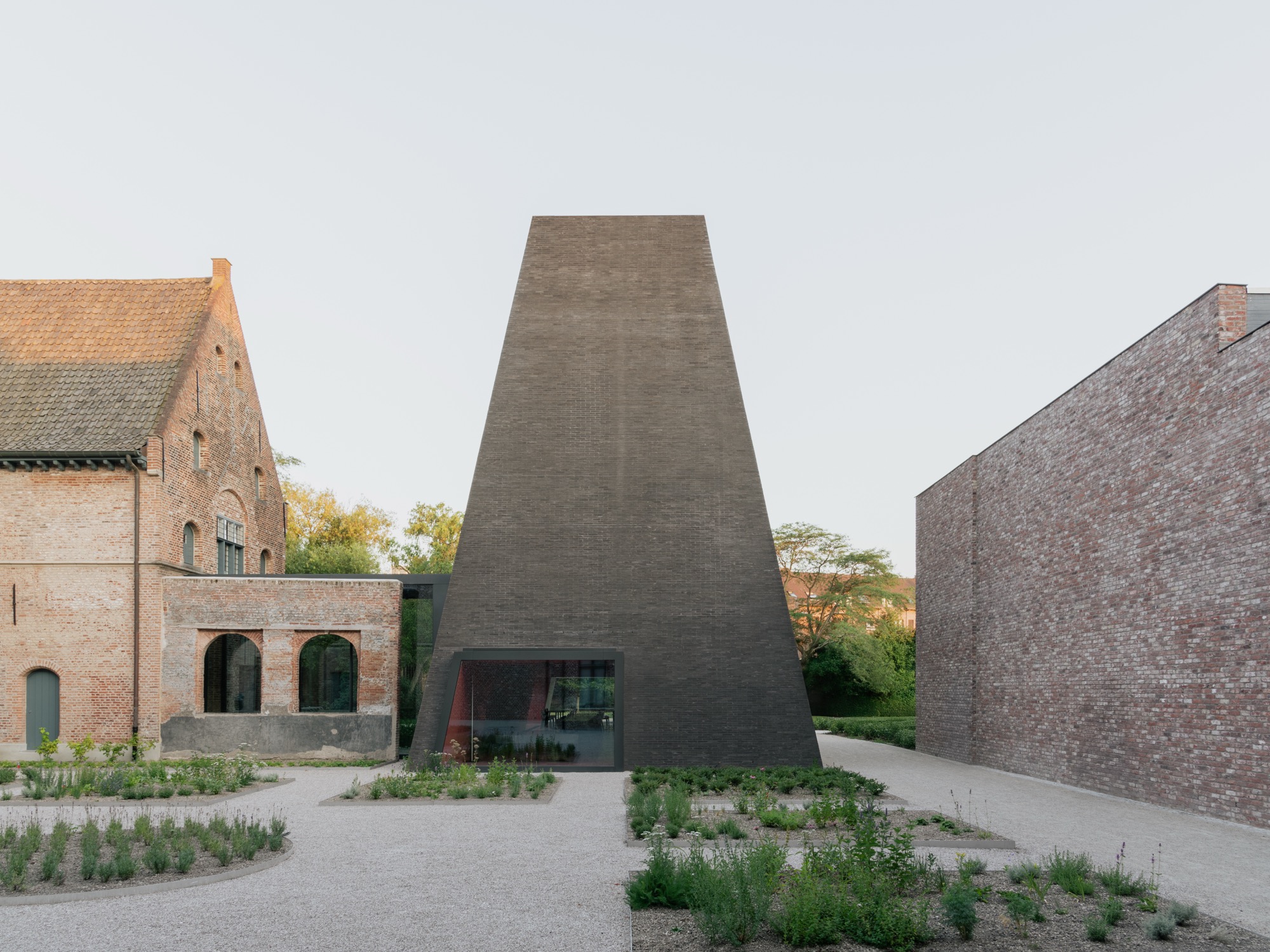

Abby Kortrijk extends and transforms the historically significant complex of Groeninge Abbey into an arts space for site specific temporary exhibitions and public events. Conceived as a new kind of museum, it positions itself as a place for everyone, open and versatile, and acts as an urban living space set within Begijnhof Park in the centre of Kortrijk.
The design develops a broad interpretation of identity, balancing persistence, restoration, and transformation to rediscover a renewed character for the ensemble, deeply rooted in what already exists. Rather than treating the abbey as a closed monument, the project clarifies its original structure and repositions it as a civic threshold, where culture can be encountered as part of everyday movement through the city.

From an urban design perspective, the intervention removes elements that were not part of the original abbey layout. This clearing makes the historic composition legible again, reinstates the former courtyard, and redefines the cloister as a spatial hinge. A passage is created from Groeningestraat to the public garden, allowing the once inward facing complex to open toward the park and operate as a public route as well as a destination.

A SEQUENCE OF ROOMS FROM CHAPEL TO PAVILION TO PARLOUR
The proposal reveals the beautiful spatiality of the original structure of the abbey chapel and dormitories, treating the ensemble as a series of distinct yet connected rooms, each with its own atmosphere. The abbey becomes an art house where visitors experience art throughout its spaces. From the dormitory to the pavilion, one can encounter exhibits without needing a ticket, while the sequence continues upward to the parlour above the dormitory, adjacent to the former chapel.


Minimal interventions were made to the former dormitory building, restoring the original windows, ceiling, and red terracotta floor. A long display case was added to showcase works from the city of Kortrijk, inviting artists to engage with the collection and bringing a civic layer to the experience of the building.
The new park pavilion establishes a direct dialogue with the historic structures. Although the main exhibition expansion sits below ground, the pavilion’s distinctive presence gives the renewed ensemble a contemporary address in Begijnhof Park. Positioned orthogonally to the existing composition and peeking out toward the landscape, its form evokes the verticality of the abbey’s sloping roofs while its orthogonal logic reads as a clear continuation of the site’s urban composition, one more pavilion in a longer architectural history.

Connected to the complex through the former dormitory building, the pavilion houses a bar and restaurant. Its inclined facades create a welcoming, sheltered atmosphere while maximizing the interior. A long table can be arranged here, referencing the communal refectory of an abbey and translating monastic collectivity into a contemporary public ritual. Covered in dark coloured brick, the new building reads as an independent element within the historical complex, clearly recognizable in dialogue with the existing architecture.


UNDERGROUND WHITE BOXES AND A RESTORED VERTICAL CHAPEL
The former chapel, among the oldest elements of the composition, is returned to its original grandeur through subtraction rather than addition. By removing attached corridors and mezzanines, the project reinstates the chapel’s full spatial height. Without intermediate floors, the sixteenth century building regains its original atmosphere and becomes a new vertical space for exhibitions within the ensemble.


To avoid overburdening the park and to give the existing buildings breathing space, the project introduces an underground expansion for exhibition areas. Below the complex, neutral, state of the art museum quality rooms provide a flexible canvas for temporary exhibitions. These white boxes complement the historical richness of the chapel, dormitory, and pavilion above, allowing contemporary art to shift between charged historic interiors and controlled, adaptable gallery conditions.

The sequence of spaces is diverse yet cohesive, functional and internally logical, moving from the restored courtyard and dormitory to the pavilion’s social interior, from the chapel’s vertical volume to the subterranean galleries below. The original facades were restored with respect for their original drawing, reinforcing continuity across the ensemble.
For the new element, material research strengthens its civic presence. The pavilion’s facade features custom made bricks produced from recycled construction components, forming a monumental and expressive surface that anchors the new pavilion within the historical complex and reinforces its role in the urban fabric.


Across the project, the new architecture remains restrained and reasoned, defined by subtle, well considered interventions that balance the new with the existing. In doing so, Abby Kortrijk enhances the layered history of Groeninge Abbey while providing new spaces for art, public life, and the future of the site.
Project Credit
Project name: Abby Kortrijk
Location: Kortrijk, Belgium
Year: 2020 – 2025
Client: Stad Kortrijk
Architects: Barozzi Veiga / @barozziveiga; Tab Architects / @tab______architects
Gross floor area: 4037 m2
Photo: Simone Marcolin
More Photos