Now Reading: Barozzi Veiga builds a pair of Artists’ Ateliers for London’s Design District
- 01
Barozzi Veiga builds a pair of Artists’ Ateliers for London’s Design District

Barozzi Veiga builds a pair of Artists’ Ateliers for London’s Design District

A mirrored gateway and a blackened counterpart anchor Greenwich Peninsula’s Design District, turning the archetype of the artist studio into a flexible, light driven workplace for a new creative neighbourhood.

On the Greenwich Peninsula, the Design District occupies a one hectare riverside site conceived as an affordable base for creative businesses to trade, meet, and grow. Sixteen new buildings form a deliberately eclectic neighbourhood devoted to design, art, technology, craft, and music. Eight emerging practices from across Europe were each assigned a pair of buildings and asked to design without knowing what the others were drawing. The brief, by intention, produced a streetscape that refuses a single architectural language, favouring provocation over harmony, colour and form over quiet consensus.

Within this undefined context, where familiar urban cues are limited and the future character of the district is still being written, Barozzi Veiga respond with two pragmatic structures that lean into clarity. The practice treats the project as a pair of industrial containers, robust in concept, economical in construction, and generous in what they can become over time.


Artists’ Ateliers is built around a simple idea: maximise interior flexibility and let light do the heavy lifting. Rather than chasing a signature silhouette, the buildings explore basic construction systems and an intentionally raw material presence, using the imagery of the working studio as both reference and promise. Large windows draw daylight deep into the plan. Double height rooms open the volume upward, making space for mess, scale, and experimentation. The architecture is direct, almost tool like, designed to adapt to shifting tenants, changing disciplines, and the unpredictable rhythms of creative production.

The project’s identity is expressed through a pair of volumes, chromatically opposed yet composed as one. Barozzi Veiga treat A1 and D4 as two moments along a path through the district, distinct enough to register as separate events, but clearly stemming from a unitary design logic. Their relationship is less about symmetry than dialogue: a calibrated contrast that gives the neighbourhood two anchors, one at the threshold, one at the square.

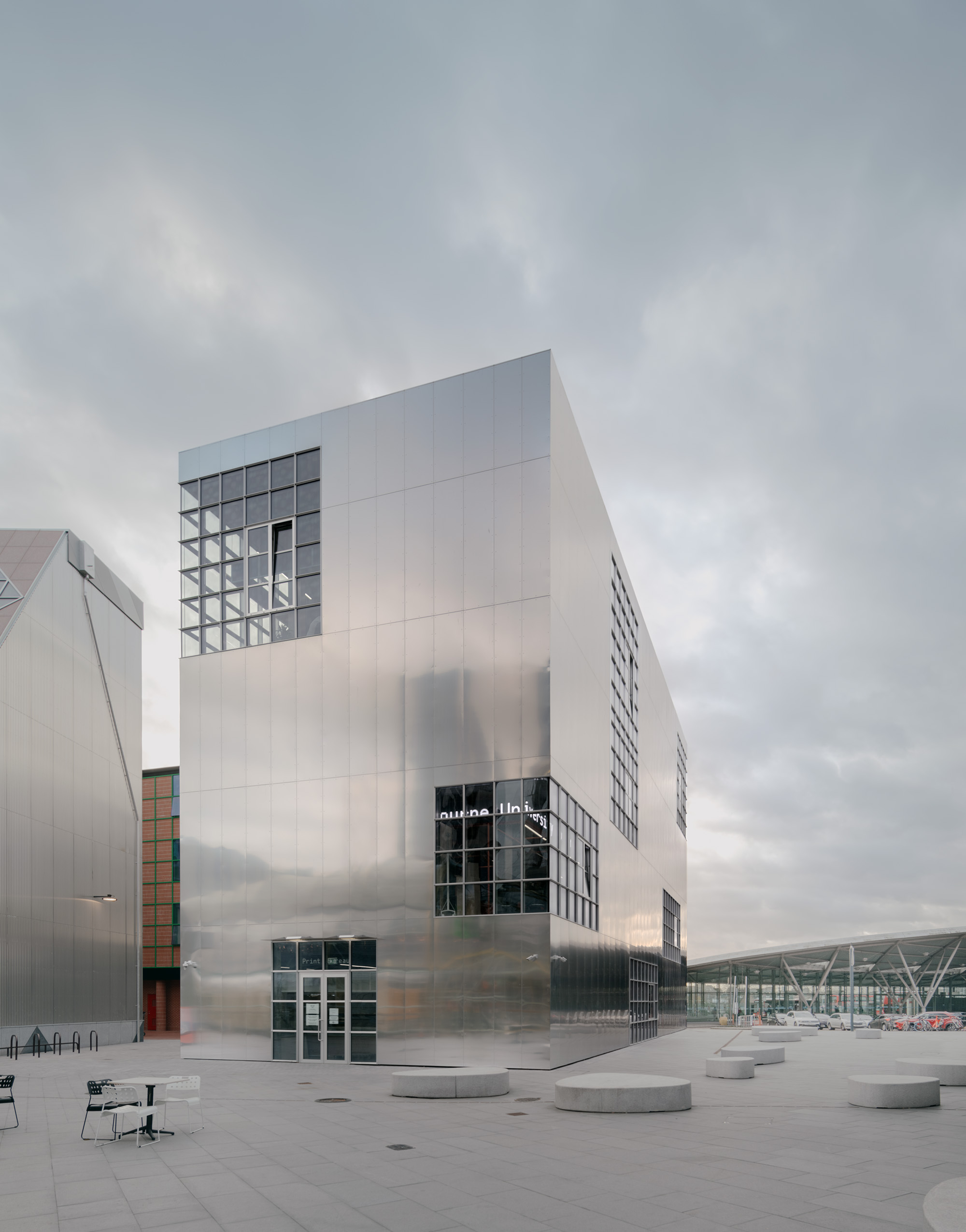
A1, positioned at the entrance, wears a mirror polished skin that reads as both invitation and signal. It catches movement, sky, and the district’s shifting palette, pulling visitors in by reflecting them back. D4, by contrast, is slim and black, a quieter presence that aligns itself with the social energy of the central square. Together, they form a paired composition that punctuates the site with two different kinds of attention, the first immediate and luminous, the second precise and grounded.
The reflective materiality is not a flourish, it is a method of belonging. In a setting where the broader urban context is still evolving, the mirror finish allows the building to dissolve into what surrounds it, even as that surround is incomplete. Light and colour become the project’s changing façade, shifting with the day, the weather, and the seasons. The ateliers participate in the life of the Design District by absorbing its atmosphere, turning the neighbourhood into a constantly updated surface.


This temporal quality also reframes the idea of permanence. Rather than asserting a fixed identity, the buildings remain porous to their environment, registering its transformations, its crowds, its events, and its everyday use. The effect is both theatrical and practical: a recognisable landmark that still feels open to the future.


As a whole, Artists’ Ateliers echoes the industrial history of the area without slipping into nostalgia. The container like logic, the straightforward construction language, and the controlled rawness of the spaces gesture toward an inherited working landscape. At the same time, the project nods to twentieth century references, not as quotation but as atmosphere, where iconic industrial and modern precedents hover in the background as familiar ghosts.

What emerges is an abstract backdrop for the urban life of the Design District, a pair of buildings that do not compete for attention through complexity, but through presence, proportion, and the choreography of light. Barozzi Veiga’s contribution is a reminder that in a neighbourhood built on difference, the most resonant architecture can be the one that stays legible, adaptable, and quietly charged with possibility.
Project Credit
Project name: Artists’ Ateliers London
Location: Greenwich Peninsula, London, England
Principal Architects: BAROZZI VEIGA / @barozziveiga
Photo: Simon Menges
More Photos