
Now Reading: The forgotten fortresses: Walled houses of the Hakka people in Jiangxi
- 01
The forgotten fortresses: Walled houses of the Hakka people in Jiangxi


BEYOND THE TULOU IMAGE
China, in the mountainous south of Jiangxi, architecture often declares itself through enclosure rather than silhouette. A thick, continuous wall emerges at the edge of terraced fields; a single gate punctures the perimeter. Cross that threshold and the world turns inward. Courtyards unfold in sequence, corridors bind rooms into a disciplined grid, and an ancestral hall anchors the plan at its deepest point. What appears from outside as a defensive shell reveals itself inside as a complete social organism, capable of housing an extended clan, storing grain, sustaining ritual life, and, historically, surviving periods when safety could not be assumed.

These are the weiwu (围屋), Hakka walled or enclosed houses concentrated in the Gan’nan region of southern Jiangxi. Long overshadowed internationally by Fujian’s circular tulou, weiwu represent a broader and more adaptable tradition of enclosed living. Official reporting notes that Longnan alone contains 376 Hakka walled complexes, accounting for more than seventy percent of those preserved in southern Jiangxi, and describes their internal composition as halls, storehouses, living quarters, and internal squares within a single fortified boundary.¹

This article reads Jiangxi’s weiwu as a major vernacular tradition in their own right. Rather than treating them as peripheral variants of tulou, it examines them as a coherent architectural response to migration, frontier insecurity, lineage organisation, and environmental constraint. Through historical context, spatial and material analysis, and a focused study of Guanxi Xinwei, it situates weiwu within contemporary debates on vernacular resilience and heritage preservation.
HISTORICAL BACKGROUND: MIGRATION AND FRONTIER CONDITIONS
The Hakka are widely understood as Han Chinese communities shaped by successive southward migrations. From the fourth century onward, warfare, political upheaval, and ecological stress displaced populations from northern and central China into the mountainous regions of Jiangxi, Guangdong, and Fujian. In Gan’nan, migrants encountered a landscape that offered refuge yet little stability: arable land was limited, valleys were narrow, and circulation routes that enabled trade and movement also enabled banditry and periodic violence. Competition over land and water was common, and inter-clan conflict was not exceptional.
In such conditions, architecture became an instrument of collective survival. Dispersed courtyard houses offered limited protection. Weiwu consolidated risk by enclosing entire lineages within a single defensive perimeter. The wall did not merely exclude danger; it reorganised life. It distributed responsibility, made defence a communal undertaking, and concentrated resources such as grain stores, water access, and ritual space within an interior commons.
By the Qing period, as some Hakka communities achieved greater economic stability, weiwu evolved from urgent fortifications into mature compounds. Defensive features remained, but they were absorbed into a more ordered spatial grammar. Hierarchy and ritual became more explicit, and the compound increasingly expressed lineage continuity as much as insecurity. The resulting architecture carries both conditions at once: frontier pragmatism and settled social form.
WEIWU AND TULOU: TYPOLOGICAL DIFFERENCE AND REGIONAL ADAPTATION
Global perceptions of Hakka architecture have been shaped disproportionately by Fujian’s tulou. Monumental in scale, immediately legible in form, and supported by institutional heritage frameworks, they have come to stand in for Hakka architecture as a whole. Their visibility can imply a single Hakka architectural identity, when in fact Hakka building culture varies markedly by region. In southern Jiangxi, weiwu are central to the historical settlement pattern.
Typologically, Weiwu tend toward rectilinear enclosures. Square, rectangular, and at times irregular in plan, they are well adapted to valley topography and to patterns of incremental expansion over generations. Their plans are typically axial and grid-based, organising circulation through corridors and successive courtyards. This contrasts with the radial organisation common in many tulou, where domestic units wrap around a single central void.

Spatial-configuration research helps clarify what is at stake. Studies comparing Hakka dwelling types describe grid-like forms as more decentralised and modular, allowing finer gradations of privacy and control than ring-based types. While much of this literature focuses on weilong houses rather than weiwu, the implication remains relevant: Hakka domestic architecture cannot be reduced to a single circular model. In Gan’nan, enclosure functions less as an emblem and more as a system that calibrates movement, access, visibility, and hierarchy. ⁴
SPATIAL ORGANISATION: SEQUENCE, AXIS, AND MICRO-CLIMATE
The spatial logic of a weiwu is best understood as sequence. The main gate establishes a hard transition from exterior uncertainty to interior order. Typically recessed and thickened, it operates simultaneously as threshold and filter. From this point, circulation commonly aligns with a central axis that draws inward toward the ancestral hall.
Courtyards modulate this progression. They introduce daylight into deep plans, support cross-ventilation, and create thermal relief in humid conditions. Corridors connect rooms into a continuous network, enabling movement without exposure to the perimeter. In ordinary time, this network supports efficiency and daily sociability; in crisis, it enables coordinated circulation and internal surveillance.

Hierarchy is embedded in depth and adjacency. Spaces nearest the ancestral hall carry greater ritual weight and social authority; peripheral rooms tilt toward domestic privacy. Yet enclosure also produces a shared condition: inhabitants rely on common circulation routes, shared water sources, and a collective defensive envelope. In this sense, the compound is not merely a large house but a micro-settlement that internalises civic order within its walls.
STRUCTURE AND DEFENCE: CONTROLLED PERMEABILITY
Defence in weiwu is not confined to wall thickness. It is embedded in control of permeability. Perimeter walls are typically high and thick, reinforced at corners to extend sightlines along exterior faces and reduce blind zones. Entry points are limited and heavily constructed. Inside, circulation can be monitored and, in some compounds, segmented by doors and thresholds that allow the interior to tighten in response to threat.
Heritage documentation describes additional measures that reinforce autonomy: hidden wells, surrounding ditches, and roof-level lookout points, indicating that some compounds were designed to withstand extended periods of isolation. In such cases, defence and self-sufficiency are conceived together, producing an architecture capable of functioning as an independent unit under stress. ⁵
MATERIALS AND CONSTRUCTION: ENGINEERED EARTH
Weiwu are closely associated with rammed earth, but official heritage records reveal a highly engineered material culture. The national intangible cultural heritage entry on Gan’nan Hakka weiwu building craft describes the use of sanhe tu (三合土), a composite earth mixture combining lime, clay, and sand or gravel, sometimes reinforced with pebbles. It also records the use of organic additives, including glutinous rice, egg white, and brown sugar, in specified proportions to improve strength and moisture resistance, as well as fermentation processes to reduce cracking and improve cohesion.⁵
Composite wall systems were common. Brick or stone outer layers protected earthen cores (often described as “gold wrapping silver”), balancing durability with material economy. Timber framing carried floors and roofs; carpentry and ornament concentrated around halls and ceremonial zones, where craft and symbolism converge.
This construction logic assumes maintenance. Earthen walls endure for centuries only with periodic care: roof integrity is critical, drainage must be managed, and re-compaction may be necessary where erosion begins. Historically, such labour was communal. In contemporary Longnan, it is increasingly professionalised, with skilled artisans restoring walls and timber using compatible techniques rather than generic modern patches.²
FUNCTIONS: DOMESTICITY, RITUAL, AND ECONOMIC LIFE
Within a single enclosure, weiwu integrate multiple functions. Residential rooms house extended families. The ancestral hall supports ritual, education, and governance. Storehouses protect grain reserves and valuables. Courtyards serve as everyday commons and ceremonial stages. Some compounds include internal squares or open grounds, reinforcing their quasi-civic character.
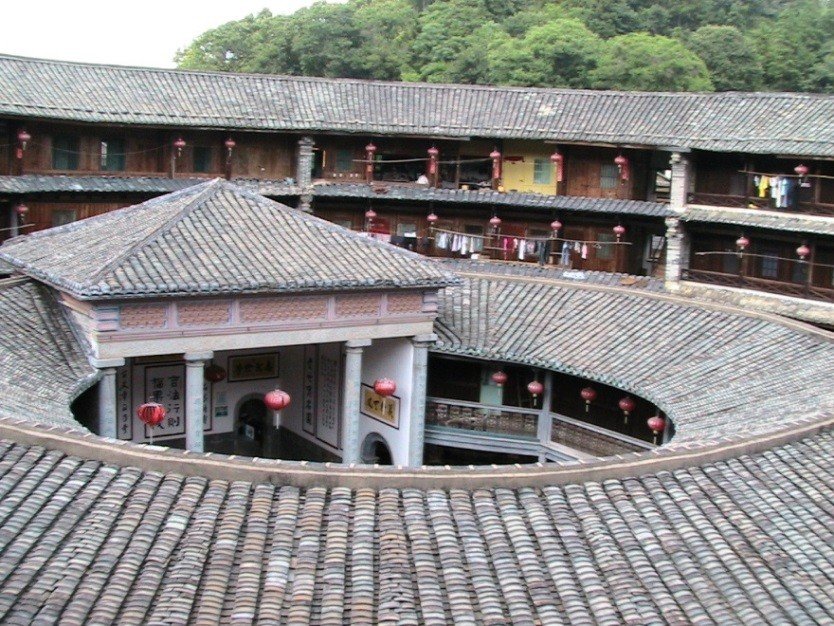
Heritage descriptions frame weiwu as a synthesis of residence, fortress, ancestral hall, meeting place, and central square, encompassing “different scenes of human life.”⁵ This multifunctionality is not incidental; it is enabled by the defensive perimeter, which creates a secure interior commons where social, economic, and ritual life can overlap.
CASE STUDY: GUANXI XINWEI
Guanxi Xinwei is widely cited as a representative masterpiece of Jiangxi’s weiwu tradition. Construction began in 1798 and continued for nearly three decades. Published accounts describe a total area of approximately 7,426 square metres, an internal organisation of eighteen halls, and a large number of subsidiary rooms.⁷ Its rectilinear perimeter is marked by four corner turrets that command views of the surrounding valley.
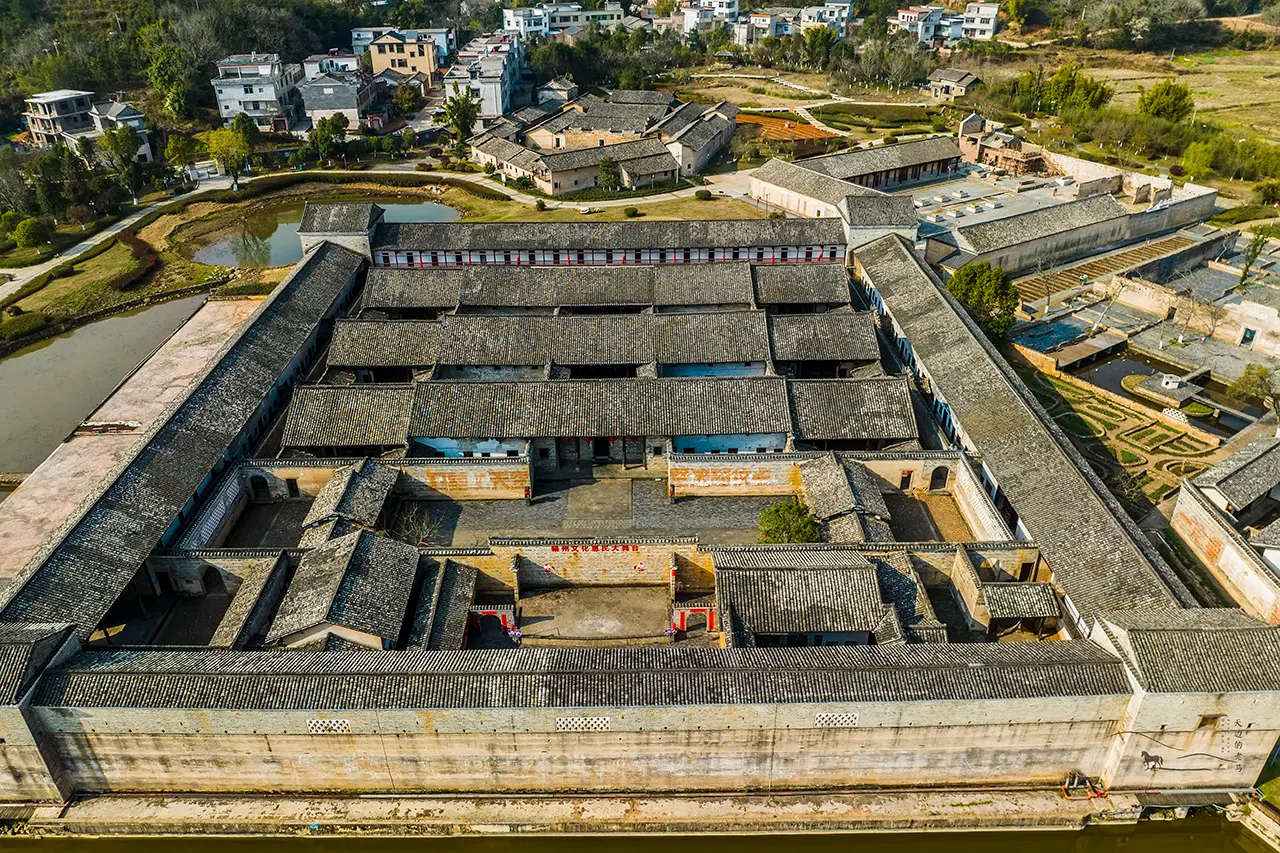
As a plan, Guanxi Xinwei demonstrates typological maturity. A central axis links gate and ancestral hall; residential wings align symmetrically; corridors connect all sectors to enable efficient circulation and coordinated defence. Wells and storage rooms reinforce autonomy. Orientation follows geomantic principles, aligning the compound with surrounding landforms.


The interior reads as a social machine. Movement inward corresponds to increased formality; halls operate as nodes for gathering, deliberation, and ceremony. Defence is expressed not only in the perimeter wall but in the spatial organisation of visibility and access, balancing hierarchy with collective coordination.


HERITAGE SIGNIFICANCE AND PRESERVATION
Jiangxi’s weiwu are significant as architectural records of migration, settlement, and adaptation. They preserve an empirically refined earthen material culture. They encode lineage relations spatially. They demonstrate how a vernacular architecture can internalise civic life under conditions of insecurity.
Their preservation, however, is uncertain. Depopulation reduces routine maintenance. Climate volatility, particularly intensified rainfall, accelerates erosion and increases the structural vulnerability of earthen walls. Tourism introduces both resources and risk: it can fund repair and increase visibility, but it can also push interventions that prioritise visitor convenience over typological integrity.
Contemporary reporting on restoration in southern Jiangxi foregrounds the labour-intensive nature of repair and the role of skilled craftspeople, framing conservation as continuous practice rather than one-time project.² At the same time, tourism narratives increasingly position major compounds as destinations, drawing visitors into interior courts and halls.¹
Sustainable preservation depends on balancing three priorities. First, maintain the perimeter logic: controlled permeability is a core architectural meaning, not a disposable constraint. Second, preserve internal hierarchy and circulation: the axial sequence, courtyard gradations, and corridor network are what make a weiwu legible as a social system. Third, ensure material compatibility in repair: heritage records are clear that historical earthen construction relies on specific mixes and processes, not generic “mud” substitutions.⁵ When these conditions are respected, adaptive reuse can extend the life of weiwu without erasing their architectural intelligence, whether through cultural programming, community functions, or carefully limited forms of hospitality..
Jiangxi’s Hakka weiwu are not minor regional curiosities. They are a dominant and sophisticated settlement form shaped by migration, frontier insecurity, lineage organisation, and environmental intelligence. Their architecture integrates defence and domesticity, ritual hierarchy and communal obligation, material precision and spatial clarity.
To take weiwu seriously is to expand Hakka architecture beyond a single iconic image and to recognise vernacular building as both social contract and engineered system. As conservation accelerates, the critical task will be not only to stabilise walls, but to preserve the spatial logic and material knowledge that made these enclosed communities viable and meaningful in the first place.
REFERENCE
- “Hakka walled complex in China’s Jiangxi attracts tourists,” Xinhua, 2025.
- Zhao Ruinan, “On a mission to restore old Hakka houses,” China Daily, 2025.
- “Discovery | Ganzhou: Cradle of Hakka Culture,” Women of China, 2024.
- Hu, L., and Yang, T., “Landed and Rooted: A Comparative Study of Traditional Hakka Dwellings,” Buildings, 2024.
- “客家民居营造技艺(赣南客家围屋营造技艺)” National Intangible Cultural Heritage Database, PRC.
- “赣南客家围屋营造技艺” Longnan Municipal Government cultural heritage page.
- Chen Liang, “Home with the Hakkas,” China Daily / Chinaculture, 2008.
Photo Cover
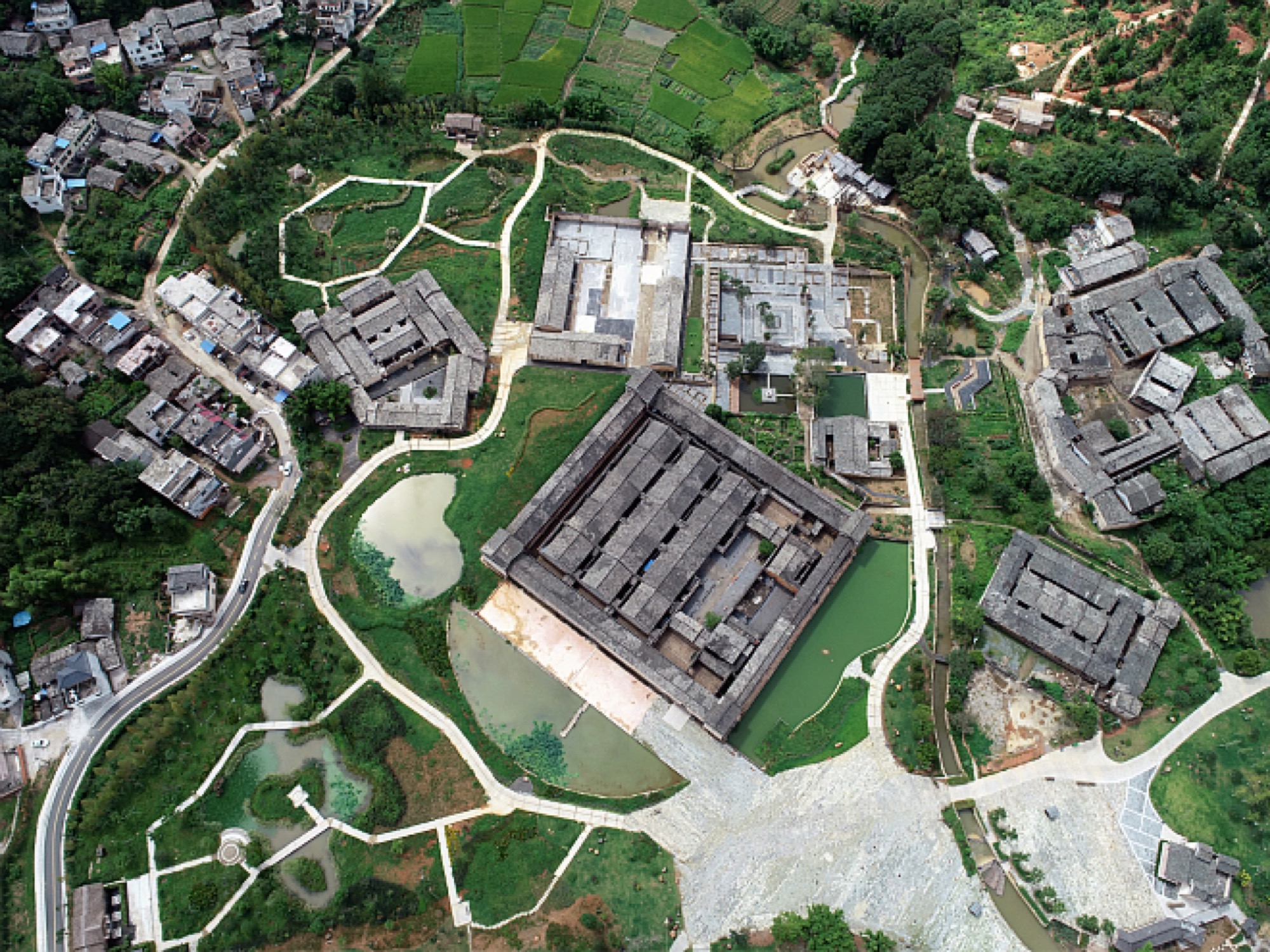
Panoramic view of a Hakka walled complex in Longnan, Jiangxi, in its mountainous frontier setting. Credit: China Story