
Now Reading: Veldstation: A research outpost designed as habitat
- 01
Veldstation: A research outpost designed as habitat


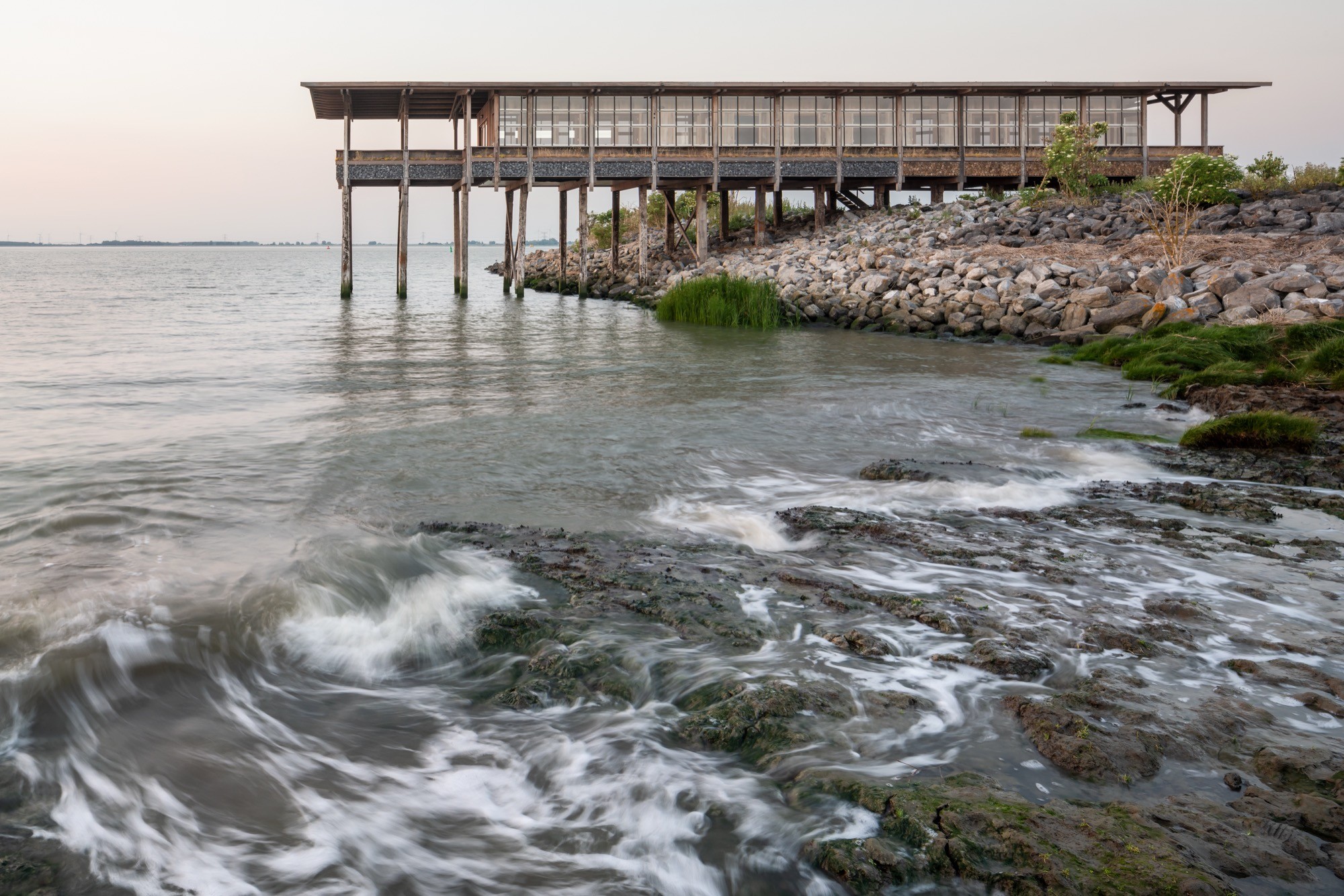
At the edge of Het Verdronken Land van Saeftinghe, where the former Hedwigepolder meets the shifting rhythms of the Western Scheldt, the Veldstation emerges as a small building with an unusually large ambition. It is not only a base for nature research and conservation, but also a constructed refuge for wildlife in a landscape that offers little protection from wind, salt, and open water.

Set on the gas plateau with its base reaching into the estuary, the Veldstation supports fieldwork that runs round the clock during the spring season, when ecological activity intensifies and observation cannot pause for nightfall. At the same time, it welcomes visiting groups, expanding its role beyond science into environmental education, where the experience of the site becomes part of the lesson.

The project begins with a simple gesture: a clear, compact volume that concentrates human activity into a central core. Around that core, the building thickens into a working shell, turning the spaces between structure and enclosure into a gradient of micro habitats. Rather than treating nature as scenery outside the walls, the Veldstation assumes that architecture can participate in the ecosystem, offering shelter, nesting, and surfaces designed for life to take hold.

In this exposed territory, where the horizon feels close and weather is always present, the building reads less like an object and more like an intervention. It does not compete with the landscape. It inserts itself quietly, accepting that the site will define the building’s character over time through growth, occupation, and seasonal change.


Sustainability here is not performed through high tech symbolism, but through material decisions that stay close to the ground imagining construction as a continuation of local processes. The Veldstation relies predominantly on reused, second life, and organic components, with wood reintroduced into a new cycle, and natural assemblies shaped from straw, flax, and clay shells. The result is a structure that aims to minimise environmental impact not only in operation, but in what it is made of and how it weathers.
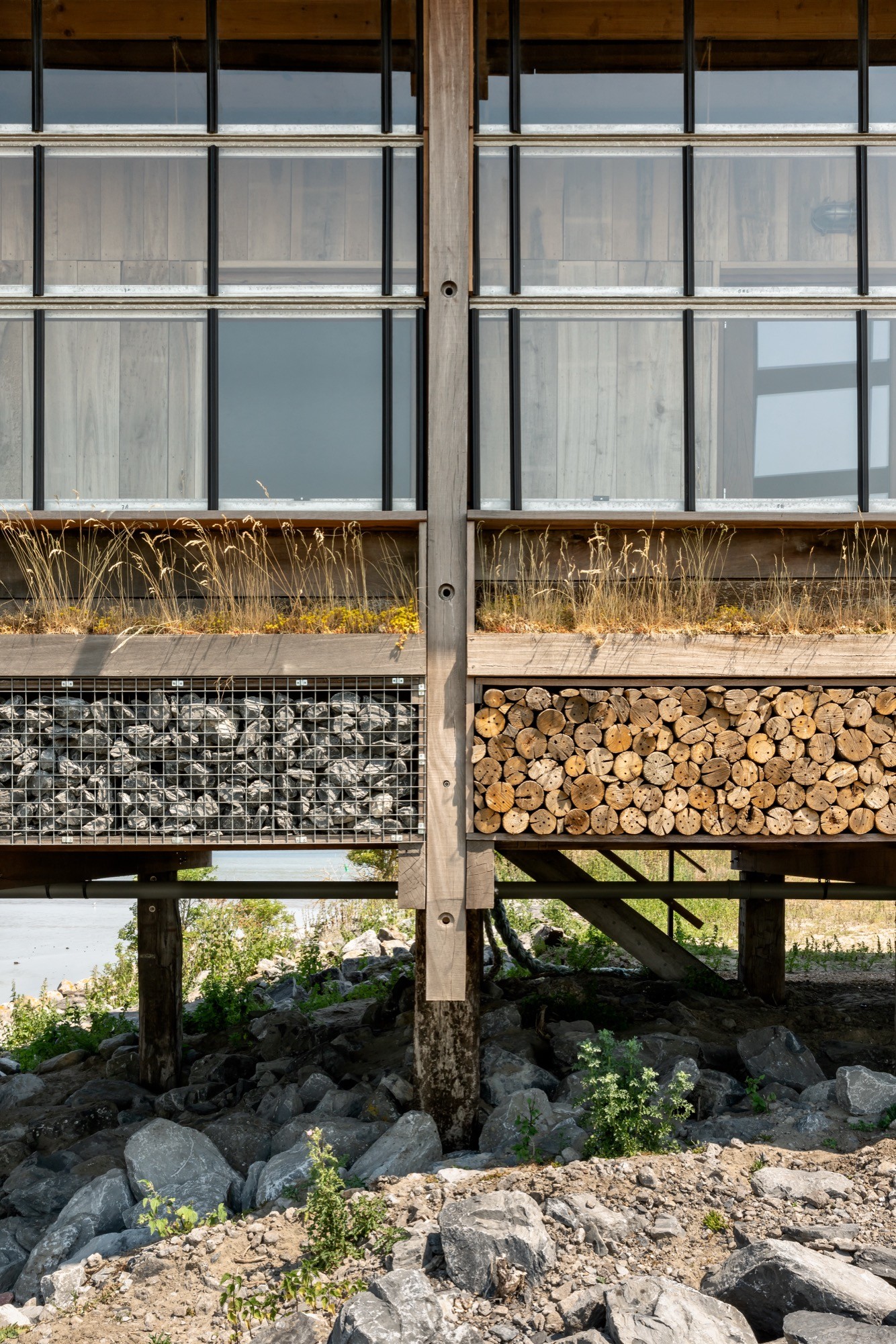
The facade becomes a living interface rather than a sealed skin. Sand, shells, and stones are embedded to create texture, crevices, and thermal variation, extending opportunities for insects and birds to occupy the building as they would a bank, a dune edge, or a fragment of eroded ground. This is architecture that anticipates inhabitance beyond the human, treating biodiversity as a design brief, not a side effect.
If the walls offer the detail, the roof offers the promise. Conceived as a safe upper ground, it becomes a nesting territory for waders and gulls, species that depend on quiet, elevated zones where disturbance is limited and sightlines are long. In a region shaped by water management, land reclamation, and shifting ecological boundaries, the roof reads as a deliberate addition to the available habitat, a new surface returned to the non human world.

This move also reframes what a research station can be. Instead of isolating scientists from the field, it places the building inside the very web it seeks to study, allowing observation to take place alongside coexistence. The Veldstation does not simply support conservation through knowledge. It supports conservation through space.


The Veldstation suggests an alternative model for sustainable architecture in fragile landscapes. It is a building that hosts people without pushing nature away, and a piece of ecological design that understands how small changes in surface, thickness, and material can produce real opportunities for life. It also makes a broader argument: that conservation infrastructure can be quietly generous, offering comfort to researchers and visitors while materially investing in the species that already define the place.
In a time when environmental projects are often reduced to labels and metrics, the Veldstation stands out for its clarity. It is direct in form, careful in construction, and radical in empathy. A research outpost, an education space, and a sanctuary, built not beside nature, but as part of it.


Project Credit
Name: Veldstation Groot Saeftinghe
Location: Netherlands, Land van Saeftinghe
Design: RO&AD architecten / @roadarchitecten
Completed: 2024
Photo: Katja Effting, Merijn Koelink