
Now Reading: Moses bridge at Fort de Roovere: An invisible cut through water and history
- 01
Moses bridge at Fort de Roovere: An invisible cut through water and history


In the flat, water shaped landscapes of the Netherlands, defence has long been designed as much with geography as with walls. The West Brabant Water Line is one of the clearest examples: a strategic system of fortresses, towns, and controlled inundation zones that once turned the countryside itself into an instrument of protection. Conceived in the seventeenth century, the line helped secure the southwest borders of the Dutch Republic, then gradually lost its military relevance as technology and geopolitics shifted. By the nineteenth century, many of its components had slipped into disrepair, becoming fragments of a larger story that remained legible mainly to historians and locals.
Today, that story is being reactivated through restoration and public access. Around Fort de Roovere, a renewed landscape invites visitors into the site not as a museum set piece, but as lived terrain. Cycling and hiking routes stitch the fort back into the region, allowing the defensive line to be read at walking speed, through the rhythms of soil, water, and vegetation. The aim is not to erase the past, but to make it present again, while keeping the fort’s character intact.


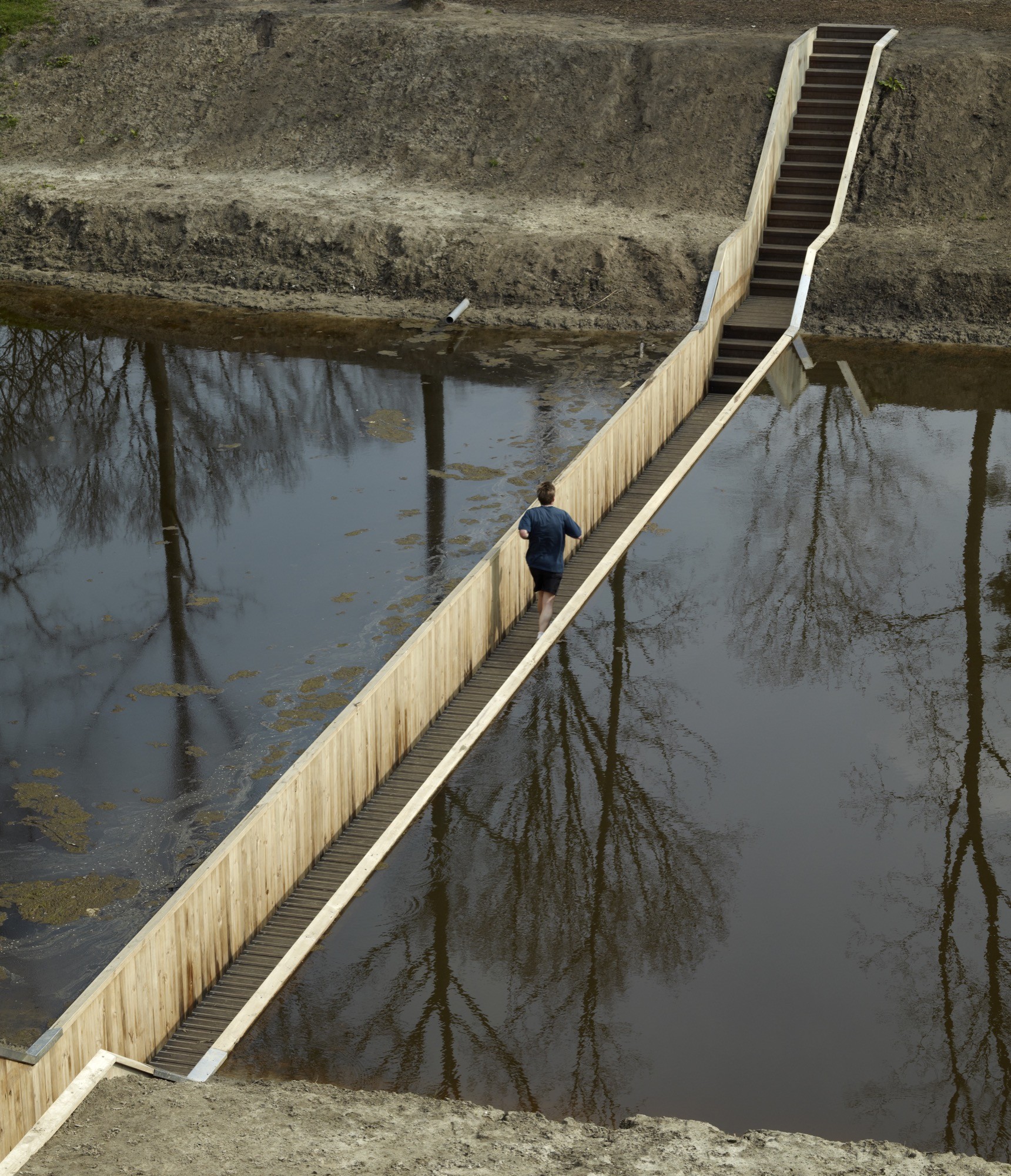
The most talked about intervention at Fort de Roovere is also the one that tries hardest to disappear. Rather than spanning the moat with a conventional bridge, the designers chose a gesture that protects the visual logic of fortification. The access route is carved into the waterline, so low and discreet that from a distance it reads less like a structure and more like a shadow, a trench, a void.


Built entirely from wood and waterproofed with EPDM foil, the passage is set between retaining walls that hold back the moat on both sides. Water sits flush with the top edge, creating a razor thin horizon where construction and landscape become difficult to separate. There is no elevated viewpoint, no triumphant arc, no object claiming attention. Instead, the visitor is guided through a narrow incision, entering the fort by moving into the moat rather than over it.


The experience is carefully paced. At first, the bridge is almost illegible, absorbed by terrain and reflections. Then a slit opens, and the fort reveals itself only at the moment of entry. The choreography is cinematic but restrained, turning arrival into discovery. It is this delayed reveal that has earned the project its popular association with Moses parting the waters. The comparison is theatrical, yet it captures something essential: the sense that the landscape is briefly allowing passage, then closing again behind you.


What makes the moment compelling is not spectacle, but precision. The intervention respects the fort’s original defensive intelligence, where visibility and access were never neutral. In a place designed to resist intrusion, even a tourist entrance becomes an architectural negotiation. Here, access is granted without compromising the fortress’s silhouette, and contemporary design works not by contrast, but by restraint.


As adaptive reuse projects proliferate across Europe, Fort de Roovere offers a lesson in how landscape architecture can operate as quiet infrastructure. The bridge does not compete with the historic site, nor does it mimic it. Instead, it borrows the logic of defence, thickness, concealment, and controlled entry, and translates it into a public experience. The result is a contemporary landmark that feels almost inevitable, as if it had always been latent in the moat.
In the wider context of the West Brabant Water Line restoration, the bridge functions as a hinge between memory and movement. It makes the fort reachable, but also makes the act of reaching meaningful. Visitors do not simply cross a boundary; they inhabit it. The moat becomes not just a picturesque perimeter, but an active spatial device again.

For a new generation of travellers seeking destinations where heritage, landscape, and design meet, the invisible bridge at Fort de Roovere is a sharp reminder that the most powerful architectural gestures are sometimes the ones that refuse to announce themselves. In a country where water once defined the terms of survival, an incision through the moat becomes both a path and a statement: history can be entered, carefully, without being overwritten.


Project Credit
Name: Moses Bridge
Location: Netherlands, Halsteren
Design: RO&AD architecten / @roadarchitecten
Complete: 2020
Photo: RO&AD architecten