
Now Reading: Garden house under floating roof on the edge of the Kanto plain
- 01
Garden house under floating roof on the edge of the Kanto plain


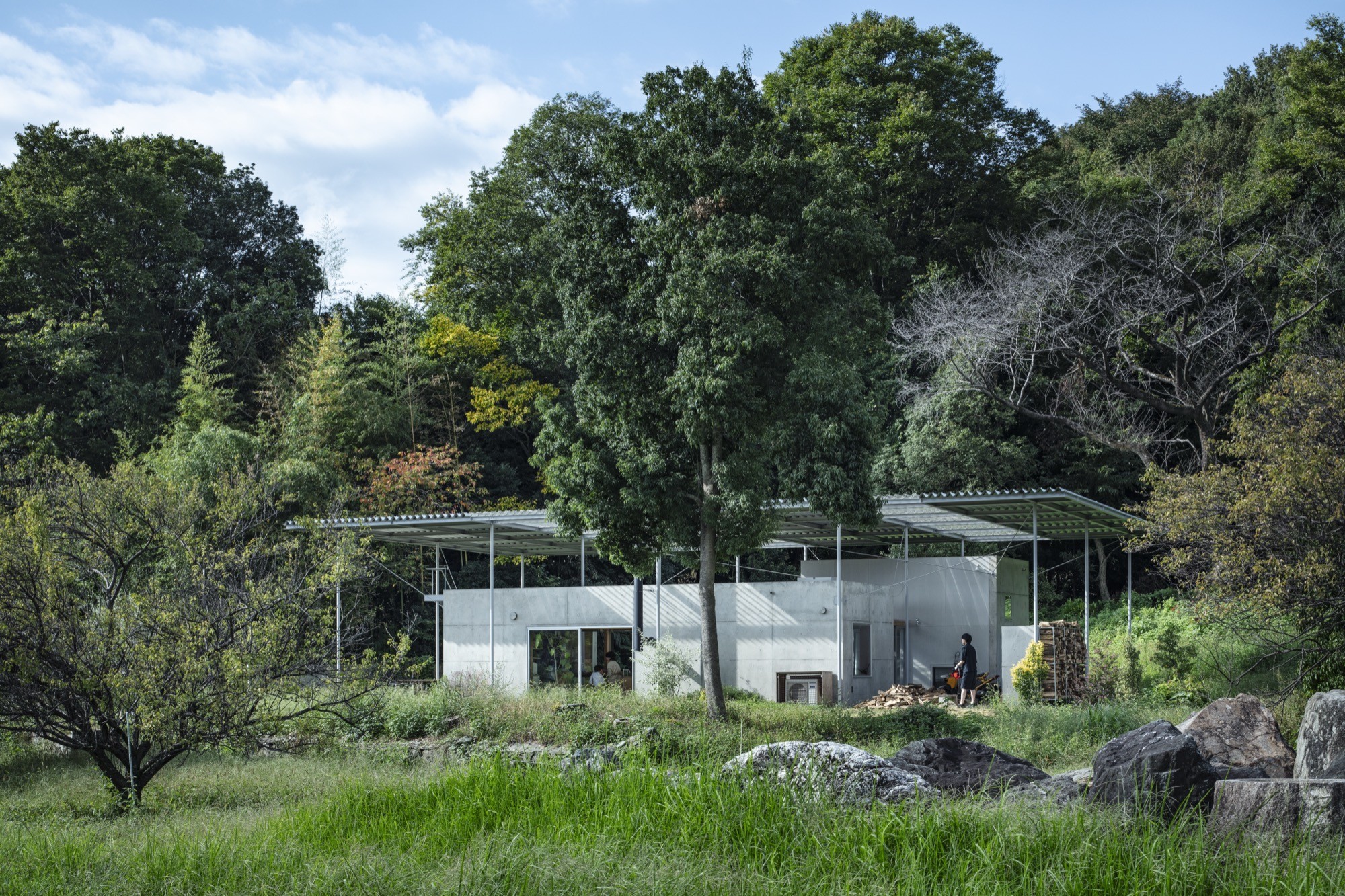
On the northern fringe of Japan’s Kanto plain, a 2,000-square-metre plot sits between modest workshops and wide rice paddies. The land once held a generous farmhouse, backed by a dense hardwood grove that still anchors the site’s sense of depth and shade. For a client who had recently moved from the city, the ambition was not simply to build a home, but to inhabit the greenery in full: a residence, a small entrepreneurial base for local exchange, and an arrangement able to adapt if the family relocates in the future.

The project answers with an architecture that treats the garden as the main room. Rather than separating indoors from outdoors, it stitches daily life into a continuous semi outdoor landscape, absorbing the site’s vegetation, agricultural rhythms, and the quiet social life of the neighbourhood.


FRAGMENTED VOLUMES, ONE DIAPHANOUS CANOPY
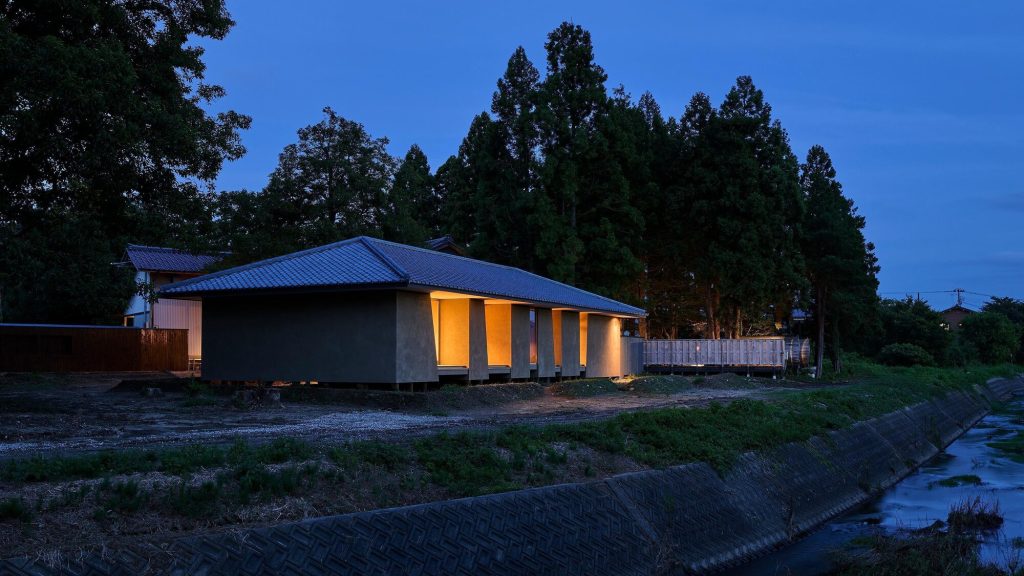
The plan is composed as a cluster of discrete volumes arranged to enclose an earthen floor courtyard at the centre. Above them, a single, light roof plane gathers everything into one readable figure. This hovering canopy does more than provide shelter. It produces a gradient of spaces that sit between house and garden, opening up multiple ways to inhabit the site across seasons.

Beneath the roof, circulation becomes an alley like passage, edged by greenery and thresholds. Elsewhere, the roof extends into a shed inspired deck, creating an elevated outdoor room that shifts the horizon from paddies to treetops. At the heart of the composition, a more inward chamber is crowned by a large top light, drawing daylight deep into the plan while keeping the atmosphere calm and protected.


MICROCLIMATES AS A DOMESTIC PLAN
The semi outdoor garden is organised as a sequence of microclimates shaped by orientation, adjacency, and enclosure. The central court turns toward the woodland and becomes the social engine of the house, hosting an outdoor kitchen where meals can unfold under cherry blossoms and children can circulate freely between rooms and soil.


To the south, the garden aligns with the entry approach and settles into a deep eave porch. It works as a dry threshold for receiving visitors, furnished in a way that can switch from conversation to rest without needing a formal indoor parlour. To the north, a walled garden supports the practical side of rural living, accommodating weekend joinery, vehicle maintenance, and the everyday tasks that benefit from weathered cover. In each case, the garden is not a backdrop but a spatial device, calibrating comfort through shade, wind, and exposure rather than mechanical separation.


ARCHITECTURE THAT ANTICIPATES DEPARTURE
A key premise is resilience across life stages. Each volume maintains a degree of autonomy, allowing the complex to contract or be repurposed over time. If relocation becomes necessary, the bedroom and bath pavilion can remain as a compact retreat, preserving a foothold in the landscape. The other structures are positioned to shift into retail, workshop, or exhibition use, extending the client’s original ambition to create a small local node without locking it into a single programme. The garden, sustained by casual encounters and shared routines, becomes an incubator for hybrid uses that cannot be fully planned in advance.


A POROUS HABITAT FOR SEASONS AND NEIGHBOURS
The roof is the project’s unifying gesture, but its real effect is to cultivate a chameleon like environment, constantly recalibrated by interior needs and external change. Domestic life spills beyond enclosures and returns again, braided with topography, weather, and time of day. The house does not perform as an isolated object in a field. It behaves more like an inhabited edge, a porous habitat where relationships with neighbours and vernacular practices can form naturally through proximity, visibility, and shared ground. In this way, the design proposes a contemporary rural dwelling that is less about retreat from context and more about attentive participation in it, with the garden as mediator, commons, and daily stage.

Project Credit
Name: ROOF HOUSE
Location: Japan, Tochigi
Design: TAMADA & WAKIMOTO ARCHITECTS
Completed: 2023
Photo: Kenta Hasegawa
More Photos