Now Reading: Unity: Tia Thuy Nguyen reimagines Vietnam’s forest archetype as a luminous civic landscape in Hanoi
- 01
Unity: Tia Thuy Nguyen reimagines Vietnam’s forest archetype as a luminous civic landscape in Hanoi

Unity: Tia Thuy Nguyen reimagines Vietnam’s forest archetype as a luminous civic landscape in Hanoi

In October 2025, Vietnamese artist Tia Thuy Nguyen presents Unity, a large scale public artwork situated in a central urban park in Hanoi. Conceived as an immersive spatial environment rather than a conventional monument, the installation translates collective memory into an abstract constellation of light. Through the integration of stainless steel, glass, ceramics, illumination, and sound, Unity intervenes in the everyday rhythms of the city, offering a poetic encounter where art, nature, and urban life converge.
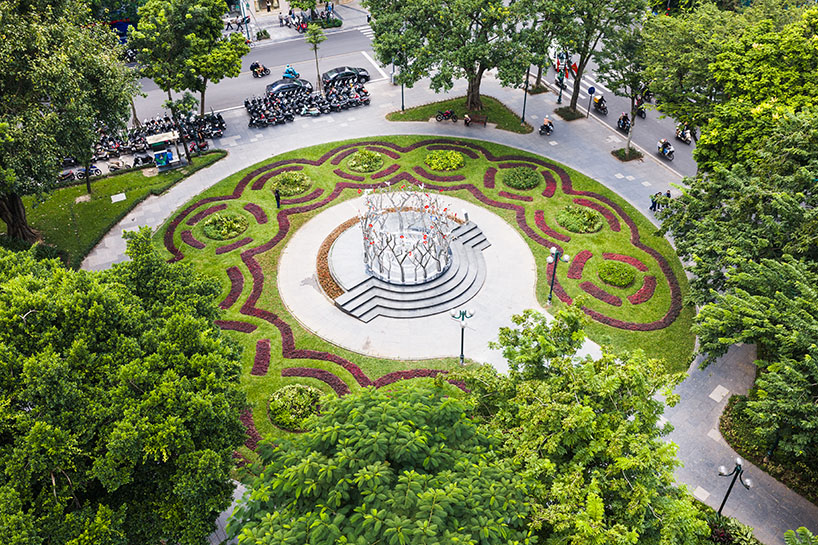
Rejecting the fixed symbolism of traditional sculpture, Unity unfolds as a dynamic field of perception. Light becomes both material and language, shifting across reflective surfaces and refracted through handcrafted elements. The work invites visitors not merely to observe but to enter, dwell, and move within its luminous architecture.
FOREST AS ARCHETYPE AND COLLECTIVE MEMORY
The conceptual foundation of Unity draws from the archetype of Vietnam’s primordial forests. Throughout history, forests have functioned as places of shelter, sustenance, resistance, and spiritual continuity. They are embedded in the nation’s collective consciousness as landscapes of survival and solidarity.
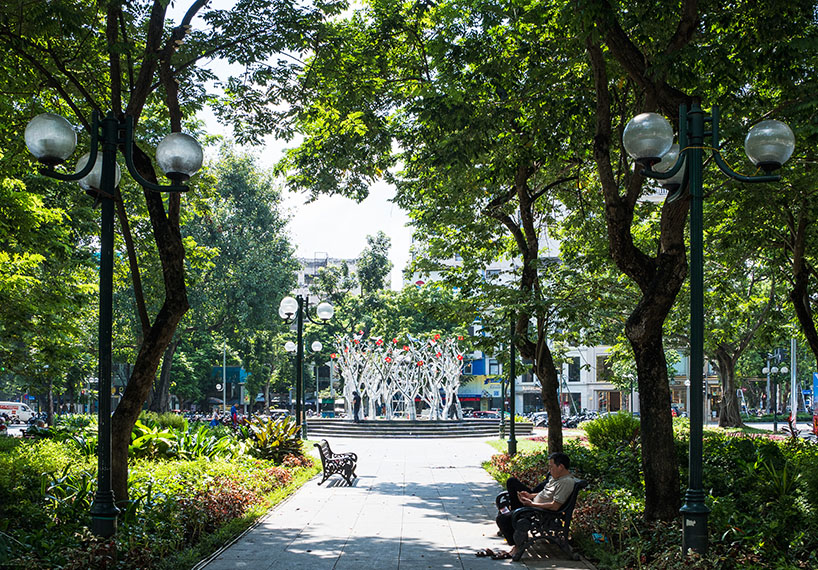
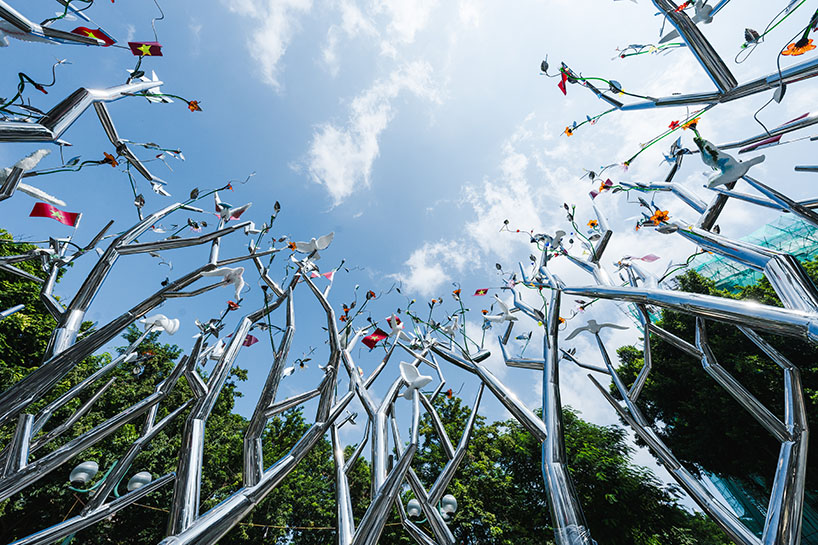
This ancestral memory is translated into eighteen stainless steel columns, hand welded and mirror polished, arranged in a circular formation with a diameter of twelve meters. The vertical elements do not imitate trees in a literal sense. Instead, they operate as abstracted vessels of accumulated energy. Their collective presence evokes the revolutionary image of banners rising together, while simultaneously forming an open, inhabitable interior. The visitor becomes part of the composition, absorbed into a spatial choreography of reflection, light, and movement.
MATERIAL DIALOGUES BETWEEN INDUSTRY AND CRAFT
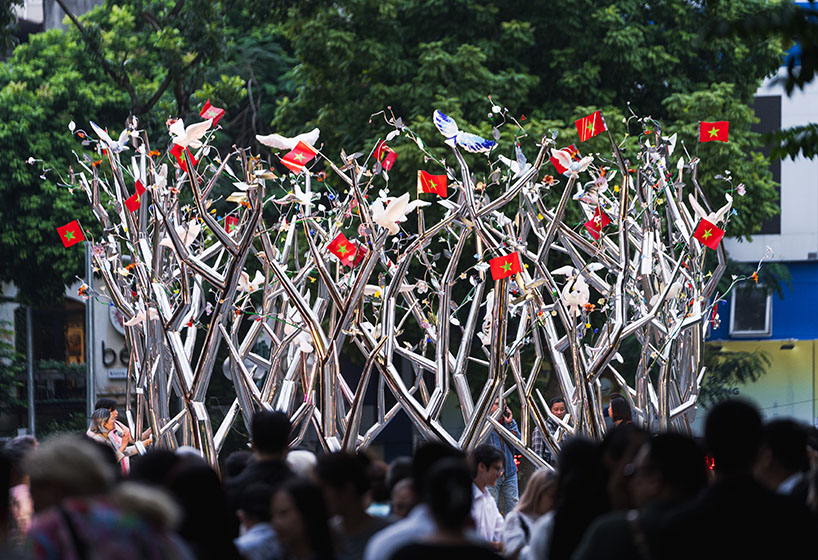
The severity of polished steel is softened by a rich layer of artisanal interventions. Mouth blown glass blossoms, hand formed ceramic elements, and stainless steel motifs of doves and pinwheels are embedded throughout the structure. These details draw from Vietnam’s long standing craft traditions and introduce tactile intimacy into an otherwise industrial framework.


The dialogue between rigidity and delicacy, precision and imperfection, transparency and opacity generates a constantly shifting visual rhythm. Each material responds differently to light, transforming the circular structure into a kinetic prism that evolves with time, weather, and human presence. As sunlight changes throughout the day, the installation oscillates between solidity and immateriality.
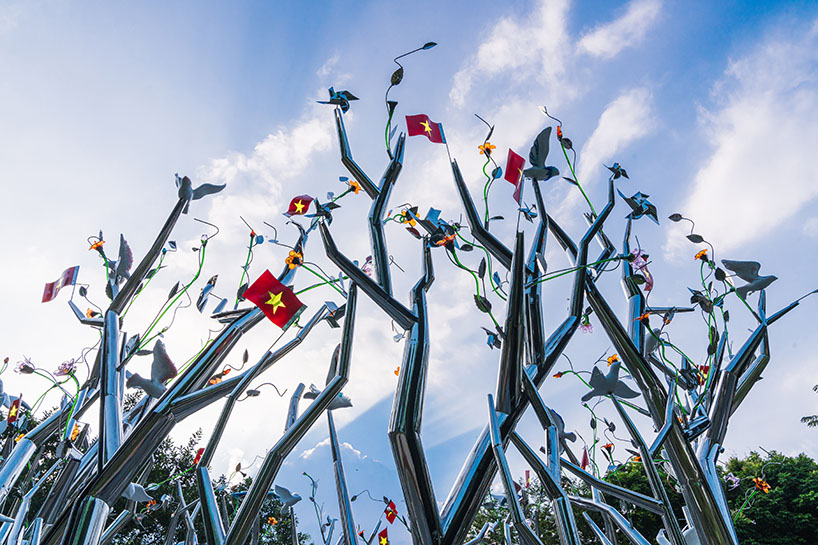
Within Tia Thuy Nguyen’s practice, light is not treated as spectacle but as an essential medium. It flows through glass surfaces, glides across metal planes, and dissolves boundaries between object and atmosphere. The result is a forest of radiance that feels at once physical and ephemeral.
CRAFTSMANSHIP AS CULTURAL CONTINUITY
The realization of Unity required thousands of hours of fabrication and reflects a profound commitment to manual craftsmanship in an era dominated by industrial efficiency. The artist was directly involved in every stage of production, collaborating closely with master welders, ceramicists, glassblowers, and floral artisans.


This collaborative process functions as both preservation and transformation. Traditional techniques are not frozen in nostalgia but reactivated within a contemporary artistic language. Every weld seam, ceramic fragment, and glass petal bears the imprint of human labor and knowledge. The work embodies a collective intelligence, where individual skill contributes to a unified whole.

Designed to withstand Hanoi’s demanding climate, the installation negotiates heat, humidity, rain, and wind. Its material endurance parallels its conceptual ambition to remain relevant across time, absorbing the city’s constant flux without losing its symbolic clarity.
PUBLIC ART AND URBAN TRANSFORMATION IN HANOI
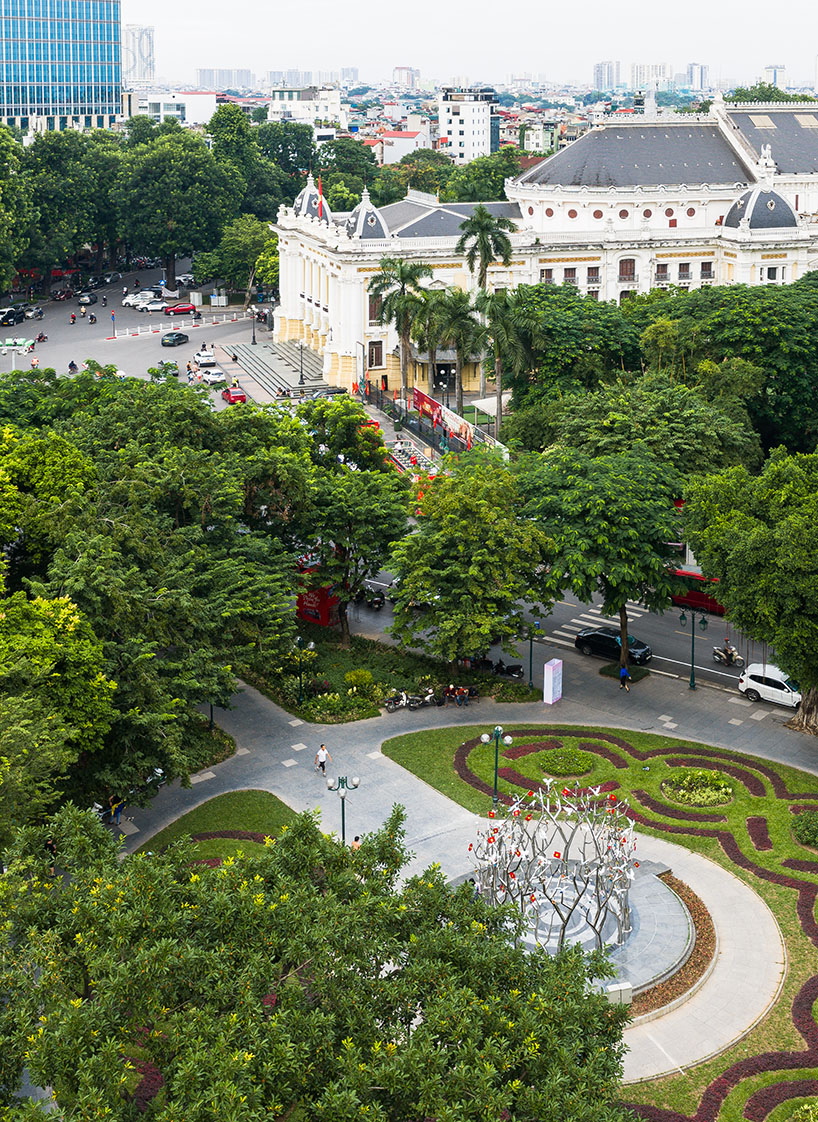
Unity arrives at a moment when Hanoi is rethinking its approach to urban development. The city is gradually shifting away from superficial beautification toward projects that engage deeper cultural and social narratives. Public art is increasingly understood as a vital layer of civic life, capable of shaping identity and fostering shared belonging.
Within this context, Unity operates as a restorative gesture. It does not impose a singular historical narrative but opens a space where memory can be continuously reinterpreted. The installation demonstrates how contemporary public art in Vietnam can be both locally grounded and globally conversant, rooted in history while addressing present and future urban realities.

More than a sculptural object, Unity proposes a new model for public art in Vietnam. It releases memory from static commemoration and repositions it as a living, luminous presence sustained through everyday interaction. The work suggests that remembrance need not be confined to monuments of stone or bronze but can exist as light, movement, and shared experience.
In this luminous forest at the heart of Hanoi, collective memory remains alive, responsive, and perpetually renewed through the gaze and movement of its people.

PROJECT CREDIT
Title: Unity
Designer: Tia-Thuy Nguyen / @tia.thuynguyen
Materials: Stainless steel, glass, ceramics, light, and sound
Dimensions: Circular configuration of 18 metallic columnar elements
Venue: August 19 Memorial Garden, Hanoi
Photo: NOTES

Tia-Thuy Nguyen, born in 1981, is a Vietnamese multidisciplinary artist raised in Hanoi and currently based in Ho Chi Minh City. She graduated from the Vietnam University of Fine Arts in 2006 and earned a PhD in Fine Arts from the National Academy of Fine Arts and Architecture in Kyiv in 2014. Her practice spans installation, fashion, film, and media, often addressing storytelling, the role of women, and the reinterpretation of Vietnamese cultural heritage within contemporary contexts.
She is the founder of Xuong Phim Mau Hong, a film production company established in 2017, and a co founder of The Factory Contemporary Arts Centre, inaugurated in 2016 as Vietnam’s first purpose built space for contemporary art. Her works have been exhibited and collected in Vietnam and Europe, including Silver Room at Château La Coste in France in 2019.