
Now Reading: Playtime Cabin turns a forest in Wuhan into a liveable playground
- 01
Playtime Cabin turns a forest in Wuhan into a liveable playground

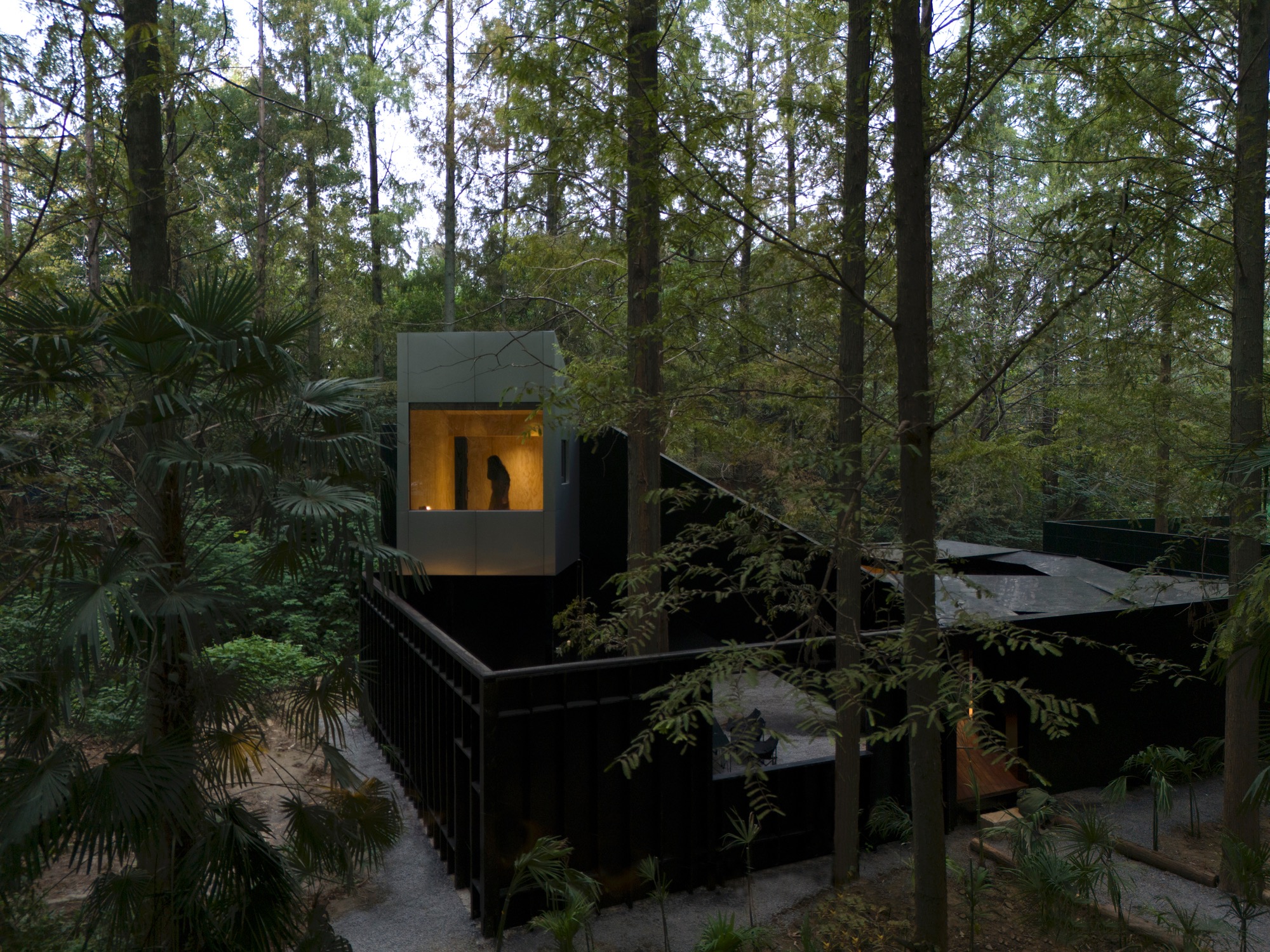

The project originates from a simple yet radical question: what if a playground could become a place to live. Rather than treating play as a separate program, the design absorbs it into the core of domestic life. Circulation is no longer linear or functional, but experiential, defined by climbing, sliding, and wandering.

A square courtyard is inserted into the forest, enclosing existing trees and establishing a clear yet porous boundary. Within this frame, the house unfolds as a sequence of interwoven spaces. The ground level accommodates living, sleeping, and bathing, but these functions are deliberately destabilised by irregular geometries and shifting orientations. Small triangular courtyards emerge between walls set at unexpected angles, encouraging exploration rather than efficiency.


A slide replaces the conventional staircase, connecting the interior to an elevated treehouse that marks the culmination of the spatial journey. From this vantage point, the forest becomes both backdrop and extension of the dwelling. Beneath, a swing and terrace continue the inhabitable landscape, dissolving distinctions between architecture and play.
Despite its geometric outline, the cabin resists fixed orientation. Trees punctuate the plan unpredictably, while pathways twist and overlap, producing a spatial condition that avoids hierarchy. Every room maintains a visual relationship with the surrounding forest, and light penetrates deeply into the interior.


This deliberate ambiguity challenges conventional domestic logic. Instead of organising space through cardinal directions or functional zoning, the project encourages intuitive occupation. Movement becomes exploratory, and dwelling becomes inseparable from experience.


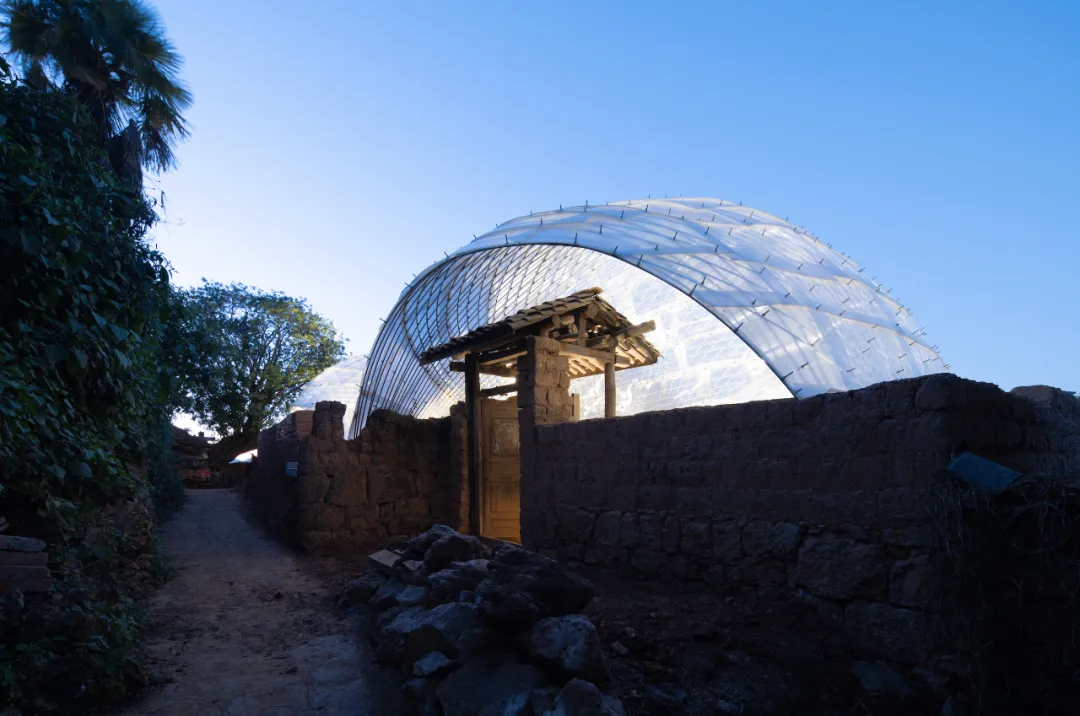
Material strategy reinforces this reading. The courtyard and ground floor are finished in black, grounding the architecture within the forest. In contrast, the treehouse appears as a luminous silver object, glowing at night like a beacon suspended among the trees.
Playtime Cabin continues Wiki World’s broader investigation into small scale living. Rather than focusing on size as a constraint, the project treats compactness as a catalyst for heightened sensory awareness. The reduced footprint intensifies the relationship between body, material, and environment.

Here, architecture moves away from predefined solutions and instead embraces a more speculative position. The domestic is redefined not through efficiency or optimisation, but through its capacity to evoke alternative ways of inhabiting space.


The structure is realised through a fully prefabricated timber system, with each component digitally modelled and fabricated to accommodate irregular geometries. Elevated above the ground, the cabin preserves the existing terrain, allowing vegetation and natural patterns to remain intact.
Construction follows Wiki World’s philosophy of co building with nature. Trees and bamboo on site are retained, and the architecture adapts to their presence rather than imposing a new order. Carbonised timber panels are produced manually, while small metal connectors allow the structure to be assembled and disassembled with precision.

By avoiding artificial landscaping and enclosure, the project positions nature as the primary spatial envelope. Architecture does not dominate the site but negotiates with it, establishing a delicate balance between intervention and preservation.

Project Credit
Project name: Playtime Cabin, Merryda Wiki World Wild Home 139
Location: Wuhan, Hubei province, China
Year: 2026
Floor area: 80 m²
Design firm: Wiki World / @wiki__world
Photo: Arch EXIST / @archexist, Cai Muan
More Photos