
Now Reading: Pavilion of Ceramics and Tea ceremony bridging Vietnamese craft and Japanese ritual
- 01
Pavilion of Ceramics and Tea ceremony bridging Vietnamese craft and Japanese ritual

Pavilion of Ceramics and Tea ceremony bridging Vietnamese craft and Japanese ritual

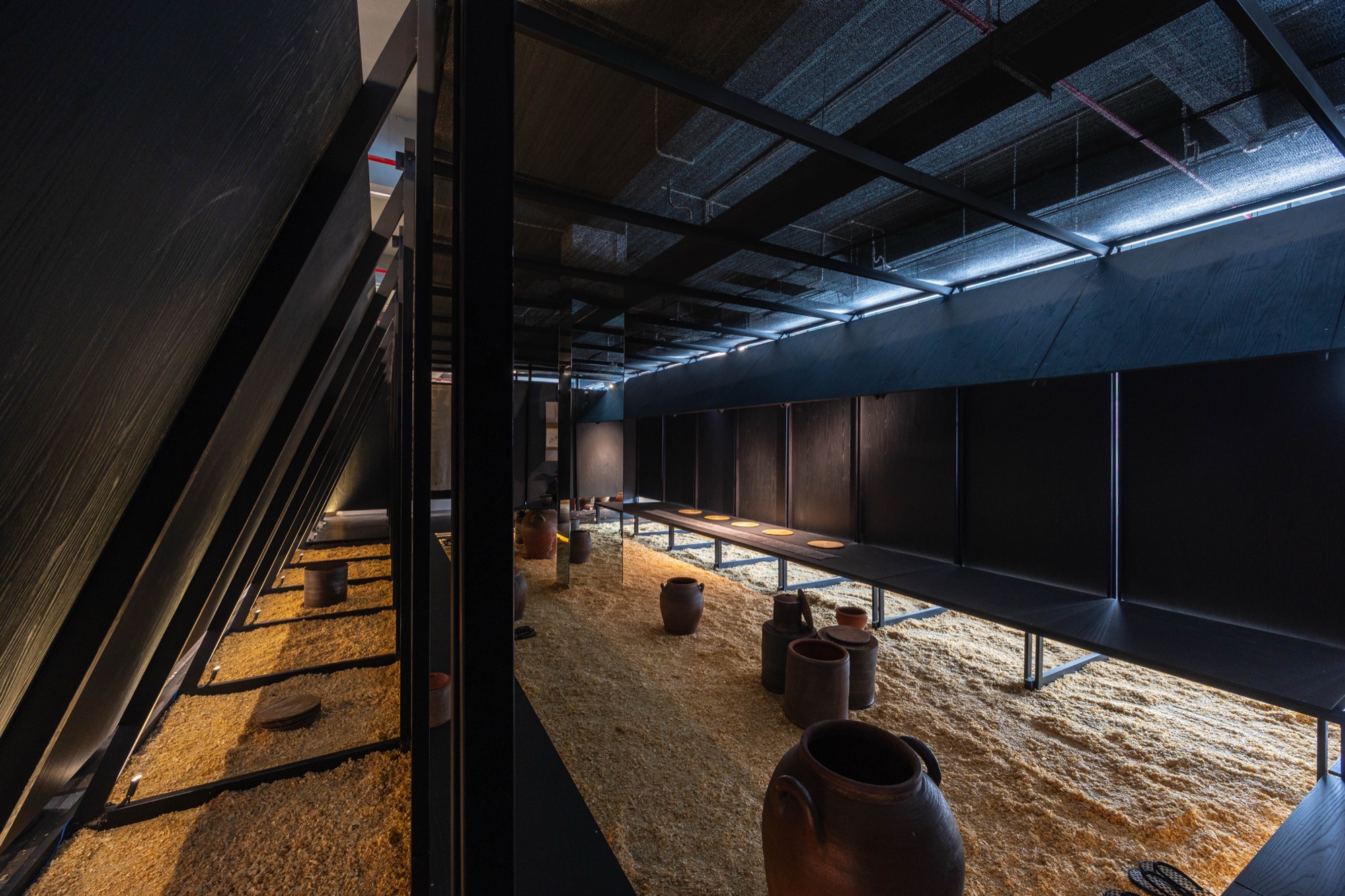
Conceived as a compact 70 square metre pavilion, this space brings together two cultural lineages through the shared material language of fired earth. Dedicated to the display of ancient Vietnamese ceramics and the practice of Japanese tea ceremony, the pavilion draws its primary inspiration from the traditional longhouse of the Êđê ethnic minority in Vietnam. More than a formal reference, the longhouse is understood here as a social structure, a place where ritual, memory and collective life are spatially intertwined.

At the centre of the Vietnamese Ethnic Êđê longhouse stands the K’pan bench, a sacred object that embodies communal unity in its making, mediates the relationship between humans and the spiritual realm, and serves as a vessel for transmitting cultural knowledge across generations. Rather than reproducing the bench literally, the pavilion translates its essence into a linear corridor pathway. This elongated element functions simultaneously as circulation, seating and a place for pause, allowing visitors to rest, observe or participate in tea drinking. In doing so, the corridor becomes the spatial and symbolic heart of the pavilion, echoing the role of the K’pan bench as a locus of gathering and exchange.


KILN, LIGHT AND MATERIAL MEMORY
While the overall form references the longhouse, the interior language is deliberately restrained. Industrial wood panels finished in black define the enclosure, creating a neutral yet intense backdrop for ceramics and ritual. Slits of light are introduced from above and below, their sharp, controlled quality inspired by the interior atmosphere of traditional kilns in Phu Lang ancient village in Bac Ninh province (Vietnam). With more than seven centuries of continuous ceramic production, Phù Lãng represents a lineage of handmade pottery deeply embedded in everyday Vietnamese life.


Suspended beneath the roof structure of the central corridor is a sequence of images documenting the transformation of raw clay into finished ceramic objects. From the seated position below, visitors are invited to look upward, encountering the labour, skill and tacit knowledge of artisans as an integral part of the spatial experience. Ahead, ceramics are displayed openly, encouraging proximity and touch, dissolving the distance between viewer, object and process.


TEA CEREMONY AS CULTURAL BRIDGE
Interactivity is further intensified through the practice of Japanese tea ceremony within the pavilion. Japanese tea masters have adapted Vietnamese ceramic jars and vats as tea tables, seating elements and display surfaces for utensils. These objects, originally shaped for storage and daily use, are recontextualised within the precise choreography of tea preparation, revealing unexpected affinities between two cultures shaped by clay, fire and ritual.


This encounter between Japanese tea aesthetics and Vietnamese ceramic heritage does not seek fusion as spectacle, but rather dialogue. Through the hands of artisans and practitioners from both countries, fired earth becomes a shared medium for reflecting on craftsmanship, slowness and cultural continuity.


RESISTING INDIFFERENCE IN A FLATTENING WORLD
In an era defined by convenience driven lifestyles and industrial consumption, traditional Vietnamese handmade ceramics are steadily disappearing. Along with them, many ceramic villages and craft communities across the country face decline and erasure. This pavilion positions itself as a quiet but firm response to that condition.

Carrying a clear message against indifference, the project connects the beauty and value of traditional ceramics with contemporary audiences through exhibition and tea ceremony, a cultural practice inseparable from ceramic material in both Vietnam and Japan. Rather than nostalgia, it proposes attention. Attention to process, to material, and to the fragile ecosystems of craft that continue to shape cultural identity in a rapidly homogenising world.


PROJECT CREDITS
Name: CHASHITSU & POTTERY PAVILION
Design firm: TOOB STUDIO / @toob.studio; NOTES / @notes.vn
Location: Ho Chi Minh City, Vietnam
Area: 70m²
Completion: 10.2025
Materials: Plywood, Steel, Mirror
Photos: Trieu Chien
Video: NOTES
More Photos