
Now Reading: Memoria House organised around central core
- 01
Memoria House organised around central core

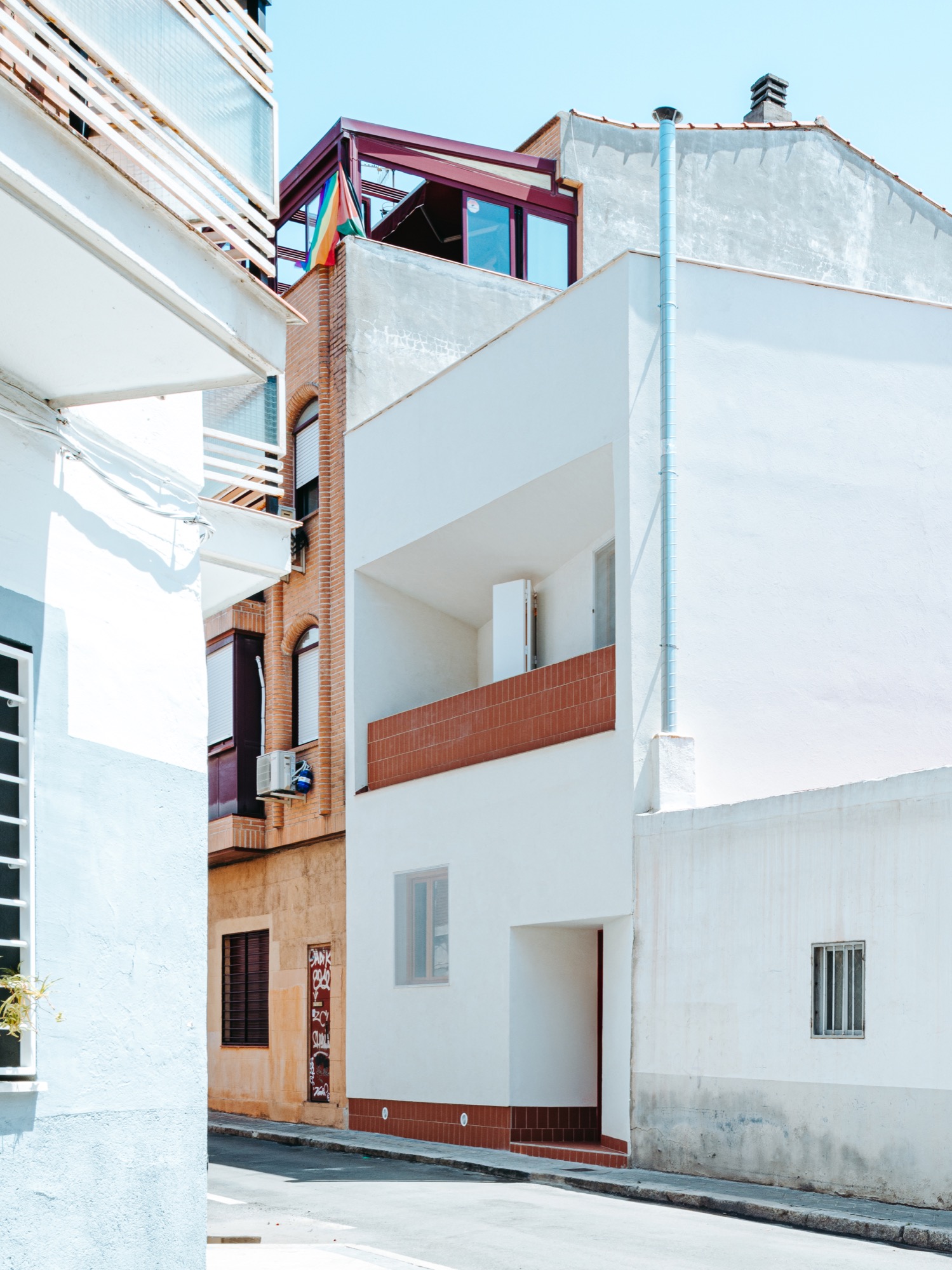

Memoria House is conceived as a compact urban dwelling on a modest plot of approximately 200 square metres. Rather than pursuing formal complexity, the project develops from a clear architectural diagram that organises space, circulation, and services with precision.
The house is structured across two levels around a central infrastructural band. This core accommodates the staircase, bathrooms, and the vertical distribution of services, establishing the technical backbone of the building. From this central spine, four rooms unfold on each floor, creating a balanced and legible spatial organisation.


The arrangement allows each room to remain spatially equivalent while maintaining direct visual and functional relationships with the central core. The system establishes a house that is both compact and adaptable, where circulation, service infrastructure, and inhabitable rooms are integrated into a single geometric framework.


At the point of entry, the diagram is modified to introduce a double height spatial volume. The removal of the intermediate slab transforms one of the rooms into a vertical entrance courtyard, a space that operates simultaneously as threshold, circulation node, and interior patio.

This double height void becomes the spatial hinge of the house. It structures the vertical movement through the central band while establishing visual continuity between the two floors. Rather than functioning as a decorative gesture, the void intensifies the perception of depth within the relatively compact footprint.

The ground floor contains the kitchen and living spaces, arranged as interconnected rooms rather than a single open plan. Sliding doors allow these spaces to be reconfigured according to use, enabling the house to shift between continuity and separation.


The upper floor accommodates three bedrooms arranged around the same central core. Each room opens onto a terrace, extending the interior spaces outward while providing additional light and ventilation. Built in storage bands reinforce the separation between the bedrooms and the circulation zone, ensuring spatial clarity despite the compact dimensions.


The architectural language of the house is defined by a limited palette of materials. Floors throughout the interior are finished with red ceramic tiles measuring 12 by 25 centimetres, laid in a staggered pattern that reinforces the continuity of the spaces.


Joinery elements are crafted from varnished birch wood, while the windows are framed in pine. Kitchens and bathrooms are lined with glossy white ceramic tiles measuring 6.5 by 30 centimetres, combined with granite countertops. The exterior is finished in white render, giving the house a clear and restrained presence within its urban context.


This material economy contributes both to the construction efficiency of the project and to its spatial clarity. The continuity of flooring unifies the interior, allowing the house to read as a continuous spatial field rather than a sequence of fragmented rooms. White surfaces enhance daylight reflection, while the use of wood introduces warmth and natural insulation.

Memoria House demonstrates how a clear architectural diagram can generate spatial richness within limited dimensions. The combination of a central infrastructural core, a double height entrance courtyard, and a restrained material palette produces a dwelling that is simultaneously simple and articulated.
Through the precise organisation of structure, space, and material, the project transforms a compact urban plot into a coherent architectural system where spatial continuity, flexibility, and clarity define the experience of domestic life.
Project Credit
Project name: Memoria House
Location: Madrid, Spain
Area: 158 m² (interior) + 90 m² (exterior)
Architecture firm: MINIMO
Photography: Hiperfocal / @hiperfocal_
More Photos