Now Reading: Off-grid cabin above Devín Castle opens to vineyards with fold-down terraces
- 01
Off-grid cabin above Devín Castle opens to vineyards with fold-down terraces

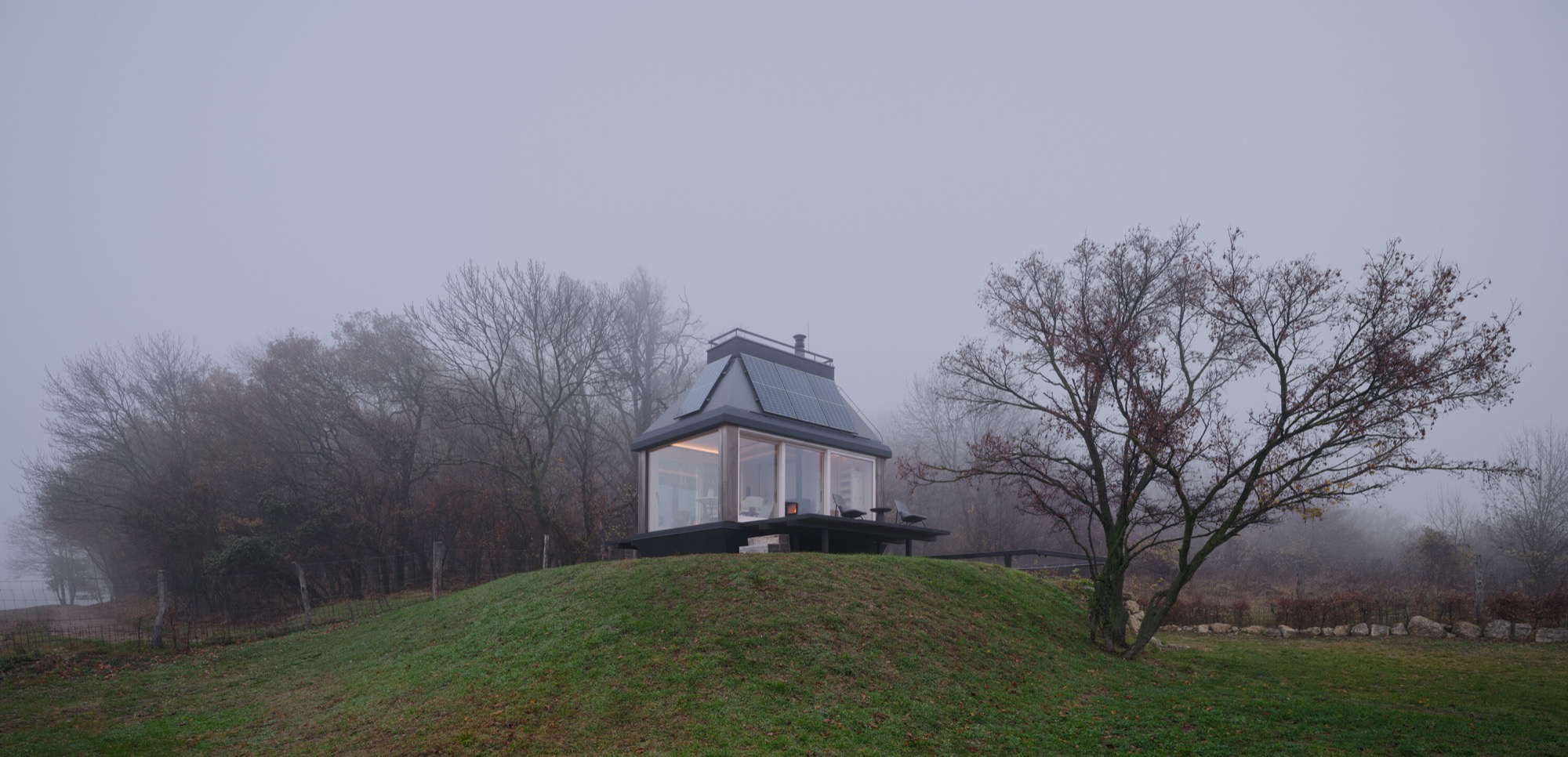
Off-grid cabin above Devín Castle opens to vineyards with fold-down terraces

Set at the edge of the Zlatý Roh vineyards, approximately three kilometres above the ECK restaurant and overlooking Devín Castle, this compact cabin explores how architecture can compress comfort, autonomy, and landscape immersion within a remarkably small footprint. The project was conceived as a fully functional weekend retreat occupying just 20 square metres, designed to operate independently from conventional infrastructure while responding carefully to the local climate.

From its elevated position above the vineyards, the cabin commands expansive views toward the setting sun and the distant Austrian Alps. Rather than competing with the power of this landscape, the architectural strategy seeks to frame it. The dwelling acts as a protective shelter throughout the seasons while maintaining an uninterrupted sensory connection to its surroundings.


The result is a small yet intensely atmospheric structure that balances security and openness, transforming the act of inhabiting nature into an everyday spatial experience.

The cabin responds to its dramatic setting through a concept of radical openness. Two sides of the structure are equipped with fold-down terraces that, when lowered, reveal sliding glass walls. The façade facing the landscape is defined by full-height glazing protected by integrated shading screens.

Much of daily life unfolds precisely in this intermediate zone between interior and exterior. When the terraces open, the living space expands outward, visually and functionally multiplying the usable floor area. The boundaries between inside and outside dissolve, allowing the cabin to behave less like a closed object and more like a permeable frame for the surrounding vineyard landscape.


Within the compact interior, spatial organisation follows a carefully calibrated sequence. Behind the main living area lies a compact kitchenette, followed by a bathroom with a shower. A bespoke concrete sink is positioned directly within the window frame, transforming the simple act of washing into a moment of contemplation directed toward the forest beyond.

This deliberate alignment between everyday routines and the surrounding landscape slows the rhythm of habitation and reinforces the cabin’s role as a retreat from urban life.


As evening arrives, the spatial character of the cabin shifts. A pendant lamp descends from the loft above the living space. When its cable is pulled, the lamp rises, revealing a sleeping area concealed during the day.


The absence of a permanent staircase preserves the visual clarity of the interior. Access to the loft is provided by a retractable ladder integrated discreetly into the cabinetry, appearing only when needed. This gesture allows the upper level to remain visually hidden, maintaining the sense of openness within the small ground floor.

The atmosphere of the loft contrasts intentionally with the transparency of the living space below. Rather than large glass surfaces, the sleeping area is enclosed by a solid roof envelope that creates an intimate and protective environment. A single skylight opens the room to the sky, offering a quiet vantage point for stargazing above the vineyards.
Beyond its spatial qualities, the cabin is designed as a fully autonomous dwelling capable of operating off-grid throughout the year. Achieving reliable winter operation at this latitude required a carefully engineered hybrid energy system.

Photovoltaic panels supply primary electrical power, which is stored in battery units integrated into the building infrastructure. When battery capacity drops below a defined threshold, hybrid appliances automatically switch to gas operation. This prioritisation ensures that electricity remains available for lighting and small devices, while more energy-intensive processes such as heating or cooling adapt to available resources.


Water infrastructure is similarly integrated into the architecture. A concealed service-water reservoir is located within the raised floor, alongside a dedicated wastewater storage tank. These systems allow the cabin to function independently from external utilities while maintaining everyday comfort.

Climate control is achieved through a combination of intelligent shading, natural ventilation, and mechanical support. During summer months, cooler air is drawn from beneath the northern side of the cabin floor while warmer air is extracted through a heat recovery unit positioned beneath the skylight. In winter, the airflow reverses, with CO₂ and humidity sensors regulating ventilation to maintain balanced indoor conditions.

Despite its extremely limited footprint, the cabin demonstrates how spatial intensity can be amplified through careful design. Fold-down terraces expand the living area, the loft transforms the daily spatial configuration, and autonomous infrastructure allows the building to function independently from urban systems.


Rather than presenting minimalism as a constraint, the project treats compactness as an opportunity to intensify the relationship between architecture, technology, and landscape.
The result is a form of compressed architecture in which a small structure delivers an unexpectedly rich experience of living within nature while remaining technologically self-sufficient.


Project Credit
Studio: Ark-Shelter Archekta / @ark.shelter
Location: Devín, Bratislava, Slovakia
Completion year: 2024
Built-up area: 20 m²
Usable floor area: 14,7 m²
Photo: BoysPlayNice / @boysplaynice