
Now Reading: La Fusteria transforms former carpentry workshop into contemporary village home in Alt Empordà
- 01
La Fusteria transforms former carpentry workshop into contemporary village home in Alt Empordà

La Fusteria transforms former carpentry workshop into contemporary village home in Alt Empordà

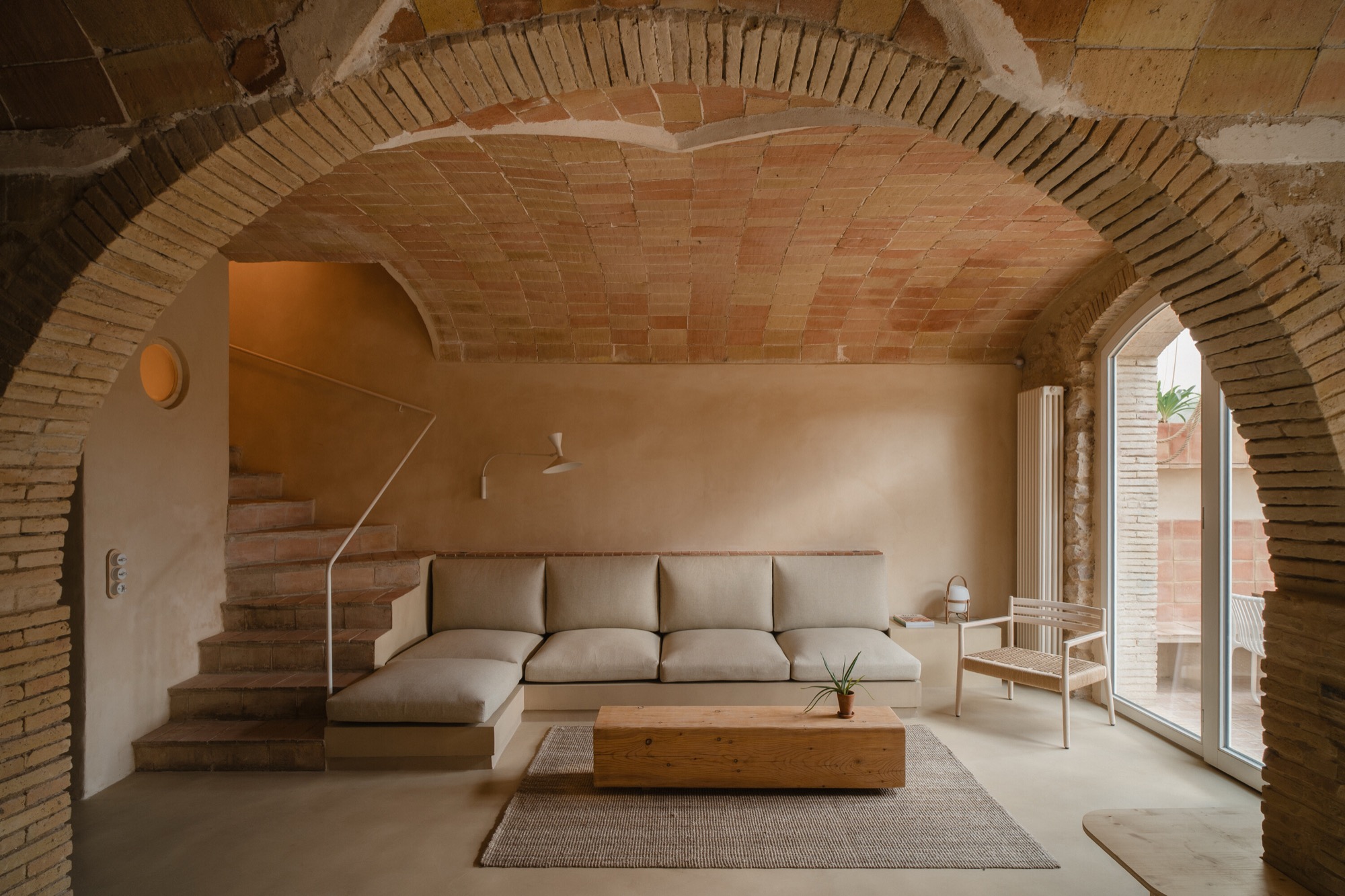
In a small village in Alt Empordà, La Fusteria reconsiders the life of an existing structure through a careful balance of preservation and transformation. The project occupies a former carpentry workshop, retaining the spatial memory embedded in its construction while adapting it to contemporary domestic use. Two Catalan vaults on the ground floor define the architectural language of the intervention, anchoring the project in its material past while guiding its present configuration.

The renovation responds to a dual mode of inhabitation. The house serves both as a temporary residence for family members returning to the village, particularly during the winter months, and as a short term rental. This condition informs a spatial strategy that prioritises clarity, flexibility, and comfort.
The ground floor becomes the centre of daily life. The kitchen is repositioned alongside the living area, forming a continuous open space that engages directly with the existing vaults. This move allows the upper levels to be reorganised as private zones, where bedrooms and more intimate functions unfold with greater autonomy. Circulation is simplified, and the sequence of spaces becomes more legible, reinforcing a sense of coherence across the house.


Material decisions operate as both a technical and cultural strategy. Later additions are removed to reveal the original structure, allowing the building to regain its tactile presence. Walls are restored using lime based mortars and plasters, enabling the masonry to breathe while introducing a soft luminosity across interior surfaces.


The recovery of handmade toba floors and artisanal ceramic tiles reinforces the project’s connection to local craftsmanship. These elements are not treated as nostalgic artefacts but as active components within a renewed spatial environment, where texture, light, and material continuity define the domestic atmosphere.


The intervention extends beyond the interior to address the building’s relationship with its surroundings. Updated installations and new exterior joinery improve thermal performance and environmental comfort, while maintaining visual continuity with the original structure. The front courtyard is reactivated as a mediating space between street and house, restoring a traditional threshold condition that had been diminished over time.


Custom designed railings introduce a contemporary layer that integrates safety requirements with a consistent architectural language, avoiding visual fragmentation. La Fusteria proposes a mode of intervention grounded in continuity rather than contrast. The project does not seek to overwrite the past, but to accompany it, extending the building’s lifespan through precise and measured adjustments. By aligning spatial reorganisation with material restoration, the former workshop is transformed into a dwelling that remains deeply connected to its place while meeting the demands of present day living.


Project Credit
Studio: Clara Crous Arquitectura / @claracrousarq
Project location: Vilamacolum, Spain
Completion year: 2025
Gross floor area 232 m²
Usable floor area 184 m²
Photo: Montse Capdevila / @montsecapdevila_
More Photos