
Now Reading: Mar Nostro traces memory through Mediterranean architecture
- 01
Mar Nostro traces memory through Mediterranean architecture

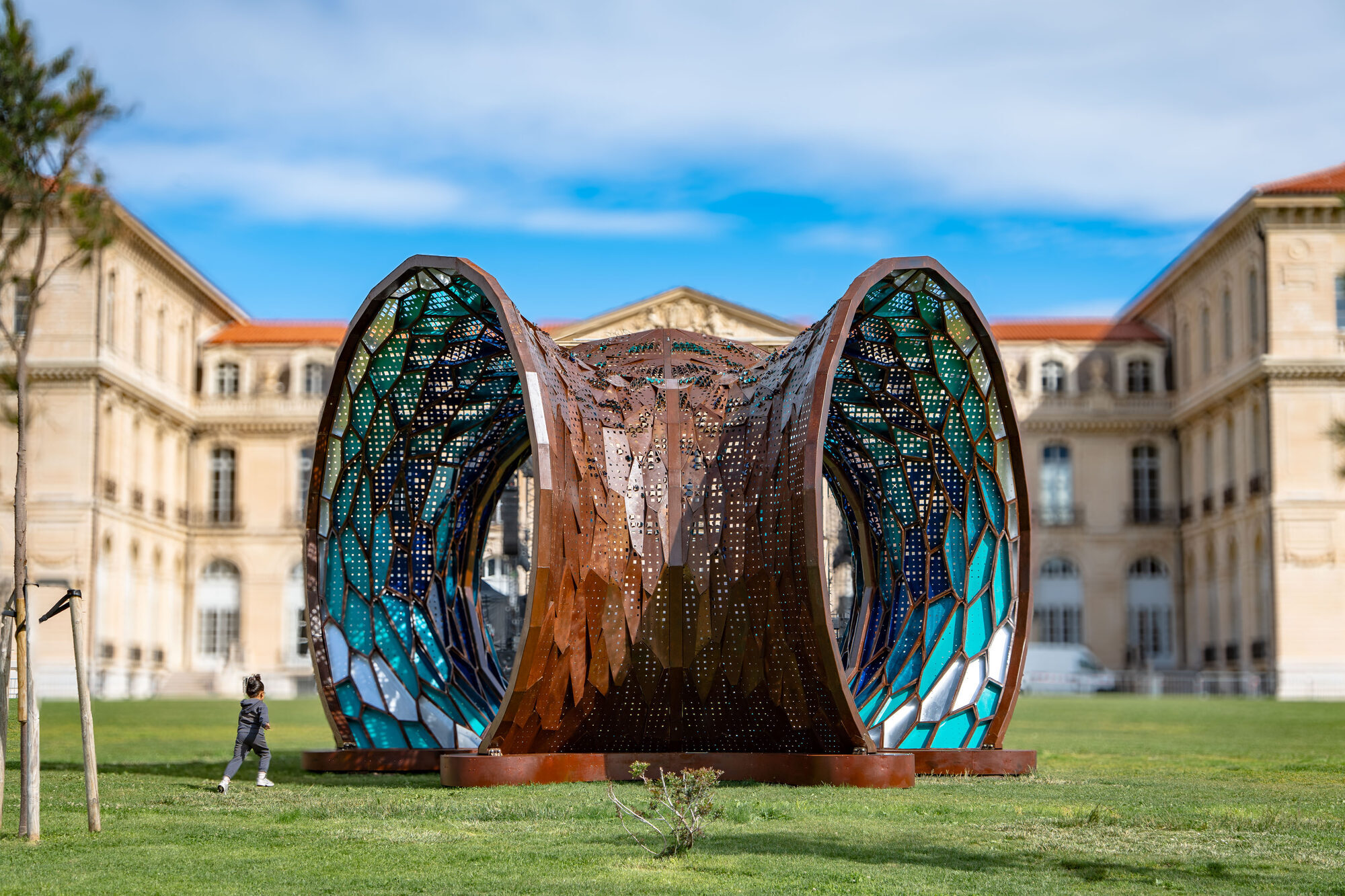

Presented as part of the 2026 Mediterranean Season at the historic Palais du Pharo in Marseille, Mar Nostro – Notre Mer – رناُ بحَ is a site-specific installation that transforms architecture into an instrument of collective remembrance. Conceived by UV Lab, the project stands as a tribute to the cultures, histories, and human journeys that have shaped the Mediterranean for centuries. It honors those who crossed its waters in search of new beginnings, while commemorating the countless lives lost along the way.
Rather than functioning as a monument in the traditional sense, Mar Nostro creates an inhabitable space where memory, movement, and encounter converge. Positioned between sculpture, architecture, and public art, the installation invites visitors to reflect on the Mediterranean not as a border, but as a shared cultural territory continually shaped by migration, exchange, and coexistence.

One does not simply arrive at Mar Nostro. The installation reveals itself gradually, refusing the conventional hierarchy of façade, entrance, and destination. Openings unfold in multiple directions, encouraging visitors to navigate through intuition rather than prescribed routes. Orientation becomes a sensory experience.


Stepping beneath the structure, visitors enter a landscape of shifting light and shadow. Folded metallic surfaces rise and intersect overhead, capturing the Mediterranean sunlight and filtering it through a dense geometry of openings. Air, light, and movement become active components of the architectural experience, allowing the installation to continuously transform throughout the day.


The space does not present itself all at once. Instead, it unfolds slowly through movement, revealing changing perspectives and unexpected relationships between the structure, the sky, and the city beyond.


At the heart of Mar Nostro lies a deliberate dialogue between advanced computational design and traditional craftsmanship. The installation is composed of 486 individually folded metal panels, each precisely developed through parametric modeling before being fabricated with millimetric accuracy using digital technologies.


Yet the realization of the project remained profoundly human. Every panel was assembled on site through manual processes that required patience, precision, and collective effort. Folding, positioning, and connecting each component became an act of construction rooted in time, care, and embodied knowledge.
This coexistence of digital innovation and handcrafted production reflects a conscious response to the sensitive context of the Palais du Pharo. Rather than relying on industrialized assembly methods, the project embraces a slower and more attentive mode of making, one that acknowledges both the significance of the site and the value of human presence within the construction process.

The making of Mar Nostro was itself conceived as a social act. Developed in collaboration with the Cascadeurs et Cascadeuses training program of the Cité des Arts de la Rue, the installation emerged through a participatory construction process that brought together designers, performers, technicians, and local participants.
Throughout weeks of fabrication and assembly, the site became a place of encounter. Individuals gathered around the evolving structure, sharing knowledge, labor, and conversation. Construction became inseparable from meaning, transforming the installation into a collective work that carries within it the traces of those who built it.


By the time the final panels were installed, the structure had become more than an architectural object. It embodied the memory of a shared experience, marked by collaboration and shaped through human connection beneath the open skies of Marseille.

The title Mar Nostro operates on multiple levels of meaning. It echoes Mare Nostrum, the expression through which the Roman Empire once claimed the Mediterranean as “our sea,” transforming a vast and diverse territory into an extension of imperial power.
The installation deliberately reopens this historical narrative. Instead of asserting possession, it poses a question. Who does this sea belong to today? Who benefits from its promise, and who bears the consequences of its divisions?
At the same time, the title evokes the historical Lingua Franca of Mediterranean ports, a hybrid language that emerged through centuries of trade, migration, and cultural exchange. Blending Arabic, Italian, Spanish, French, and numerous other influences, it functioned as a shared language of encounter rather than domination.

In this sense, Mar Nostro proposes a different understanding of belonging. It suggests a Mediterranean defined not by ownership, but by coexistence; not by borders, but by movement.
Viewed from a distance, the installation evokes multiple interpretations. It recalls the hull of a ship, the shell of a marine creature, a fragment of ruin, or a temporary shelter emerging from the landscape. Its ambiguity is intentional, allowing visitors to project their own readings onto its form.

As one approaches, attention shifts toward the complexity of its geometry. Folded surfaces capture and redirect light while framing fragments of Marseille beyond. The city appears intermittently through the openings, creating a visual dialogue between the installation and its surroundings.


Inside, sunlight animates the structure with remarkable intensity. Patterns of light move continuously across the ground and interior surfaces, forming an ever-changing constellation that evolves throughout the day. The effect evokes the celestial navigation systems once relied upon by sailors, travelers, and exiles crossing open waters guided only by the stars.

There is no singular axis organizing the experience. No dominant orientation, no privileged viewpoint, no symbolic center. Three primary passages extend outward, evoking the interconnected geographies of Africa, Asia, and Europe. These are not presented as separate worlds, but as territories whose histories have long been intertwined through the Mediterranean.
The architecture resists hierarchy. Instead, it creates a spatial condition in which proximity, exchange, and interdependence become tangible.
Standing beside the sea that inspired it, Mar Nostro reflects on the Mediterranean as more than a geographical entity. The sea becomes a repository of human experience, shaped over centuries by migration, commerce, conflict, hope, and loss.

Its waters have witnessed countless departures and arrivals. They have carried merchants, pilgrims, refugees, explorers, and dreamers. Across generations, they have connected civilizations while simultaneously revealing the inequalities that define mobility and belonging.
The installation mirrors this condition. Like the Mediterranean itself, it transforms through movement. Every visitor alters the experience of the space, just as successive generations have reshaped the cultural landscape of the region through their journeys and encounters.


For centuries, empires attempted to claim the Mediterranean through the language of ownership and control. Yet the sea has consistently resisted such definitions. It remains a space of exchange, complexity, and continuous transformation.
The thousands of lives lost while crossing its waters remain part of this history. Their stories form an invisible layer within the cultural memory of the Mediterranean, reminding us that mobility and displacement remain defining realities of contemporary life.
Mar Nostro acknowledges these histories while refusing nostalgia. Instead, it invites reflection on the present and future of a sea that continues to shape identities across continents.

Installed within this context, Mar Nostro becomes more than an architectural intervention. It functions as a spatial reflection of Marseille itself, a city built through movement, transformation, and the ongoing conversation between different worlds connected by a shared sea.
Project Credit
Project name: Mar Nostro – Notre Mer – ﺑَﺣرُﻧﺎ
Location: Palais du Pharo, Marseille, France
Year: 2026
Design Firm: UV Lab | @uv.lab
Study, technical engineering and structural calculations: Quentin Alart, Laurent Gauthier
Photo: Khal, Ismael Bazri