Now Reading: Nine suspended “glaciers” respond to visitors in Shanghai installation
- 01
Nine suspended “glaciers” respond to visitors in Shanghai installation

Nine suspended “glaciers” respond to visitors in Shanghai installation
Climate change is often experienced through statistics, satellite images, and distant headlines. Yet glaciers remain physically and emotionally remote from everyday urban life. Developed by Dayuan Design in collaboration with the ocean conservation organization N.O.C., Glacier Project seeks to narrow that distance through architecture, installation, and exhibition design.
Presented under the theme Resonance of the Extremes, the project explores the interconnected relationship between glaciers, oceans, cities, and human activity. Rather than presenting environmental issues as abstract information, it creates a sequence of spaces and objects that invite visitors to experience climate change through movement, interaction, sound, and material.


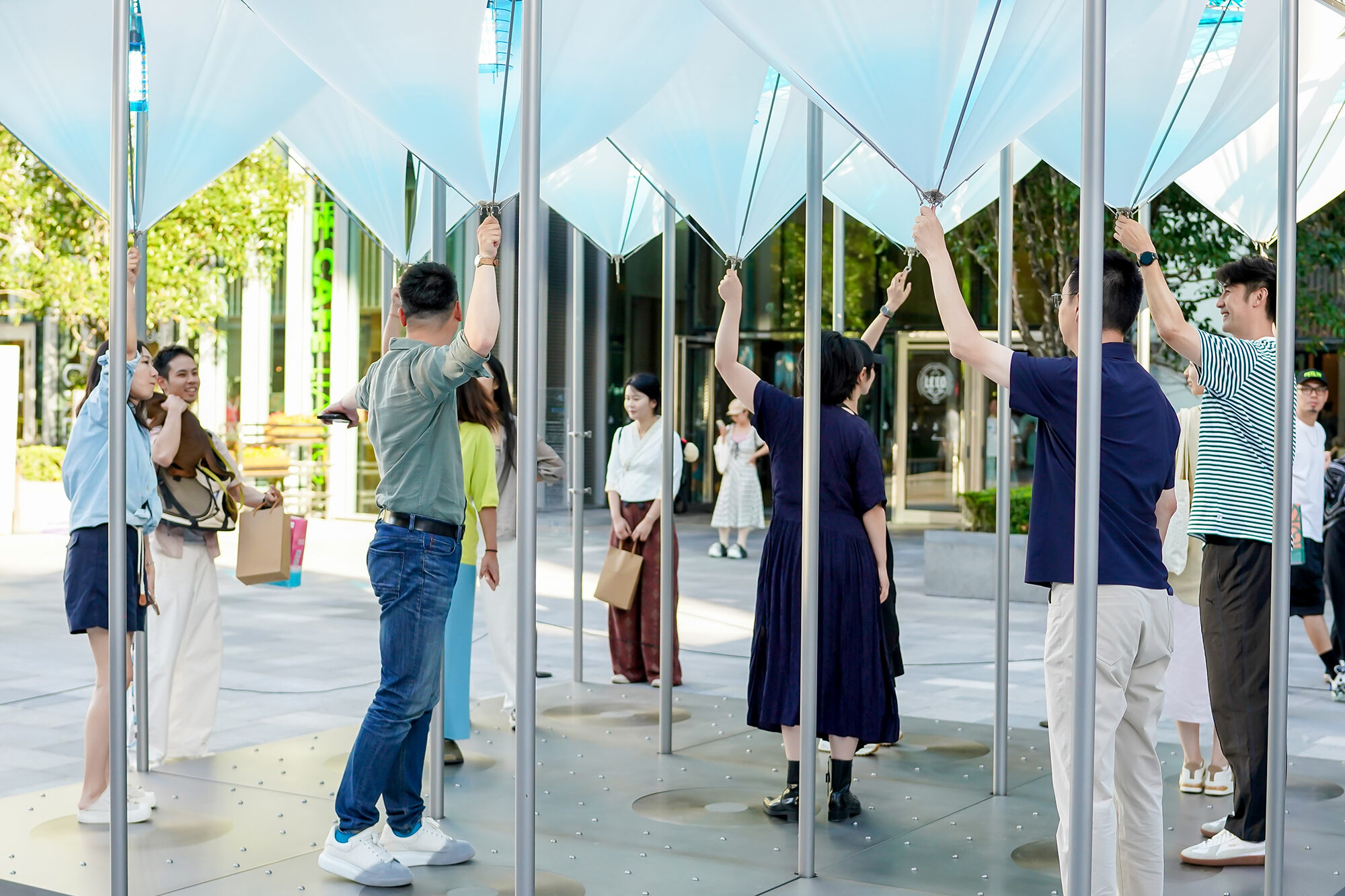
Installed at Shanghai Jing’an Kerry Centre, the public artwork consists of nine suspended geometric forms that evoke fragments of drifting glaciers. Their faceted geometry references the visible and submerged portions of an iceberg, suggesting that what can be seen represents only part of a much larger environmental system.

Walking beneath the installation, visitors become active participants. Pulling suspended elements causes the seemingly stable structures above to contract, fold, and distort. Instead of relying on digital interfaces, the installation uses direct mechanical interaction to demonstrate how even small human actions can trigger wider environmental consequences. Observation becomes participation, and participation becomes awareness.


Sustainability informed every stage of the project’s construction. The installation is assembled from modular components that can be dismantled, transported, and reused after the exhibition. Recycled steel and discarded waterproof fabric form the primary material palette, reducing waste while extending the work’s life beyond a single event.


Material expression reinforces the environmental narrative. Perforated metal surfaces reference the fractures and retreating edges of melting glaciers, while translucent white membranes capture the visual lightness of suspended ice. Reflections from polished stainless steel and shifting daylight continually alter the appearance of the installation, allowing the work to evolve with weather, light, and the movement of visitors.


Rather than treating rain as an obstacle, Glacier Project incorporates it into the experience. Water is guided through openings at the top of the structure before falling naturally across its surfaces. Droplets striking metal panels create delicate sounds, while shallow pools and reflections reshape the installation during wet weather.
These changing conditions quietly connect urban rainfall with glacial meltwater and larger climatic cycles, allowing natural phenomena to become active components of the work instead of external forces.


The project extends beyond the plaza through Flowing Glacier, a tabletop installation derived from the larger work. While Glacier Project occupies the scale of the city, Flowing Glacier brings the same environmental narrative into domestic space.


Its central medium is backflow incense. As smoke slowly descends through a translucent glass glacier, it recalls the movement of cold air and meltwater flowing through ice. The gradual downward motion becomes a visible measure of time, suggesting the irreversible nature of glacial retreat.
The sculptural form is crafted from liuli, the traditional Chinese glassmaking technique recognized as an intangible cultural heritage. Formed through fire yet recalling the clarity and fragility of ice, the material establishes a dialogue between historical craftsmanship and contemporary environmental concerns.


Beyond the outdoor installation, Dayuan Design developed an accompanying exhibition that translates scientific research into a carefully choreographed spatial experience. Film, sound recordings, artifacts, and interactive displays guide visitors through a sequence of increasingly intimate encounters with polar environments.

The exhibition unfolds through four chapters: Encounter, Remains, Listening, and Resonance. Large openings frame views between the glacier installation and the surrounding city, dissolving the perceived boundary between urban life and distant landscapes. Historical objects and photographs connect climate change to lived experience, while an immersive sound chamber replaces visual information with recordings of cracking glaciers, flowing meltwater, marine life, and the acoustic atmosphere of the polar regions.
The final chapter turns attention toward shared responsibility, encouraging visitors to recognize climate change not as a distant phenomenon but as part of an interconnected ecological system that directly shapes everyday life.
From the suspended glacier field in Shanghai to the intimate scale of Flowing Glacier, the project progressively shortens the distance between environmental change and personal experience. Public art becomes architecture, architecture becomes exhibition, and exhibition becomes an object for everyday contemplation.

For Dayuan Design, sustainability extends beyond recycled materials or low impact construction. It also concerns whether design can remain meaningful after an exhibition ends, continuing to generate reflection long after visitors have left the space. Glacier Project demonstrates how architecture and installation can make invisible systems perceptible, allowing distant environmental realities to become immediate, tangible, and deeply human.
Project Credit
Project name: “Glacier Project” Sustainable Exhibition and Spatial Installation
Location: Shanghai, China
Design Firm: Dayuan Design | @dayuan_design_official
Area: 160 sqm
Photography: © XUEQING; © sesawu
Related Posts
Previous Post
Next Post
- The timeless elegance of domestic appliances: From the Iconic Braun KF 20 aromaster to the German design ethos

- Emilio Ferro on the light, sound and memory of a place
- At Maniwa, an architect’s family home opens to the neighbourhood
- What bronze remembers of the hand

- Caught in light: Moradavaga’s suspended shoal

- The making of Alex Chinneck’s impossible Dior windows