
Now Reading: RedBall: Simple sphere and the Urban Question “What If?”
- 01
RedBall: Simple sphere and the Urban Question “What If?”


In Rennes, during the summer of 2014, a giant red sphere appeared as if the city had briefly held its breath. Inflated to roughly 4.5 metres in diameter and weighing about 113 kilograms, it pressed itself into thresholds, archways, and narrow passages where architecture is usually passed by without notice. At one point, the sphere lodged into an arch at the local opera house, transforming a transitional space into a moment of pause. The intervention was temporary, unannounced, and disarmingly direct.

The work was part of Kurt Perschke’s RedBall Project, a travelling public artwork that began in St. Louis in 2001 and has since unfolded across dozens of cities worldwide. Often described as one of the longest running street art projects still in progress, RedBall is neither monument nor installation in the conventional sense. It does not seek permanence. Instead, it arrives, occupies, and withdraws, leaving behind a subtle recalibration of how urban space is perceived.

THE CITY AS MATERIAL
Trained initially as a traditional sculptor, Perschke’s practice underwent a decisive shift when he began working in public space. Rather than treating the city as a backdrop, he came to understand it as the primary material of the work. RedBall embodies this shift with radical economy: a single, vividly coloured sphere, instantly legible and free of narrative instruction. Meaning emerges not from the object itself, but from its placement and from the reactions it provokes.
The first RedBall was commissioned by Arts in Transit in St. Louis and positioned beneath an overpass, a site defined less by function than by neglect. That initial choice established the project’s central concern: the activation of spaces that exist between architectural intentions, under bridges, between buildings, within infrastructural leftovers. From the outset, Perschke was less interested in spectacle than in attention.

OCCUPYING THE IN-BETWEEN
At the core of RedBall lies an architectural intuition. The sphere occupies voids that cities routinely generate but rarely acknowledge, residual spaces shaped by circulation, regulation, and efficiency. When filled by a body like mass, these voids are no longer neutral. A passage becomes a threshold. A gap acquires weight. An overlooked corner becomes a site of encounter.
In Rennes, where the project was presented as part of the Les Tombées de la Nuit festival, the ball’s temporary wedging into an opera house arch exposed the latent drama of the architecture itself. The gesture did not alter the building, yet it reframed it, inviting passers by to reconsider scale, pressure, and the relationship between body and structure.
PERMISSION AND PUBLIC CLAIM
The project’s relationship to authority is deliberately uneven. In some cities, RedBall operates within official cultural frameworks. In others, it tests their limits. Barcelona remains a telling example. There, Perschke proceeded largely without permission, treating the city as a field of negotiation rather than a regulated container, with the exception of a sanctioned placement at MACBA. The act was neither vandalism nor provocation for its own sake, but a question posed in spatial terms: who controls imagination in public space?
Rather than delivering a polemic, RedBall stages situations in which ownership, access, and visibility become tangible. The sphere does not declare meaning. It makes the absence of consensus visible.

SCALE WITHOUT MONUMENTALITY
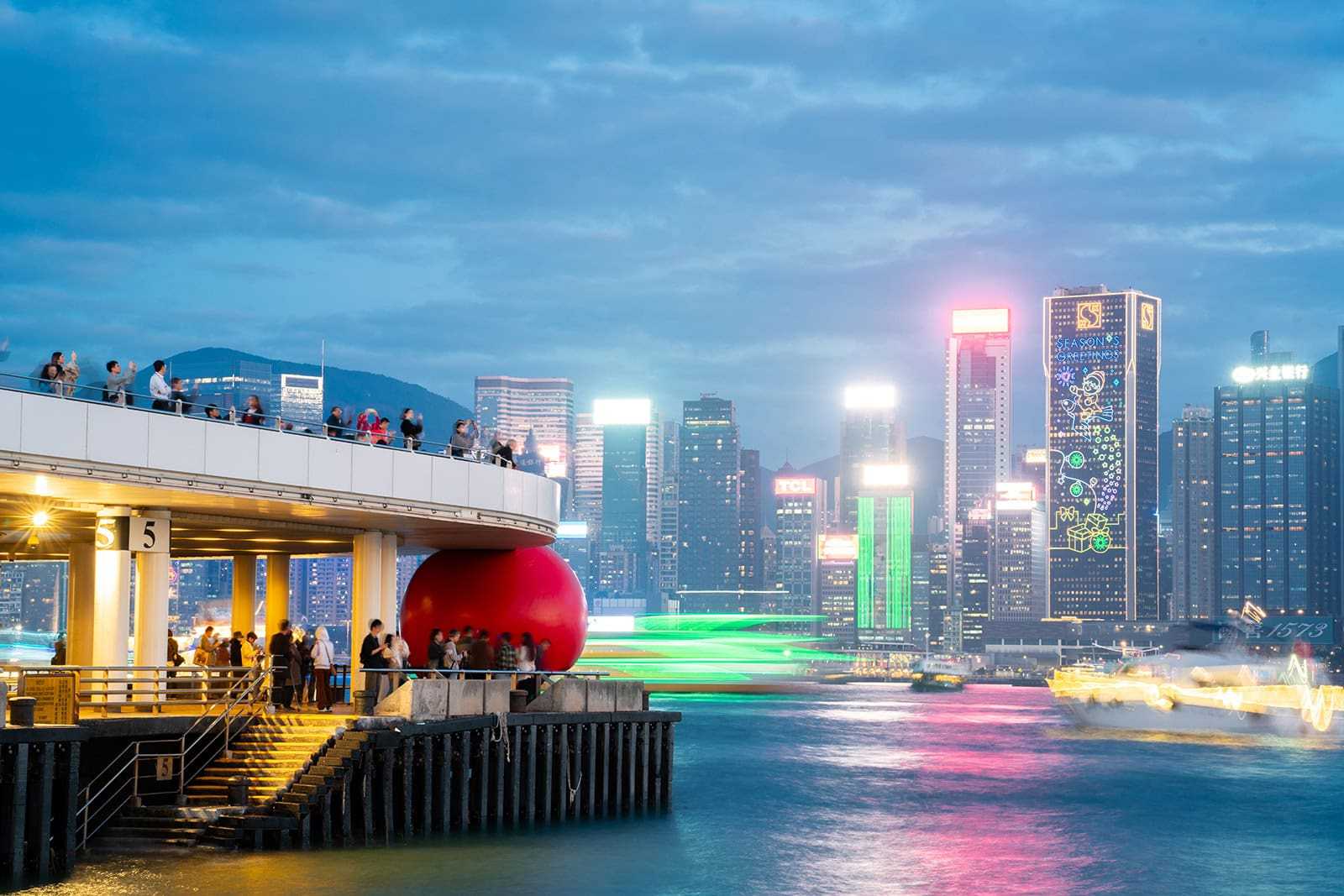
Despite its size, RedBall resists monumentality. It does not demand distance or reverence. Instead, it encourages proximity and informal engagement: a hand on its surface, a spontaneous photograph, a brief detour from routine. The work’s effectiveness lies in this inversion. What appears monumental behaves as intimate. What is visually dominant remains socially approachable.
Media coverage has often cited Perschke’s own framing of the project: while the experience may seem to be about the ball, its real power lies in what it enables, an invitation to imagine, to ask “what if?”. The simplicity of the form leaves space for projection, allowing each encounter to remain open ended.


A CHOREOGRAPHY OF MOVEMENT
If the sphere is constant, the city is not. RedBall unfolds through repetition and displacement. In Tokyo, during Roppongi Art Night 2019, the ball moved daily, reappearing in different locations and subtly redrawing the mental map of the district. The work was defined as much by its rhythm as by its presence, emphasising impermanence as a condition rather than a limitation.

Over time, this accumulation of temporary placements forms a dispersed narrative, one that connects cities not through similarity, but through the shared experience of interruption.


BEYOND THE SPHERE
While RedBall remains Perschke’s most recognisable project, his practice extends into other spatial experiments. He has designed sets for contemporary dance companies, including the Kate Weare Company, applying his understanding of space as a performative medium. His commissions for institutions such as MACBA, the Vienna Technical Museum, and the Contemporary Art Museum St. Louis reflect a practice that moves fluidly between the street and the museum, without treating them as oppositional realms.
Perschke has also engaged selectively with commercial partners, maintaining control over the integrity of the work. These collaborations acknowledge an unavoidable reality of contemporary cultural production: public visibility often intersects with economic frameworks. What distinguishes RedBall is not a rejection of this condition, but a consistent insistence that the work’s meaning remains anchored in experience rather than branding.
THE VALUE OF INTERRUPTION
RedBall does not propose new architecture. It builds nothing, renovates nothing, and leaves no trace once removed. Its contribution lies elsewhere, in revealing what is already there. By occupying forgotten spaces with a form both absurd and precise, the project exposes the latent possibilities embedded in the urban fabric.


In a period when cities are increasingly shaped by optimisation, surveillance, and managed experience, Perschke’s work introduces a rare pause. It asks for attention without instruction and offers imagination without conclusion.
RedBall is not an answer. It is a prompt. A simple, persistent question posed to the city and its inhabitants alike: what if?


Photo Cover
Iconic RedBall wedged into a dramatic architectural pier setting in Hong Kong (recent placement), capturing the project’s essence of interruption and scale in urban space. Credit: Kurt Perschke / RedBall Project.