Now Reading: Janet Echelman and the art of sesilient futures in Radical Softness
- 01
Janet Echelman and the art of sesilient futures in Radical Softness


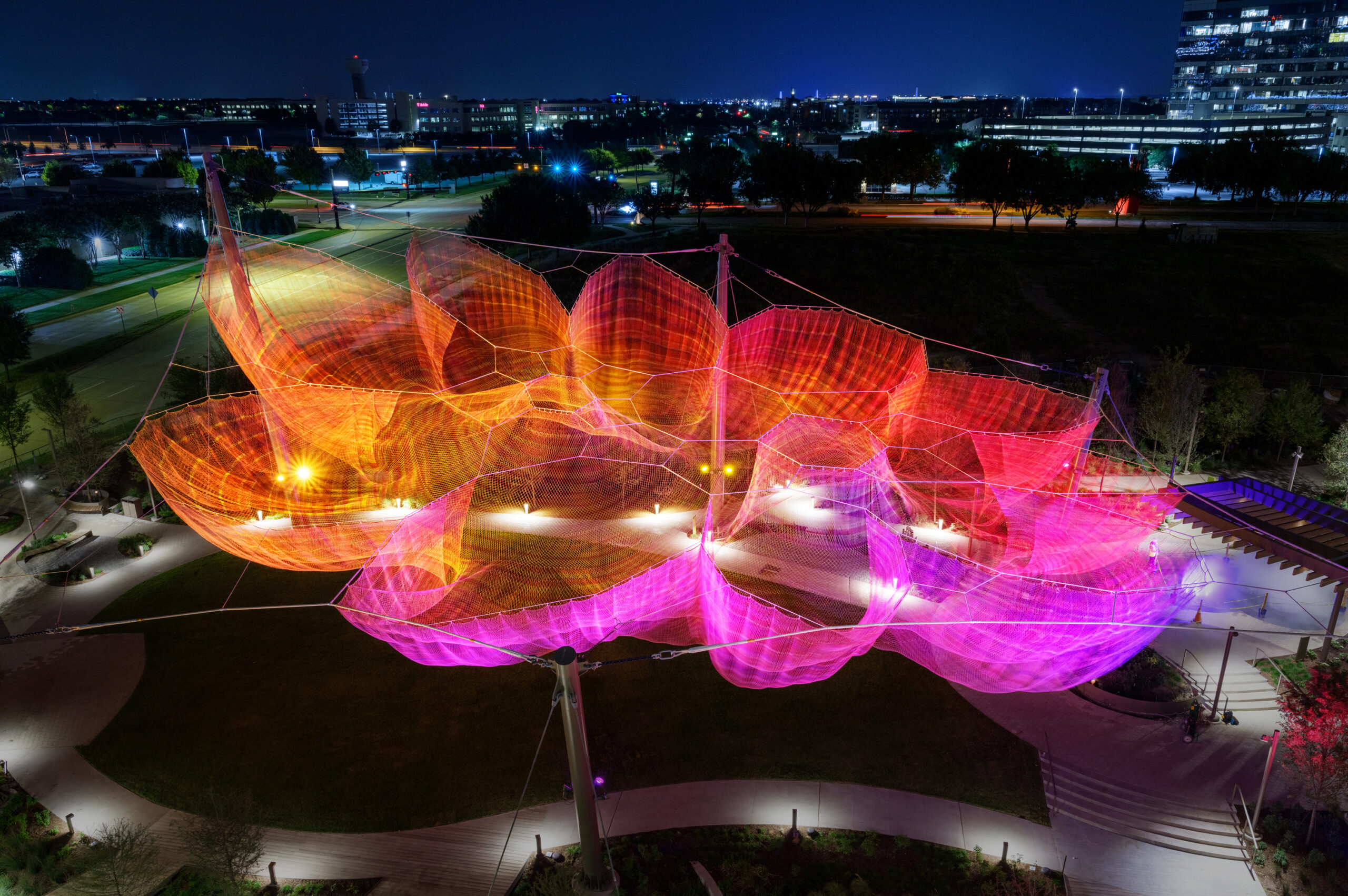
In the hands of Janet Echelman, beginning with the seismic whisper of 1.26, art no longer operates as a static monument. It becomes a living dialogue, one that breathes with the wind, shifts with the light, and unfolds in real time. Her installations ask viewers not merely to look, but to situate themselves within a dynamic field of forces, inviting a reconsideration of our place in an increasingly precarious world.


Echelman’s legacy is already inscribed across the skylines of cities on multiple continents. From the enduring ripple of She Changes hovering above Porto’s harbor to the patient bloom of Her Secret is Patience suspended in the desert air of Phoenix, her works occupy a scale that is at once monumental and intimate. More recently, Remembering the Future has taken residence in the grand lobby of the MIT Museum, where climate data drawn from the last ice age branches outward into speculative futures. These installations do not simply inhabit space. They actively reconfigure it, transforming the hardness of urban environments into moments of collective pause, attentiveness, and wonder.
As observed by Sarasota Art Museum associate curator Lacie Barbour in the context of the Radical Softness exhibition, Echelman’s notion of softness functions not only in material but as a philosophy. It is a way of thinking that reshapes how physical space is perceived and how interpersonal connections are formed. Softness, in this sense, becomes an operative strategy rather than a passive condition, allowing structures to respond, adapt, and remain open to change.
The resonance of this legacy feels particularly acute in the present moment. As of January 2026, with the Sarasota retrospective continuing through April, Echelman’s work unfolds against a backdrop of accelerating climate instability, political fragmentation, and the relentless compression of attention produced by digital life. Her vast nets, crafted through ancient knotting techniques yet fabricated from aerospace grade fibers, embody a quiet resistance to rigidity. They propose an alternative understanding of resilience, not immovability, but adaptive pliancy. Not dominance over forces, but the capacity to distribute stress, to billow without breaking, and to connect disparate elements into a coherent whole.
In Remembering the Future, suspended in MIT’s public interior through fall 2027, Echelman extends this logic across time as well as space. By weaving together data from deep geological history with contemporary climate modeling, the work expands the temporal horizon through which human agency is understood. It poses a deceptively simple yet urgent question: what does it mean to be human now, knowing what we know about the past and estimations for the future? The installation becomes a sculptural meditation on responsibility in an era when individual actions ripple outward on a planetary scale, echoing in conceptual form the infinitesimal shortening of Earth’s day that first inspired 1.26.
Looking forward, Echelman’s trajectory shows no indication of slowing. Her studio has signaled forthcoming projects across Europe, the Middle East, and North America in 2026 and beyond, suggesting a continued expansion of both geographic reach and conceptual ambition. At the same time, collaborations such as the aerial performance Noli Timere, set to premiere at Boston’s Cutler Majestic Theater with choreographer Rebecca Lazier and composer Jorane, point toward a further evolution of her practice into live, embodied experience, where movement, sound, and suspended form converge.


The recent publication Radical Softness: The Responsive Art of Janet Echelman reinforces this expanded field of influence. With a foreword by Swizz Beatz and contributions from scholars, engineers, architects, and designers, the volume operates simultaneously as an archive and a manifesto. It situates Echelman’s work within a broader interdisciplinary conversation, ensuring its relevance across art history, computational thinking, landscape architecture, and the design of public space.

From the vantage point of an editor who has followed the arc of contemporary practice for decades, Echelman’s work marks a significant shift, from art conceived as an autonomous object to art understood as a relational field. Her installations do not encourage passive spectatorship. They require presence. Standing beneath these hovering structures, viewers become aware of subtle atmospheric changes, the pull of wind, the modulation of light, and the shared silence among strangers gathered below. In these moments, public space is reclaimed as a site of empathy and collective imagination.

Ultimately, Echelman’s practice offers a compelling redefinition of strength itself. Softness, in her work, is not a diminishment but an elevation. In a cultural climate that often valorizes the fixed, the rigid, and the absolute, her whispering webs propose another model of endurance. The most resilient structures, they suggest, are those that bend, that yield, and that weave individual lives into a larger, responsive whole. From the seismic echo of 1.26 to the branching futures envisioned in her most recent works, Janet Echelman invites us to take imagination, and radical softness, seriously. In doing so, she offers not certainty, but a form of resilience attuned to whatever may come next, one gentle undulation at a time.

Photo Cover
Aerial view of Janet Echelman’s vibrant, illuminated net sculpture at night, symbolizing radical softness in urban spaces. Credit: AAP Cornell University.