Now Reading: Brooklyn Dairy Project: Industry city as an urban productive System
- 01
Brooklyn Dairy Project: Industry city as an urban productive System


The Brooklyn Dairy Project proposes a radical yet grounded transformation of South Brooklyn’s historic Industry City, recasting a vast industrial enclave as a productive, publicly accessible, and environmentally regenerative urban landscape. Rather than treating the site as a relic of manufacturing heritage or a tabula rasa for redevelopment, the project positions industry, agriculture, and daily urban life within a single, continuous system.
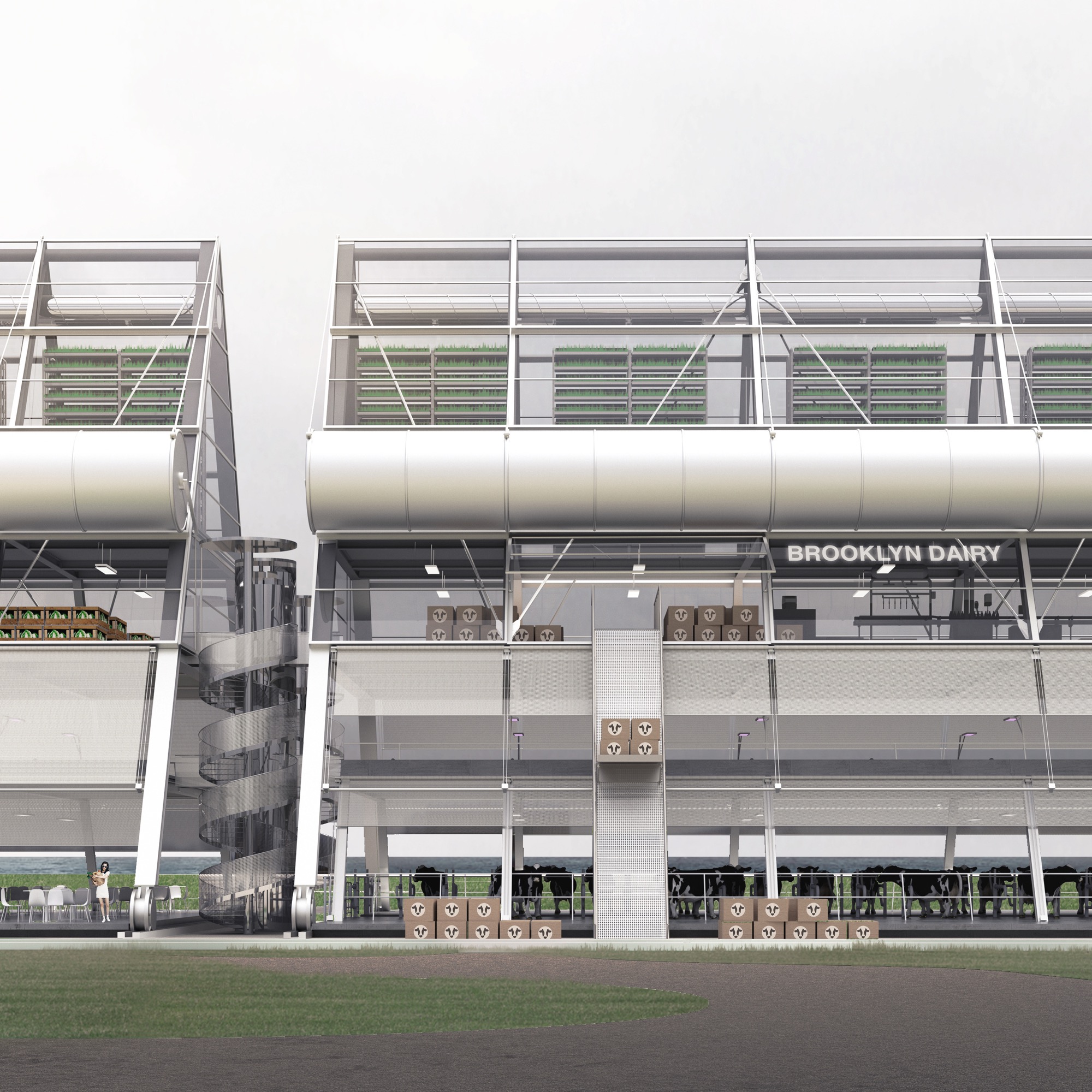
At the heart of the proposal are two intertwined programs, a contemporary dairy facility and an urban farm. Together, they respond to long standing issues of spatial segregation and limited accessibility that have historically defined the area. By reopening the site to the city and embedding food production into its fabric, the project reframes Industry City as a civic resource rather than a closed industrial zone.

The design draws its spatial logic from the linear infrastructures that surround the site, particularly the adjacent highway and existing railway lines. These elements are extended and reinterpreted as organizing devices, stitching the project back into the wider urban context. A network of roads and tracks subdivides the expansive industrial ground into modular and adaptable fields, allowing the overwhelming scale of the site to be recalibrated into legible, human oriented spaces.
Former rail lines are reused as logistical corridors for both internal circulation and external distribution, reinforcing the site’s productive character while reducing reliance on new transport infrastructure. Warehouses are adapted for agricultural use, including hay storage and processing, creating a closed loop system that supports dairy production on site.

Landscape is not treated as an ornamental layer but as a working ecological system. The ground is reconstituted with nutrient rich soil capable of supporting diverse crops, pastureland, and dairy farming. This multi layered landscape promotes biodiversity, contributes to soil remediation, and gradually transforms a formerly hard industrial surface into a living terrain.


Agriculture unfolds vertically as well as horizontally. Sheltered cow gardens and public gathering spaces occupy the ground level, allowing animals and visitors to coexist within a shared environment. Above, aquaponic systems and greenhouse production areas introduce controlled agricultural processes, expanding productivity while minimizing land use.
Architecturally, the project emphasizes flexibility and environmental responsiveness. Upper building sections are designed to move and transform in response to seasonal shifts and extreme weather conditions. Sliding panels, unfolding sheds, and adjustable enclosures create a dynamic envelope that supports crop growth while mediating light, ventilation, and temperature.


This adaptability extends to programmatic zoning. Along the southern edge of the site, transportation and distribution functions maintain a direct relationship with the city’s logistical networks. In contrast, the northern areas are reserved for farmland and shared open spaces, offering a quieter, more contemplative environment for both animals and urban residents.
The Brooklyn Dairy Project presents a holistic vision of urban revitalization in which industrial heritage, contemporary agriculture, and public life operate as a single ecosystem. The repeated movement of a triangular module across the site becomes a symbolic and spatial device, representing evolution, continuity, and interdependence.

By transforming Industry City into a productive landscape that feeds the city both literally and socially, the project challenges conventional boundaries between urban and rural, production and leisure, architecture and landscape. It offers a compelling model for how post industrial sites can evolve into inclusive, resilient infrastructures for the future city.

Yujin Cao (@yujincao_)is a multidisciplinary architect, artist, and educator whose practice bridges architecture and visual art. Educated in Urban Design at the Harvard Graduate School of Design, she works across architecture, painting, installation, photography, and film, developing immersive and concept driven narratives. Her international experience across Asia, North America, and Europe shapes a globally informed design approach.
Yujin’s work has received major international awards, including Architizer A+, International Design Awards, and MUSE Design Awards, with her architecture project earning Distinction at Harvard. Her artistic work has been featured on platforms such as KOOZARCH and Harvard Zone 3, and she regularly serves as a juror for international design competitions.