Now Reading: Beijing City Library: Snøhetta builds a reading landscape under a canopy of ginkgo light
- 01
Beijing City Library: Snøhetta builds a reading landscape under a canopy of ginkgo light

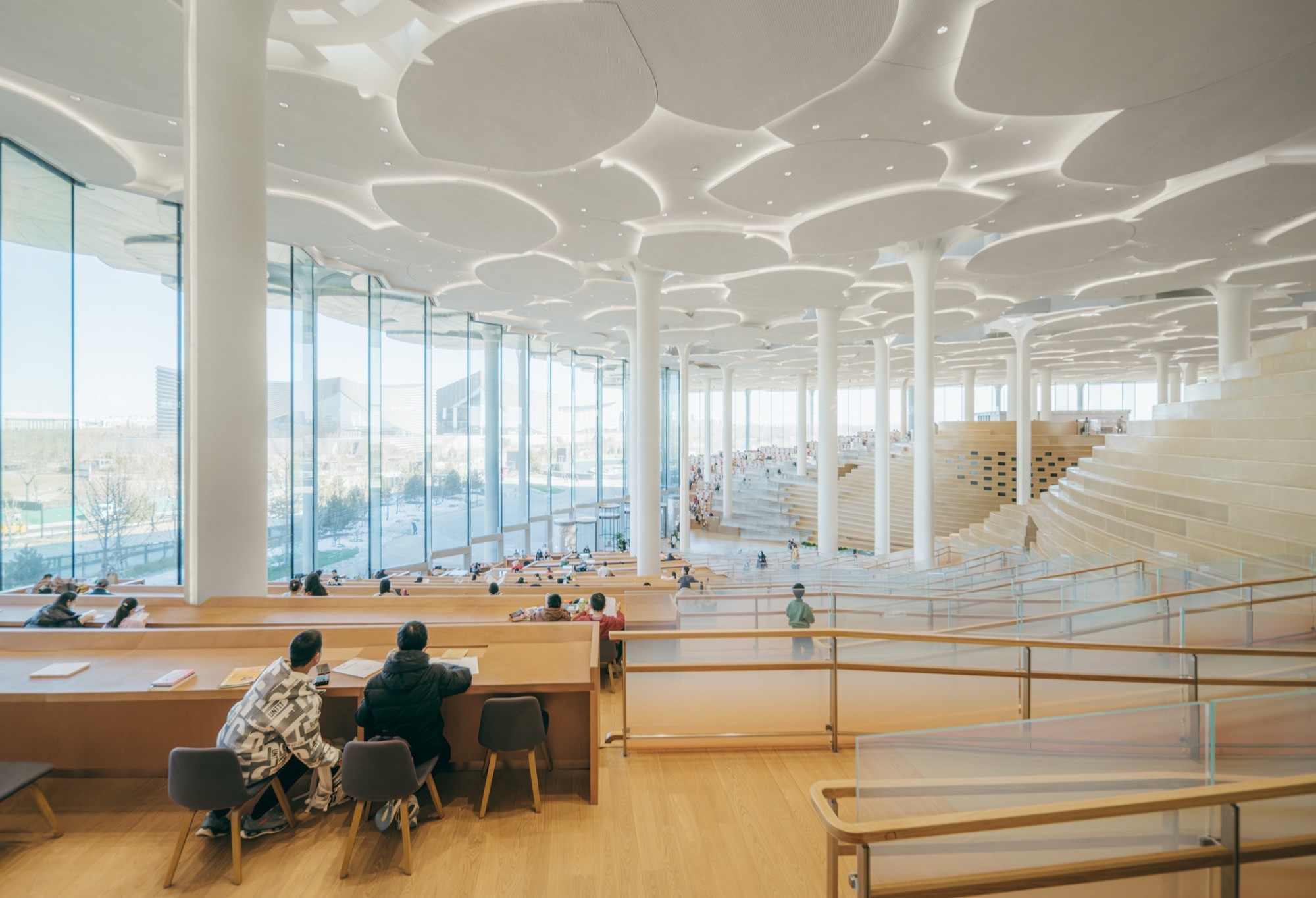
Beijing City Library: Snøhetta builds a reading landscape under a canopy of ginkgo light

Snøhetta’s Beijing City Library arrives in Tongzhou with a pointed ambition: to make the library feel necessary again. Rather than treating digitisation as an existential threat, the project doubles down on what screens cannot replace, the bodily pleasure of wandering, pausing, and reading in a space that stages attention as an experience. Conceived as a modern hub for learning, knowledge sharing, and social life, the building expands Beijing’s cultural infrastructure with rooms designed to host far more than books.

At the heart of the project is a monumental interior environment engineered for year round comfort at a civic scale. A welcoming forum rises to nearly sixteen metres, from which terraced surfaces lift and fold like indoor terrain. These sculpted “hills” operate simultaneously as seating, shelving, and informal rooms for study, conversation, and rest, turning reading into something closer to inhabiting a landscape than occupying a hall.


Circulation becomes narrative. A meandering route known as the Valley cuts through the centre as the library’s main artery, linking the north and south entrances while echoing the nearby Tonghui River. It frames the interior as a continuous public room, where movement becomes a form of browsing, and where visitors can look across terraces of readers as if surveying a public park.


The library’s most memorable figure is structural, yet it is also environmental. Tall, slender columns rise and flare into ginkgo leaf shaped panels, referencing a tree native to China while forming a ceiling that filters daylight into the reading areas. The overlapping panels and glass inserts create a luminous canopy that softens the vastness of the room and calibrates glare for long stays with a book. Here, structure is not just support. It becomes atmosphere, and it carries the hidden work of the building as well, integrating climate control, lighting, and acoustics into the architectural language.


Behind the calm, park like interior sits heavy duty logistics. The library incorporates a major automated system for storing and retrieving books, allowing large scale collections to be handled efficiently while keeping the public spaces generous and uncluttered. It’s a precise pairing of two worlds: the slow, intimate rhythm of reading and the fast, invisible choreography of contemporary infrastructure.
Transparency is treated as both a spatial promise and a technical challenge. Expansive glass façades open views to the surrounding landscape and allow the library to register the changing day, while generous roof overhangs work to limit solar gain. High performance glazing and careful calibration of the most exposed orientations reinforce the building’s environmental discipline, proving that a glass lined public interior can still be designed with restraint.


Nature is not only referenced, it is physically staged. Ginkgo trees mark the entry points, extending the project’s interior metaphor into the site itself and strengthening the bond between reading and landscape. Performance, exhibitions, conferences, and the restoration of ancient texts are folded into the programme, positioning the library as a cultural condenser, part forum, part archive, part public living room.

There is a long arc embedded in this commission. Decades after Snøhetta’s early library work, Beijing City Library reframes the institution not as a monument to knowledge but as an environment for it. In doing so, the project proposes a contemporary answer to an old question: what is a library for? Here, the response is spatial and emotional. It is a place where books are still physical, where learning is social, and where architecture makes room for attention.


Project Credit
Project name: Beijing City Library
Location: China, Beijing
Architecture Firm: Snøhetta / @snohetta
Completed: 2024
Photo: Zhu Yumeng