Now Reading: Inside Corberó’s Labyrinth: A house built as Practice
- 01
Inside Corberó’s Labyrinth: A house built as Practice

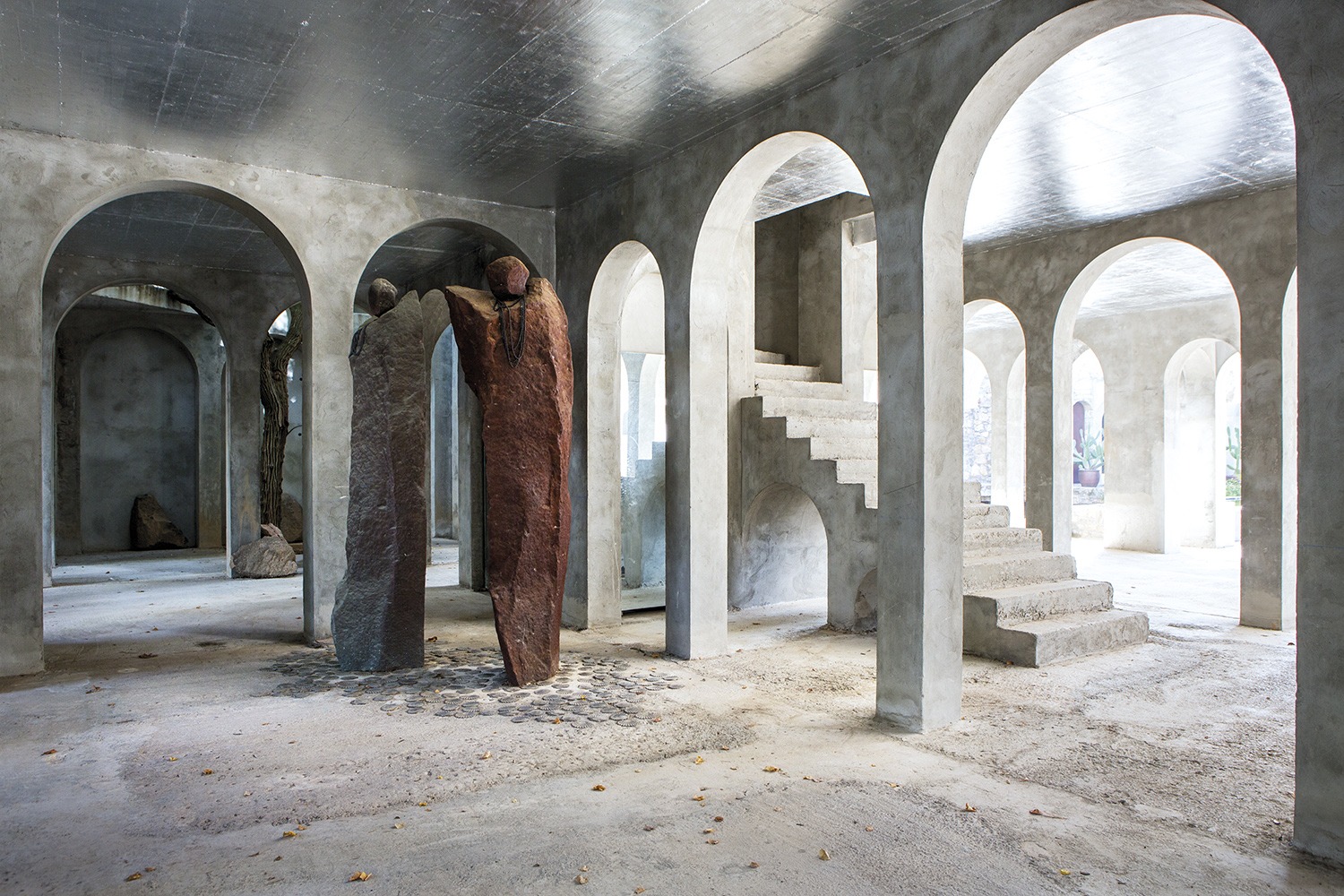

Espai Corberó sits in Esplugues de Llobregat, just outside Barcelona. It is not simply a residence. It reads as a long act of making: concrete arches, courtyards, stair runs, and suspended landings. Corberó treats space the way a sculptor treats mass. He carves, repeats, and adjusts over time.
You arrive expecting a private address. The approach stays modest: walls, a gate, a hint of privacy. Once inside, the place opens into sequences rather than rooms. Concrete dominates, but transitions shape the experience. You move from shade to sun, from compression to release, from corridor to courtyard.

Sound travels and returns. Footsteps change as you leave a tight passage and enter a larger void. Water sits somewhere in the plan. You hear it before you see it. Temperature and scent shift between enclosed corridors and open patios.

People call Espai Corberó labyrinthine. The word fits, but in a precise way. The house never gives you full orientation. Stairs do not always lead to a clear destination. Sightlines bend. Familiar points reappear from new heights and angles. The place does not aim for confusion. It trains attention. It makes the body part of looking. It forces you to track light and shadow. It turns each change of direction into information.
The threshold is not only architectural. It is conceptual. Espai Corberó asks a blunt question: what happens when the home becomes an artwork, and the artwork becomes a way of living? The compound does not sit alone in a landscape. It sits inside a town. Neighbors and streets press close. Ordinary life surrounds the site. The place does not reject that world. It insists on a different tempo within it.
1968: “MAKING POETRY” AS A MATERIAL COMMITMENT
Accounts of the house return to 1968. That year, Xavier Corberó bought the site and began a transformation that would take decades. Writers often repeat one phrase from that beginning, “hacer poesía,” to make poetry, because it frames the project as labor, not image.
Duration shapes the meaning of Espai Corberó. The compound does not behave like a finished architectural object. It behaves like a studio method you can inhabit. Corberó builds, tests, adjusts, and lives with the results. He does not complete a single closed design. He keeps adding, revising, and reconfiguring. Time becomes a material here.
The idea of “poetry” becomes procedural. It means return, refinement, and change. The compound grows through iteration, not ornament. Corberó works with a limited vocabulary: arches, stairs, courtyards, platforms. He repeats it, then shifts it slightly each time. The result is accumulation. The eye learns through return.
A ROUTE THROUGH LIGHT, SOUND, AND THRESHOLDS
The most direct way to understand Espai Corberó is to treat it as a route. Not a museum tour with labels and linear narrative. A walk turns you into a reader. Courtyards work like paragraph breaks; corridors carry the sentence forward; stairs shift the register.
A first courtyard often feels like relief. The entry compresses, then the sky appears as ceiling and the building’s edges become frames. The courtyard stays “empty” on purpose. It acts as a calibrated void that distributes light into surrounding spaces. You begin to notice how concrete holds shadow, and how the same arch feels heavy at noon and lighter late in the day.

Then the route tightens again. Arched corridors pull you into shade. The air cools slightly. Acoustics sharpen. Footsteps seem louder because surfaces stay continuous and reflective. A turn opens onto another courtyard, smaller, perhaps more intimate, where the void reads less like a plaza and more like a room without a roof. Here, smell and sound matter, not as decoration but as structure.
Stairs act as both infrastructure and provocation. Some runs connect levels in a conventional way. Others end on platforms that feel like stages. They invite you to stop and look, and they make you visible in return. Writers often compare the site to Escher. The “impossible” quality does not come from tricks. It comes from partial resolution. A stair gives you elevation, then refuses closure. It grants a vantage without declaring its purpose.

At times the compound feels subterranean, even when you stay above ground. Dense arches and deep shade can make it feel carved from a single mass. Then a courtyard opens and daylight returns. The place repeats this alternation until rhythm emerges. You start to anticipate release. You also see why the site reads so strongly on camera. It sequences perception by design.
HOME, STUDIO, ARCHIVE
In the 2010s, film and editorial coverage sharpened public perception of Espai Corberó as both home and working environment. NOWNESS’s In Residence episode, directed by Albert Moya, follows Corberó through the compound as if he walks inside his own practice. The film avoids over-explaining. It relies on movement and proximity. He touches, turns, pauses, and lets use speak.
That approach matters. The compound photographs well, but it does not behave like a picture. It reveals itself through movement and return. Standard labels fail here. House, gallery, set, museum, all apply at times, but none holds fully. The compound treats circulation, thresholds, and voids as the primary medium. It turns passages into the main event.

The arch anchors that logic. It does not act as ornament. It acts as grammar. Repetition sets rhythm; rhythm sets pace. Arches regulate how much sky you see, how light enters, and how sound carries. Courtyards reset perception. They divide the ensemble into chapters. One passage compresses into shade; the next opens into a patio where sky becomes ceiling; the route narrows again and squeezes light into a thin strip. Patios bring air and light in practical terms. They also keep the architecture from collapsing into sameness. They make small differences legible: an angle of sun, a sound of water, a temperature shift.

Meaning emerges through repeated encounters. You pass the same arch twice. You notice a new shadow. A small stair rise changes your view of the same courtyard. Repetition makes difference legible, and legibility is the labyrinth’s real output.
VOICES ACROSS TIME AND CIVIC SCALE
Interviews and broadcasts place the house back into Corberó’s cultural position. A 1964 entry in the WFMT Studs Terkel archive frames him through Catalan and Castilian folk traditions. It ties form to collective memory and regional craft. TVE Catalunya’s Giravolt, filmed in 1975, shows Corberó in his home environment and makes the overlap between living space and working space unmistakable. A fondo, from 1976, places him in a broader media frame as a cultural figure in long-form conversation. Apartamento’s 2015 interview shifts to intimate portrait and reads him through habits, objects, and domestic ecology, an apt lens for a practice where the house becomes part of the work.
Corberó’s public profile also reaches beyond this compound. Reporting around his death in 2017 notes his link to Barcelona’s civic imagery, including his role in designing the Barcelona ’92 Olympic medal. That detail points to a practice comfortable with public symbolism and scale.
That civic scale returns here in private form. The compound organizes itself around routes and nodes. Courtyards read like small plazas. Stairs read like streets. Arches repeat like infrastructure. Ownership stays domestic, but structure reads urban. The old question, architecture or sculpture, matters less than what the place does. It teaches you to read space like a work over time.
FROM PRIVATE TO PUBLIC: CARE, ACCESS, AND THE PROBLEM OF PRESERVATION
In 2022, the story changed phase. The town moved toward public stewardship. The shift forces a different evaluation. Private hands can follow the maker’s logic. Public hands must manage maintenance, access, interpretation, and long-term care.
Conservation becomes a conceptual task. What do you conserve? You cannot freeze a single canonical plan. You cannot point to one definitive “as built” moment. Materials record phases, decisions, and budgets. Conserving a “look” would hollow the work out, because Espai Corberó is not a look. It is a method made visible.

Standard adaptive reuse often follows a pragmatic script: keep the shell, upgrade services, add program. Espai Corberó resists that script because it already acts as a program. It works as a spatial machine for movement, pause, encounter, and atmosphere. Public access will require safety measures, staffing, and conservation planning. Too much normalization could undo what makes the site worth caring for.
A more suitable model may come from museums that conserve installation art. They separate the work from replaceable components. They define what must remain, what can be repaired, and what can be remade under strict conditions. A similar logic could preserve Espai Corberó’s core capacity: slow movement, calibrated light, and thresholds that force attention.

Public presentation will tempt spectacle. Visitors will want a photogenic maze to “discover.” The deeper value lies elsewhere. The site teaches practice, iteration, and continuity between life and work. It shows how a limited vocabulary can generate variation. It shows how patience can operate as a design tool. It shows domestic space as a long-term artistic medium.
Espai Corberó does not ask for quick admiration. It asks for experience. It teaches attention in practical terms. It makes you track light, sound, and repetition. It slows perception rather than accelerating it. Corberó built neither a neutral home nor a pure set piece. He built an argument in concrete: practice can be lived, making can unfold across decades, and a house can operate as a continuous work rather than a completed object. If the site succeeds as public space, it will succeed by keeping that premise intact, one courtyard, one arch, one slow turn at a time.

Photo Cover
Panoramic view of Espai Corberó’s interconnected concrete arches and courtyards, embodying the sculptural labyrinth.
Credit: Photography by Mari Luz Vidal for Openhouse Magazine.