Now Reading: From Percutaneous Delights to Delirious Decay: The subversive intelligence of Gelitin
- 01
From Percutaneous Delights to Delirious Decay: The subversive intelligence of Gelitin

From Percutaneous Delights to Delirious Decay: The subversive intelligence of Gelitin

PERCUTANEOUS DELIGHTS, 1998
In the summer of 1998, the courtyard of MoMA PS1, then still widely known as P.S.1 Contemporary Art Center, was reconfigured into an improvised public environment. As part of the early Young Architects Program, Gelitin constructed Percutaneous Delights, a large scale installation assembled from salvaged furniture, timber structures, inflatable pools, and ad hoc cooling devices.

The work did not stabilise into a singular form. It operated as an inhabited field. Visitors climbed stacked domestic remnants, reclined on provisional platforms, moved through dampened air, and occupied structures that hovered between sculpture and temporary architecture. The courtyard ceased to function as neutral container. It became a site of negotiated use.


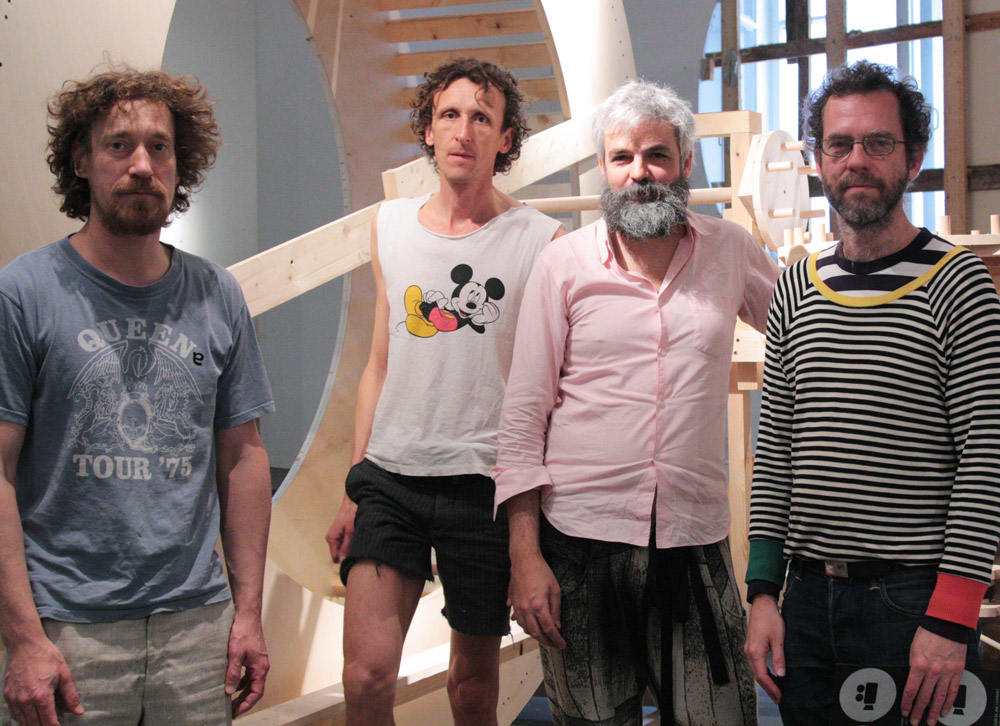
Formed by Ali Janka, Florian Reither, Tobias Urban, and Wolfgang Gantner, the Vienna based collective had been collaborating since the early 1990s, following an initial encounter at a summer camp in 1978. That origin is not anecdotal. It informs the procedural looseness of their practice. Improvisation is not decorative rhetoric but operational logic.
Percutaneous Delights clarified the elements that would persist throughout their work. Participation is constitutive rather than supplementary. Humour disrupts authority. The body anchors perception. Instead of refining space, the installation exposed it to friction.
THE B THING, 2000
If Percutaneous Delights recalibrated public space through invitation, The B-Thing tested constraint directly.
In 2000, while occupying a temporary studio on the 91st floor of the North Tower of the World Trade Center, Gelitin removed a window pane and constructed a small external balcony projecting into open air more than 300 metres above Manhattan. The intervention was brief and later presented through sparse photographic documentation and a publication.

The gesture condensed several tensions central to their practice. It confronted architectural enclosure with exposure. It replaced compliance with physical experiment. It treated impossibility as a prompt rather than prohibition.

Completed one year before September 11, the work now carries an unavoidable historical charge. Yet its internal logic was neither allegorical nor prophetic. It functioned as a literal extension of space, executed with calculated imprudence. The balcony was not metaphor. It was an addition.
The question embedded in the act remains disarmingly direct. Where does architecture end, and who determines that limit.

HASE, 2005
In 2005, Gelitin relocated their inquiry to landscape scale. On Colletto Fava in the Italian Alps, they installed Hase, a pink rabbit approximately 55 metres long.
Constructed from knitted fabric and filled with straw, the sculpture was intended to remain in situ until 2025, gradually deteriorating through weather, gravity, and biological process. Visitors climbed onto its surface, treating it as both figure and ground.
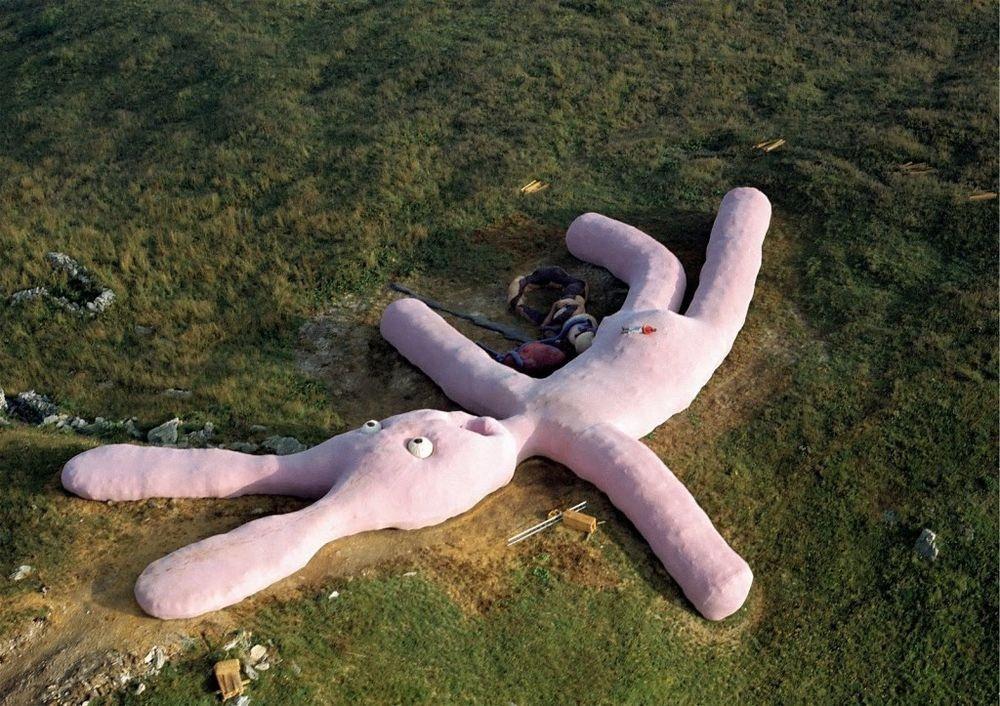
Unlike conventional monuments, Hase was structured around planned obsolescence. Its erosion was not incidental. It was integral. As seams opened and colour drained, the rabbit shifted from recognisable form to dispersed material. Landscape absorbed sculpture.
The work extends Gelitin’s interest in instability beyond the urban into temporal and ecological registers. Monumentality here is provisional. Permanence is a condition negotiated with entropy.

VORM FELLOWS ATTITUDE, 2018
By 2018, Gelitin’s engagement with the body moved toward explicit abjection in Vorm – Fellows – Attitude at Museum Boijmans Van Beuningen.
The installation filled a large gallery with monumental sculptures modelled on excrement. Visitors entered wearing protective suits, navigating between forms scaled beyond bodily proportion. The oscillation between laughter and discomfort was immediate.

The use of scatological imagery operates less as provocation than as recalibration. Bodily waste collapses symbolic hierarchy. It resists refinement. By monumentalising it, Gelitin displaced the abject into shared visibility.
Where earlier works foregrounded leisure and risk, this project foregrounded confrontation. Yet the tone remained measured. The grotesque was neither sensationalised nor sanitised. It was installed.


METHOD AND CONTINUITY
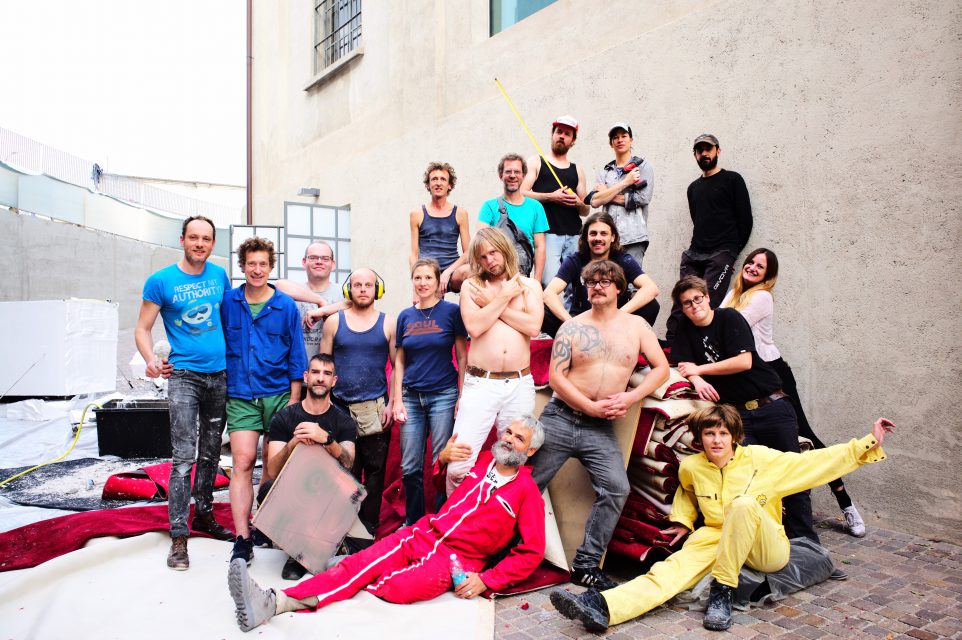
Across these works, several structural consistencies emerge. Participation is embedded within the work’s mechanics. Without bodies, the installations remain incomplete. Humour functions tactically. It lowers defences while preserving conceptual precision. Decay is treated as collaborator. Time is not external to the artwork but integrated into its unfolding. Collective authorship remains foundational. The four members operate without hierarchical attribution. Decision making circulates rather than consolidates.

RECALIBRATING THE POSSIBLE
From the provisional civic environment of Percutaneous Delights to the gradual dissolution of Hase, Gelitin has sustained a practice grounded in physical testing. They do not articulate theory first and illustrate it later. They construct situations that expose limits.
In an art landscape often mediated by discourse before experience, Gelitin maintains an insistence on embodied encounter. Structures are climbed. Surfaces are worn. Materials yield.
Absurdity in their work is not decorative eccentricity. It is a method of destabilisation. By inserting improbability into regulated systems, they reopen questions of access, authorship, and duration.
In a period shaped by digital abstraction and remote interaction, the material directness of their installations acquires renewed resonance. Their projects function less as statements than as provisional assemblies. They gather strangers into unstable proximities and allow friction to occur.
What persists across decades is not style but disposition. A willingness to test constraint physically. A readiness to let erosion complete what construction begins.
That disposition continues to define their relevance within contemporary art.
Photo Cover
Group portrait of Gelitin members Ali Janka, Florian Reither, Tobias Urban, and Wolfgang Gantner in a studio setting. Credit: Courtesy of Wikipedia.