
Now Reading: Jean Arp and the discipline of chance
- 01
Jean Arp and the discipline of chance


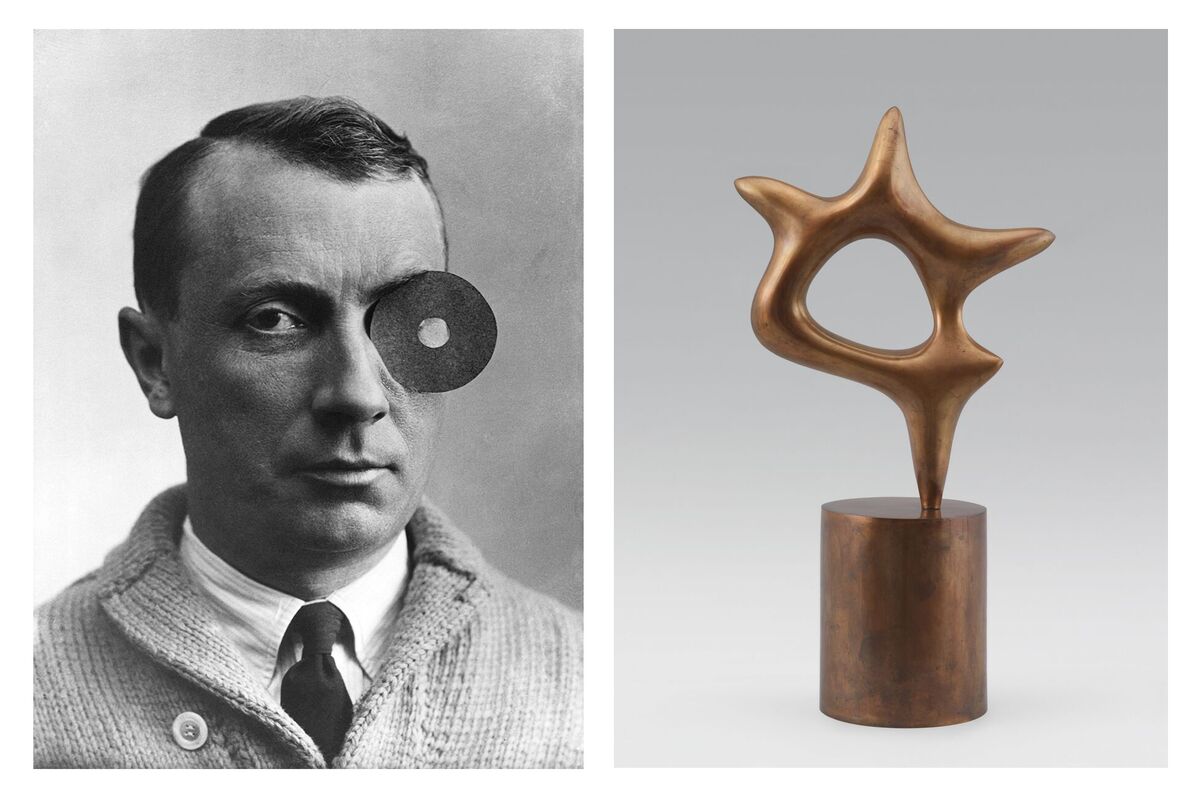
ORGANIC FORM BEYOND DADA
In the early decades of the twentieth century, European art oscillated between two dominant impulses: the machine and the organism. One privileged system, clarity and control. The other suggested growth, contingency and transformation. Jean Arp aligned himself decisively with the latter. Not as ornament, not as nostalgia, but as structural proposition.
Born in 1886 in Strasbourg, then part of the German Empire, Arp grew up within political and linguistic instability. He signed his works “Hans” in German contexts and “Jean” in French ones. This duality was more than biographical detail. It shaped an early awareness that identity is provisional, that boundaries are negotiated rather than fixed. His art would adopt the same condition.
Arp studied at the Kunstschule in Strasbourg before continuing at the Académie Julian in Paris and later in Weimar. These formative environments exposed him to Symbolism, Jugendstil and early abstraction. Yet it was not formal experimentation alone that determined his trajectory. It was the experience of war.
ZURICH 1916: DECENTRING CONTROL
In 1915 Arp moved to Zurich, a neutral refuge during the First World War. At Cabaret Voltaire in 1916, alongside Hugo Ball and Tristan Tzara, he helped shape what became Dada. Publicly, Dada appeared anarchic and anti rational. Arp’s contribution, however, was less theatrical and more structural.
For him, Dada was not an end in negation but a reorientation of authorship.

Industrial logic had culminated in mechanised devastation. Systems had detached from life. The response, for Arp, was not to abandon structure but to suspend domination. Chance became both method and ethical stance.
Collage with Squares Arranged According to the Laws of Chance, produced between 1916 and 1917 and now in the collection of the Museum of Modern Art, remains the clearest articulation of this position. Arp tore coloured paper into fragments of similar scale, dropped them onto a support and fixed them where they landed.
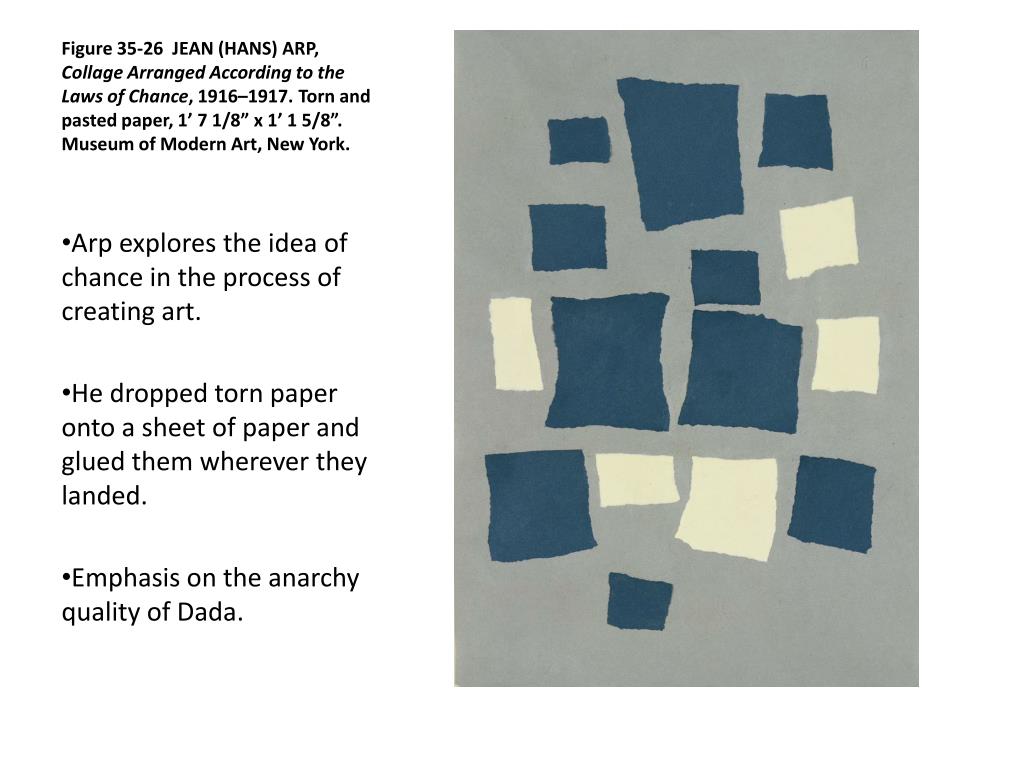
The result is neither arbitrary nor conventionally composed. The surface holds equilibrium without symmetry. Rhythm emerges, yet intention cannot be traced. Authorship is displaced, not erased.
Arp later described how the technique arose after he destroyed a drawing in frustration. Observing the fallen fragments, he recognised a coherence more vital than deliberate composition. This was not theatrical accident. It was recognition of emergent order.
Within Dada, this distinction matters. While Kurt Schwitters integrated urban debris as critique, Arp sought a logic analogous to natural process. He spoke of “an order beyond reason.” The phrase signals resistance to mechanistic thinking rather than mystical retreat.
Chance, for Arp, was disciplined contingency.
OBJECT LANGUAGE AND ORGANIC SYNTAX
By the mid 1920s, after relocating to Paris in 1926, Arp had begun articulating what he termed an “object language.” He did not speak of style. He spoke of vocabulary.
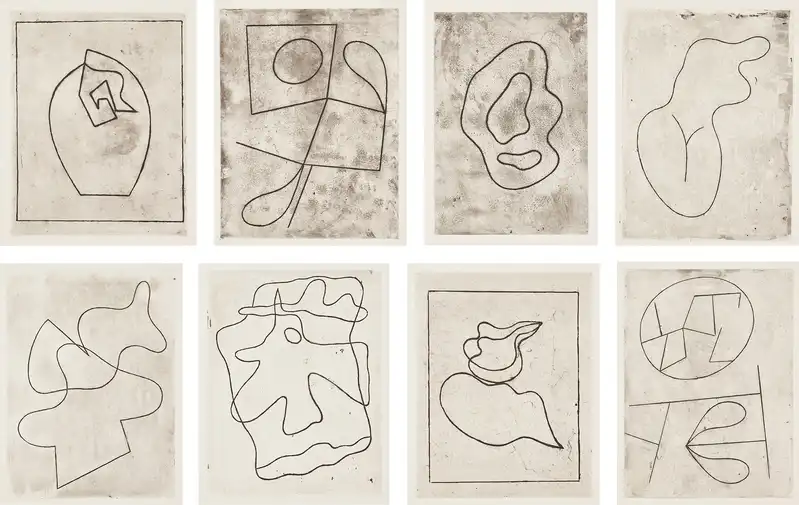
Forms derived from seeds, torsos, stones and clouds without directly representing them. They suggest, but they do not depict. Ambiguity becomes structural condition. Meaning cannot settle.
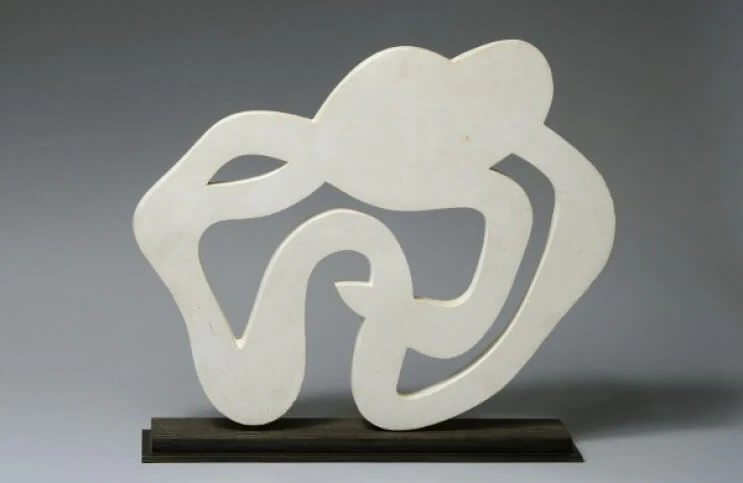
Infinite Amphora of 1916 anticipates this development. The classical vessel is abstracted into a looping configuration of swelling curves. The amphora ceases to function as container and becomes movement. The relief reads as transformation rather than object.

In contrast to Kandinsky’s spiritual geometry, Arp’s abstraction remains grounded in metamorphosis. Angles soften. Boundaries blur. Form appears to grow rather than to be designed.
Collaboration with Sophie Taeuber Arp intensified this direction. Her geometric clarity met his biomorphic contours in a shared syntax. Neither language dominated. Their joint works destabilised the hierarchy between fine art and applied practice. Textile, relief, dance and interior design intersected.
The collaboration also undermined singular authorship. If form can emerge through chance, it can also emerge through dialogue.

CONCRETION AND SCULPTURAL AUTONOMY
In 1931 Arp became a founding member of Abstraction Création, formed to defend non figurative art against Surrealism’s growing dominance in Paris. His own trajectory, however, was already independent of stylistic camps.
During the early 1930s he shifted decisively into sculpture. Three dimensional work allowed his vocabulary to detach from pictorial support. He referred to these works as “concretions.”
The geological resonance of the term is deliberate. A concretion forms through accumulation around a nucleus. It condenses. It grows. It is not assembled from parts.
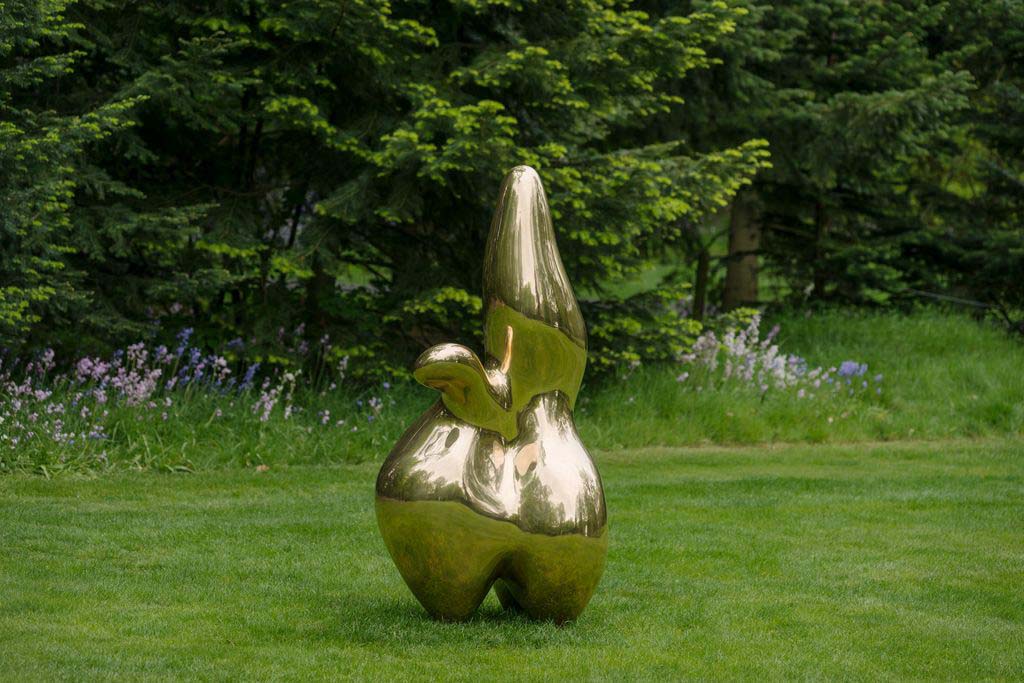
Human Concretion of 1935 exemplifies this logic. Bulbous volumes merge seamlessly. The surface appears eroded and newly formed at once. There is no privileged viewpoint. The sculpture resists narrative reading. It exists as organism.

Plaster, his preferred modelling material, allowed intuitive shaping. Later bronze casts stabilised the forms without industrialising them. The sculptures retain softness even in permanence.
Against Constructivist angularity and technological rhetoric, Arp’s volumes refuse aggression. They do not assert monumentality despite scale. They inhabit space with inevitability rather than force.
BIOMORPHISM AND MODERNISM
Arp’s organic abstraction intersected with a wider European biomorphic current. Henry Moore and Barbara Hepworth similarly pursued forms that suggested body and landscape without literal depiction. Influence circulated across this network rather than flowing in one direction.

Yet Arp’s approach remains distinct. His forms are less invested in heroic scale and more committed to internal equilibrium. Voids and bulges do not dramatise tension. They stabilise it.

After the Second World War, such organic abstraction acquired renewed resonance. In a continent marked by repeated mechanised destruction, forms that implied regeneration carried structural weight.

Cloud Shepherd, cast in bronze in 1953 and held in the Guggenheim collection, demonstrates the maturity of his sculptural language. The vertical form twists gently upward, evoking figure and atmosphere simultaneously. The title provides orientation without closure. Interpretation remains open.
WRITING AS PARALLEL PRACTICE
Arp’s theoretical writings run parallel to his visual production. In On My Way, published in 1948, he insisted that art arises from unconscious life. Yet his conception of the unconscious diverges from Surrealist theatricality. It is less psychological drama than biological principle.

In a 1958 statement for the Museum of Modern Art, he described art as a fruit growing within the human being. The metaphor recurs throughout his texts. Growth precedes intention. Form precedes program.
This position complicates conventional narratives of avant garde rupture. Arp’s development does not depend on stylistic revolution. It proceeds through refinement. Curves become more continuous. Surfaces more resolved. The discipline lies in restraint.
METHOD, NOT STYLE
Arp continued working until his death in Basel in 1966. Later works increased in scale but retained their essential logic. They remain structurally modest even when physically imposing.
Why do they continue to appear contemporary?
The temptation is to align them with digital organicism or parametric curvature. Yet formal resemblance is secondary. Arp’s relevance lies in method. He proposed that structure can emerge when control is moderated. That authorship can be decentralised without dissolving coherence.
His sculptures embody equilibrium without rigidity. They accept instability without collapse. They offer continuity without repetition.
Between Hans and Jean, between language systems, between geometry and growth, Arp sustained productive instability. He never belonged entirely to a single movement. Dada provided rupture. Surrealism provided context. Abstraction Création provided network. His work exceeds each.
His legacy is not a style to replicate. It is a discipline to practice.
Allow form to emerge. Recognise it. Resist overdetermination.
In that restraint lies his enduring force.

Photo Cover
Jean Arp with one of his iconic biomorphic sculptures, embodying the organic abstraction central to his work. Credit: Hauser & Wirth