
Now Reading: Dana Awartani’s standing by the ruins: Remembrance, Repair, and the Precarious Life of Heritage
- 01
Dana Awartani’s standing by the ruins: Remembrance, Repair, and the Precarious Life of Heritage

Dana Awartani’s standing by the ruins: Remembrance, Repair, and the Precarious Life of Heritage

There are exhibitions that ask to be seen, and there are exhibitions that ask to be approached. Dana Awartani’s Standing by the Ruins belongs to the second category. It does not deliver its meaning through instant spectacle. It trains the visitor’s pace, adjusts the body’s distance from the work, and turns looking into a form of care. First presented at Arnolfini in Bristol (28 June to 28 September 2025) and now touring at Towner Eastbourne (on view until 25 January 2026), the project unfolds through three interlocking states, remembrance, healing, and forgetting, without granting any of them the comfort of resolution. What remains is a sustained encounter with fragility, not as atmosphere, but as structure.

The installation’s force begins with restraint. Light is measured. Space is left deliberately underwritten. Surfaces refuse to shout. In this controlled quiet, material becomes the primary narrator. Earth, pigment, textile, stitch, sand. Each medium carries its own temporality and its own threshold of failure. Awartani’s exhibition makes that threshold visible, then asks what it means to stand near it.
Awartani is a Palestinian Saudi artist born in Jeddah in 1987, now working between Jeddah and New York. Her formation spans Central Saint Martins and the Prince’s School of Traditional Arts, a trajectory that helps explain why her practice does not treat craft as reference or ornament. For Awartani, inherited techniques are not a stylistic vocabulary applied to contemporary themes. They are a discipline of attention. They are also an ethic, because they bind the artwork to labour, collaboration, and the long intelligence of making. In Standing by the Ruins, craft becomes the exhibition’s operating system: a way to resist the speed of destruction with skill, time, and the patience of repair.
A FLOOR REBUILT FROM ABSENCE
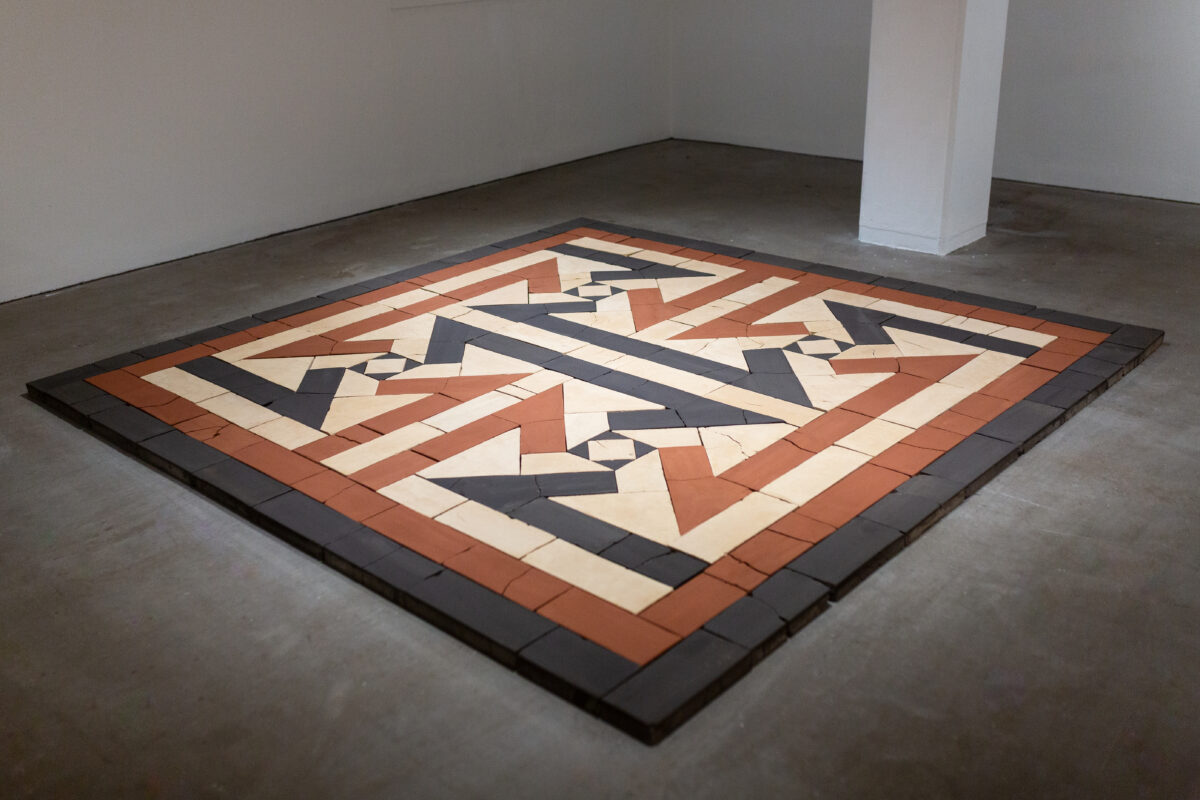
At the centre of the exhibition is Standing by the Ruins III (2025), a monumental floor installation composed of hundreds of handmade adobe bricks in a restrained palette of earthen whites, ochres, and deep greys. The work reconstructs a geometric pattern from the floor of Hamam al Sammara in Gaza, a historic bathhouse dating to the Mamluk period and now believed to have been destroyed in late 2023.
The choice of a floor matters. Floors carry the intimate weight of everyday life. They register footsteps, gathering, repetition, and ritual. When a floor disappears, what is lost is not only a building, but a choreography and a material memory that once held a community’s routines in place. Awartani’s reconstruction does not attempt to restore that life. Instead, it makes absence legible at full scale, on the ground, where the body must acknowledge it.

The work was realised in collaboration with adobe restoration craftsmen in Riyadh, whose knowledge is rooted in traditional earth building techniques. Awartani’s most decisive gesture is to withhold the final binding agent, refusing the last step that would lock the bricks into stability. Cracks form. Edges loosen. The pattern remains clear, yet the condition stays precarious. The installation presents heritage not as monument, but as something held together by care, exposed to rupture, and never fully protected.
That fragility shifts the visitor’s behaviour. The work is encountered at the level of one’s own weight, which turns movement into a negotiation. Walking becomes careful, almost ceremonial. Spectatorship becomes responsibility, because the act of passing through the space is also an act of measuring one’s impact. In that simple recalibration, heritage stops being an abstraction. It becomes a lived condition, something that can fracture under pressure.
Critics have connected the work to the tradition of pre Islamic ruin poetry, wuquf ala al atlal, in which the poet stands among remnants and speaks from longing and reflection. The connection is persuasive not because Awartani illustrates literary history, but because she activates a similar stance. To stand by ruins here is to refuse distance, and to remain present with absence without converting it into spectacle.
REPAIR AS TIME, NOT IMAGE
If Standing by the Ruins III addresses destruction through ground and fracture, other works in the exhibition treat repair as a durational practice. One of the most affecting bodies of work, Come, Let Me Heal Your Wounds. Let Me Mend Your Broken Bones (2019 to 2024, expanded iterations), transforms dyed silk panels into a cartography of damaged and destroyed heritage sites across parts of the Middle East. Awartani tears the textile at points corresponding to specific locations of loss, then mends these ruptures using traditional darning techniques. The repairs are not concealed. They read as scars, as sutures, as evidence of an encounter that cannot be undone.

What gives the series its charge is its refusal of restoration as illusion. It does not promise a return to an intact original. It proposes continuity of another kind, one that acknowledges damage and carries it forward. Each stitch becomes a unit of time and a record of attention. In a world where sites can disappear between headlines, Awartani’s slow method applies counter pressure. It insists that the act of mending matters even when the world refuses to pause.

Awartani has spoken of repair in devotional terms, drawing on ethical and spiritual registers that treat mending as care with moral weight. In her work, tenderness does not soften the argument. A repaired seam remains a seam. The wound stays legible, as does the choice to respond.
FORGETTING AS A CIVIC MECHANISM
While the textile works insist on repair, I Went Away and Forgot You. A While Ago I Remembered. I Remembered I’d Forgotten You. I Was Dreaming (2017) confronts forgetting as a spatial and civic process. Awartani begins by forming a traditional geometric pattern in coloured sand inside an abandoned house in Jeddah’s historic district. A single channel film records her sweeping the pattern away in one continuous shot, grain by grain, until modern tiles are exposed beneath.

The action is quiet, but its inevitability is unsettling. Beauty appears, then is methodically removed. The work points to an erasure that does not require catastrophe. It can happen through redevelopment, through administrative decisions, and through the logic of replacement that steadily flattens earlier layers of a city. For an architectural audience, the piece registers with particular force because it makes a familiar mechanism visible. Cities lose heritage not only through sudden violence, but also through incremental normalisation.


CRAFT AS ETHIC, NOT STYLE
Across the exhibition, Awartani avoids two traps. The first is exoticising tradition as surface. The second is instrumentalising catastrophe as content. She navigates both by making process central. Collaboration, material provenance, technique, and labour are not secondary to the concept. They are the concept.
Her practice foregrounds the social life of making through sustained collaboration with artisans and craftspeople. Materials such as earth, pigment, dye, and textile function as carriers of place, extraction, and trade, each with a cultural biography. In this context, keeping techniques alive is not nostalgia. It is transmission. It insists ensures these knowledge systems can still generate new forms and new questions.
Awartani has referenced Edward Said’s influence on her thinking about representation and power, and her work resists an audience’s desire to consume the region as image or pattern. In Standing by the Ruins, pattern is not ornament. It is evidence of architecture, ritual, and knowledge, and evidence of how easily all three can be erased.

WITNESS RATHER THAN SPECTACLE
Work about cultural destruction always risks aestheticising ruins. Standing by the Ruins remains attentive to that risk. The exhibition’s restraint reads as a refusal to dramatise loss through excess, and a refusal to offer easy emotional resolution. Instead, it asks for witness.
In the presence of Standing by the Ruins III, the viewer is not invited to marvel at scale alone, but to register how precarious the structure is and how much care is required to keep it legible. In the textile works, closeness matters, because only close looking reveals the labour of repair. In the sand film, the viewer must sit with the discomfort of watching meticulous making meet meticulous erasure.

Awartani has spoken about the unevenness of international attention when heritage is lost, noting how some sites provoke global outrage while others disappear with relative quiet. In this exhibition, that critique is not delivered as slogan. It is embedded in the visitor’s physical experience, training the eye to notice what is fragile and to recognise that preservation is not a passive wish but an active practice.
AN OPEN ENDED INVITATION
With Awartani announced as Saudi Arabia’s representative at the 61st Venice Biennale (2026), her work is entering a larger public frame. Yet Standing by the Ruins makes clear that visibility is not the end point. The exhibition insists on something more difficult: the capacity to remain with what is broken without turning it into an aesthetic category, and without losing the will to mend.
What Awartani ultimately offers is not restoration and not consolation. She offers a stance. It is a way of standing near enough to feel responsibility, close enough to see the seam, and slow enough to understand that making, especially making through inherited knowledge, can operate as resistance.
Photo Cover
Installation view of Dana Awartani’s Standing by the Ruins at Arnolfini, Bristol, 2025, featuring the monumental floor work Standing by the Ruins III. Credit: © Dana Awartani; Courtesy the artist and Arnolfini. Photography by Lisa Whiting.