
Now Reading: Whither Rivers Flow: Ximeng Tu’s intimate portrait of a transforming Chongqing
- 01
Whither Rivers Flow: Ximeng Tu’s intimate portrait of a transforming Chongqing


Ximeng Tu is a Chongqing-born photographer whose images return, again and again, to the city’s river edge – not as scenery, but as an index of change. He recalls growing up near the Jialing River and swimming there as a child; after studying in other cities, he returned to Chongqing for university to find a hometown that no longer matched memory.

Whither Rivers Flow is his attempt to record that mismatch. Not in the language of skyline worship, but through the riverside where daily life absorbs the shock of transformation. As he began photographing, Tu moved beyond architecture’s visible shifts to notice a thickening pressure on everyday life as congestion, haze, strain, poverty and then, quoting Jane Jacobs, articulated the turn that defines this body of work: “The city is an organism.”
The project has drawn international attention, with Tu appearing as a finalist in a major street photography awards program and being shortlisted for an international art and photo book award.

A CITY IN FLUX
It’s hard to speak about Chongqing without slipping into scale. Chongqing is one of China’s largest municipalities by population, with an urbanization rate now over 70%. Those numbers matter but Tu’s work is not a demographic portrait. It is a street-level reading of what such growth feels like when it meets terrain, weather, and the river’s slow insistence.
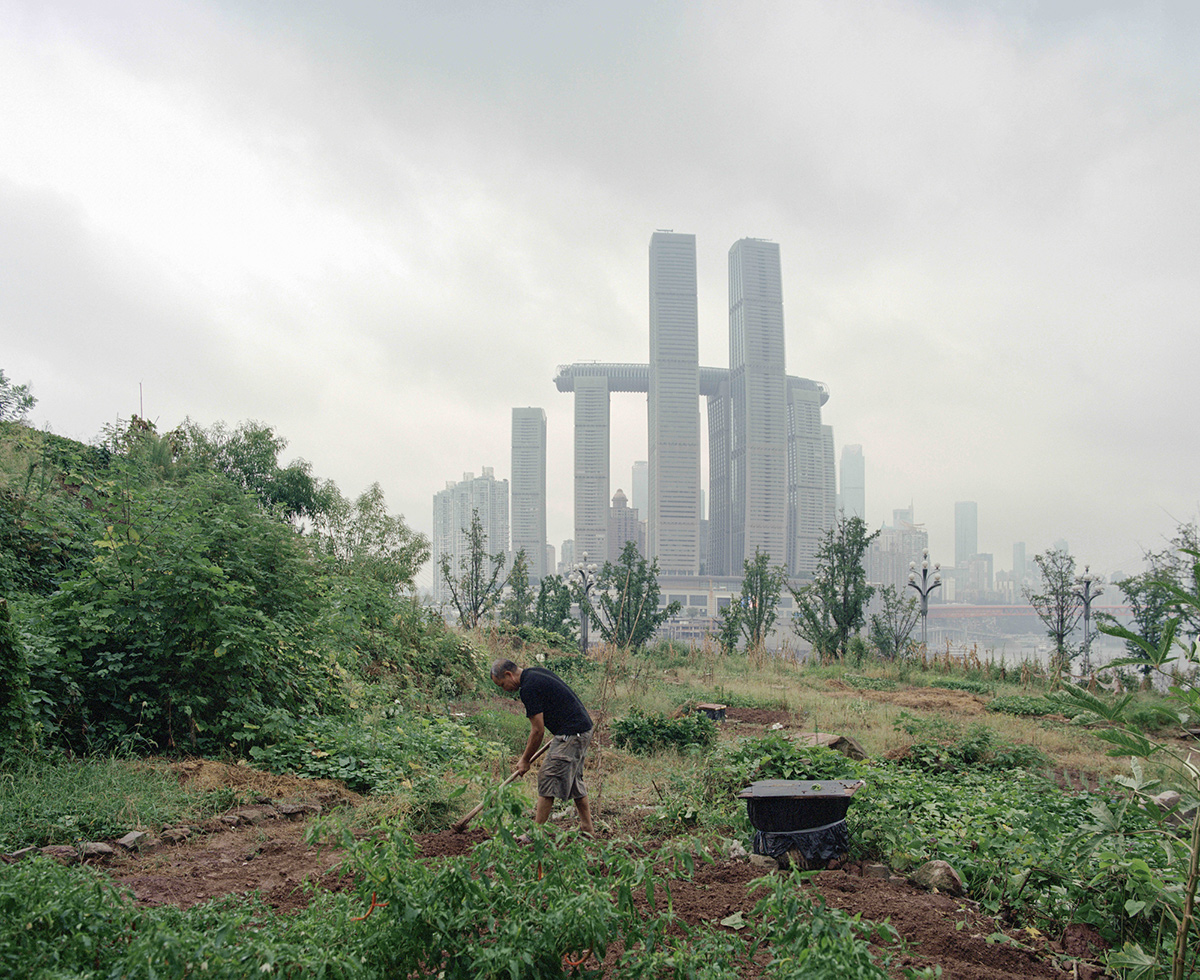
The series moves with an unhurried gravity along the Jialing, beneath the tensile webs of new bridges. The images oscillate between the monumental and the intimate: elevated highways draped in creeping foliage, anonymous towers dissolving into haze, boys standing in the shadow of an abandoned boat.


What’s most compelling is the method. Tu doesn’t chase spectacle. He dwells in the in-between, the interstices where change accumulates almost imperceptibly, like sediment along a river’s edge. The built environment asserts itself with an ambivalent authority: balconies sag under improvised gardens; underpasses become accidental green rooms; vines climb columns as if attempting to reclaim what was ceded to progress.
And then, crucially, the people arrive – not as decoration, but as measurement. They appear as quiet anchors: a lone figure dwarfed by a cable-stayed bridge; dancers practicing on a riverside plaza; workers leaning beneath an overpass adorned with wire-like, calligraphic forms.

This is where Tu’s own statement locks into place. If the city is an organism, then people are not incidental, they are how the organism is read. “So my eyes turned from the high-rise buildings in the city to individuals,” he says, “and I learned about the city by getting to know individuals.”
ECHOES OF OTHER VOICES
Tu’s project sits within a wider photographic lineage that has used China’s river systems to think about modernity, labor, and the costs of speed. Some photographers weigh industry from a distance; others register estrangement through atmospheric quiet; others compress myth and contradiction through small bodies against vast landscapes.
What distinguishes Tu is not simply that he photographs Chongqing, but that he photographs it as a return. The work carries the ethics of proximity: it is neither the triumphal gaze of a city-brand campaign nor the detached gaze of extraction. It stays close enough to be implicated.

TRANSITIONAL TRUTHS
Ultimately, Whither Rivers Flow argues as quietly, persistently that a city’s essence is rarely found in its newest landmarks. It’s found under bridges, along embankments, inside haze, in the places where planning meets habit and habit refuses to disappear.
Tu describes the project as a journey of self-discovery, visiting every corner of Chongqing, its mountains, rivers, trees, even the pebbles along its riverbanks trying to decode the relationship between people, the city, flowing waters, and his bond with home. He also names the paradox that makes the work feel precise rather than sentimental: “the closer I get, the more I seek, the deeper the sense of loss becomes.”
That sentence is the project’s quiet engine. It explains why these photographs resist tidy conclusions. The river keeps moving. The city keeps rewriting itself. And the act of looking patiently, without spectacle becomes a form of care: a way to hold onto what is changing, without pretending it can be held still.
Project Credit
Project name: Whither Rivers Flow
Photographer: Ximeng Tu
Year: 2025
Location: Chongqing, China
Images: Ximeng Tu
More Photos