
Now Reading: Beaubourg as an Open Building
- 01
Beaubourg as an Open Building

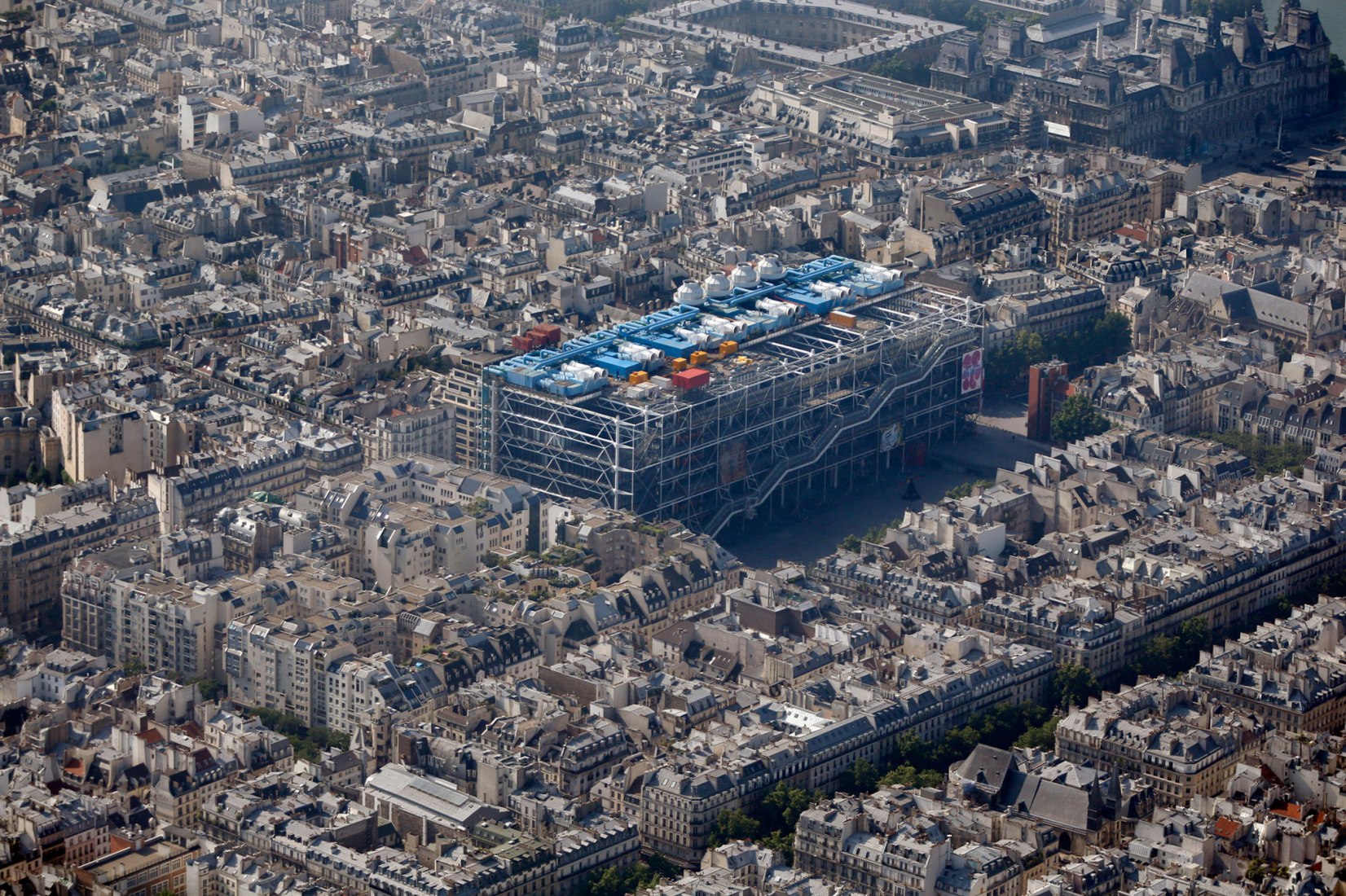

Renzo Piano still walks past the Centre Pompidou on his way to work. His Paris office sits just around the corner; his home is nearby too. That daily route turns a famous building into something rarer than a masterpiece: a companion you cannot romanticize from a distance. Piano calls it his “cumbersome child.” He still prefers the nickname. “I always say Beaubourg,” he jokes.
The habit matters. Pompidou was never designed to be viewed like a postcard. It was designed to be lived with. It behaves less like an object and more like an urban condition: a public field, a cultural machine, a building that keeps its seams visible, then asks to be cared for when time begins to fray them. Its continuing relevance comes from an attitude that is surprisingly difficult to sustain in architecture: the decision to leave space for the city, then to keep leaving space, through use, debate, and periodic repair.

A COMPETITION THAT BRIEFLY TRUSTED FREEDOM
Piano locates Pompidou’s origin in a peculiar kind of permission. The year is 1971. May ’68 is recent enough to still shape the air. London, where he and Richard Rogers were working, felt loosened: “the Beatles, miniskirts, and long hair; a real whiff of freedom.” Their office was tiny, three or four people, and when clients arrived they would summon everyone to make it look bigger. They worked on the competition for about a month, drawing intensely, carried by the sense that, for once, “everything was possible.”
But the youth-myth is only half the story. The other half is institutional. Pompidou begins as a state project that, almost paradoxically, wanted to reinvent what a state cultural institution could be. Piano insists the idea of a centre culturel had been circulating “since the early 1960s” and names André Malraux as part of that long, floating ambition. The competition did not simply ask for a museum. It asked for a new civic instrument, something more porous than a museum-temple and more public than a library alone.
Then there is the jury, and it reads like a political statement in architectural form. Jean Prouvé chaired it, with names such as Oscar Niemeyer and Philip Johnson. Piano sees Prouvé not as a celebrity stamp but as a symbol of liberty precisely because he “didn’t belong to the academic system.” He describes the jury’s posture in a sentence that still feels almost unbelievable: “go on then, tell us what to do.”
In that line, a competition stops being an exam. It becomes an invitation to propose a new rulebook. Piano calls it “courageous” for a head of state to appoint a jury in search of “completely free minds.” That courage, temporary and rare, matters as much as any later steel member or escalator. It is the precondition for an architecture that would refuse intimidation.
They did not expect to win. There were 681 entries. They told themselves they were “sure to lose,” and Piano even suspects that certainty liberated them. “What was interesting was to ask ourselves what we could do if we had a magic wand; everything was possible.” The project begins, in other words, as a thought experiment made real.
THE URBAN MACHINE AND THE END OF MUSEUM INTIMIDATION
Piano’s central claim about Pompidou is blunt, and it deserves to be heard plainly: “our idea of an ‘urban machine’ was new.” But he immediately qualifies it. The machine was not a fetish imported from elsewhere. It was “derived from the starting brief” of a state project that wanted a centre culturel rather than a conventional museum. And the machine was aimed at a social problem: museums were “slightly intimidating places.” Piano and Rogers didn’t even go.
So they designed the opposite of intimidation. They imagined “a sort of factory, a laboratory, a space liner.” Not because culture should become industry, but because industry, open, legible, infrastructural, could dismantle the museum’s aura of authority. They wanted to “ignite a spark of curiosity.”

It is tempting to read Pompidou’s exposed services as a style: inside-out architecture, a celebration of pipes and structure. Piano’s metaphors resist that reduction. He compares the building to “a strange kind of ocean liner” that is “open, transparent, and breathing.” People move through it “like blood in the veins.” This is not the language of engineering bravura. It is the language of an organism, a civic body.
The early reactions were predictable and historically revealing. “Lots of people screamed.” Some called it a “culture supermarket,” a “factory,” a “refinery.” Those insults expose a fear still alive today: that culture would turn into consumption, that the building would be too infrastructural, too public, too noisy. Piano doesn’t deny the strangeness. He insists on the wager underneath it: “there was nothing intimidating about our creature.”
Then comes the line that changes the tone from polemic to wonder: “Inside was a miracle.”

If Pompidou is a machine from the outside, the “miracle” names something else: the interior’s capacity to hold art without freezing it into ceremony. The open floors allow the institution to recompose itself. The building does not demand that visitors behave as if entering a sacred vault. It allows drifting. It tolerates the ordinary. And because it refuses to intimidate, it can afford to be generous.
Piano even calls it “a sort of open, modern cathedral” in the middle of Paris, “crazy,” but “courageous.” The phrase is exact: a cathedral without fear, a collective interior without gatekeeping rituals.
THE SQUARE AS THE ICON
If there is one element Piano treats as the key to Pompidou becoming part of Paris, it is not the pipes, not the escalators, not the bravado of exposure. It is emptiness.
“It took 10 years, even longer, for our building to become a part of the city,” he says. And he links that slow acceptance to a decision that now reads as the project’s deepest urban intelligence: they designed a square.
“We had the somewhat miraculous idea of designing a ‘square.’ And we were the only ones out of 681… to propose that.” Everybody else filled the plot. Piano and Rogers did the opposite. “Straightaway, we said we had to have emptiness, a public space.”

Here, Piano offers a definition of civic architecture that does not age: “The square is the icon of the city, a place where people meet, where disparities and differences are diminished; where the urban comes to the fore.”
The piazza is not a forecourt to dramatize an entrance. It is the building’s public conscience. It is the urban device that allows the city to test the building before granting it belonging. Piano jokes, “you really do need space to land a spaceship!” But the joke carries a serious proposition: radical architecture cannot simply be inserted into an old city as a self-contained object. It needs a field of negotiation, an open landing pad where daily life can argue with it, perform against it, accept it slowly.

Pompidou’s iconic status is secured by what is not built. The building becomes a backdrop, and the square becomes the stage. In that reversal lies a quiet ethics: culture is not only what happens inside curated rooms. It also happens in shared air, on shared ground, among strangers.
BETWEEN MEMORY AND OBLIVION
When asked about influences, Piano calls it “a delicate question,” then refuses the neat genealogies architects are often asked to produce. At his age, he says, he doesn’t really exist on his own. He is the sum of what he has seen, the people he has met, journeys, beauty, nature. He cites Borges: every creative gesture comes from somewhere “suspended between memory and oblivion.” Then he adds a sentence that feels like a method: he doesn’t want to try too hard to understand where things come from.
That reluctance is consistent with Pompidou itself. The building does not declare a single origin story. It gathers lineages, engineering, urban theatre, industrial infrastructure, cathedral ambition, without fixing their hierarchy. It remains open even in its authorship.
Still, Piano offers concrete images that sharpen the building’s metaphors.
First comes light. Born on the Mediterranean, in Genoa, he has “always had light in my eyes,” a sea of “vibrations, color, voices.” Pompidou’s transparency is not only technical. It is also an attitude toward daylight and visibility: letting the city see the building’s life, letting culture be encountered without shadows of intimidation.
Then come building sites. Piano’s father was “a modest builder.” Piano grew up on construction sites. At six or seven he would sit on a pile of sand, told not to move, participating in “the miracle of building.” The phrase echoes the earlier “Inside was a miracle.” It suggests that for Piano, architecture’s wonder is not the finished image but the act of making: labor transforming matter into inhabitable space. Pompidou’s exposed organs can be read as an extension of that childhood intimacy with construction. The building refuses to hide the work that makes culture possible.
Finally, the harbor. After Sunday mass, his father took him to the port. “He was a man of the earth, but he loved the harbor.” After the war, Genoa hosted liners: “sort of monsters, beautiful slow-moving monsters, machines that moved!” Here the Pompidou metaphors snap into focus. The ocean liner. The space liner. The breathing machine. These are not decorative concepts borrowed from theory. They are childhood memories of moving infrastructure, gigantic vessels that are both functional and uncanny.
When Piano closes the influence answer, “all you’ve seen… the living, the dead, you are the sum of all that,” he describes a worldview that Pompidou embodies as architecture: not pure, not singular, not closed.


QUASIMODO, AFFECTION, AND A SIMPLE METRIC
Pompidou’s acceptance was not immediate. People screamed in the beginning. Yet over time, something stronger than approval emerged: affection.
Piano jokes that he is “sort of the Quasimodo of Beaubourg.” It is a pointed image. Quasimodo loves the cathedral not because it is flawless, but because it is his home, heavy, burdensome, inseparable. Pompidou, too, is loved like a difficult child. It becomes a magnet.
The most important metric Piano proposes is disarmingly simple. He asks about his buildings the way one asks about children: “are they happy?” In that question, architectural legacy is not an aesthetic verdict but a social life. A happy building is one that remains inhabited, argued with, relied on, returned to.
Piano’s answer is equally simple: “I think Beaubourg is happy.”
RENOVATION AS CARE, NOT CORRECTION
The scheduled renovation starting in 2025 enters Piano’s story as proof that Pompidou was always an open system. “It’s essential to do these works,” he says, even though he likes Beaubourg with “the patina of time.” There were works in 2000, and there will be new ones, but “the spirit remains the same.”
Now comes a sentence that defines a different model of heritage: “every quarter of a century, someone comes along to take care of adapting this tool to culture.” Pompidou is imagined as an instrument, an urban tool, whose relevance depends on periodic recalibration. Piano adds what may be the building’s most precise self-description: he likes having made something capable, every quarter-century, of “questioning itself while still remaining itself.”
Repair, here, is not correction. It is care. It is the acceptance of time as a collaborator. It is also a refusal of the building’s own myth: Pompidou cannot become a sealed icon without betraying the openness it was designed to enable.

“IT ISN’T A BUILDING, IT’S A BRIDGE”
Piano’s most quoted line, “Beaubourg isn’t a building, it’s like a bridge,” is easy to treat as a slogan. In the interview, it arrives attached to a memory: meeting President Pompidou after winning the competition. Piano and Rogers show up dressed awkwardly for the occasion, ties on, Piano in a borrowed jacket that’s too small; Rogers in a T-shirt. Pompidou speaks kindly and then drops an enormous claim: the building will live 500 years. Piano and Rogers exchange a look. “We had never made something that had lasted more than 6 months!”
The anecdote matters because it frames Pompidou’s ambition as simultaneously absurd and sincere. Two architects used to temporary work are suddenly confronted with geological time. The bridge metaphor becomes less poetic and more ethical. A bridge exists to be crossed. It connects. It serves the many without asking for reverence. It also requires maintenance; its longevity depends on care.
So when Piano calls Pompidou a bridge, he is describing not only function but responsibility: to remain present, to keep enabling passage, between street and museum, between everyday life and culture, between invention and repair.

AN ETHICS OF STEPPING BACK
If we braid the interview’s threads into a single proposition, it might be this. Pompidou’s radicality is not only what it shows, pipes, structure, circulation, but what it refuses to take, all the available space. It steps back to create emptiness. It refuses intimidation to ignite curiosity. It accepts the label of machine while insisting on the miracle inside. It allows time to mark it, then invites periodic care. And it judges itself not by purity, but by happiness.
That is why Pompidou reads better as biography than as object. It was born from a competition that briefly trusted freedom. It matured into the city through the social invention of a square. It carries a Mediterranean education in light and a harbor education in moving monsters. It absorbs criticism, then becomes loved like Quasimodo, unbeautiful, indispensable. And it prepares, every quarter-century, to question itself again.
In an era where cultural buildings often arrive as sealed icons, Beaubourg suggests a different ambition: civic infrastructure that stays open to the city’s life. Perhaps the most contemporary thing about Pompidou is that it does not ask to be finalized. It asks to be cared for, so that it can continue to be crossed.
Piano’s daily walk past his “cumbersome child” is the most convincing proof. Architecture’s ultimate test is not the first photograph after completion. It is the long, ordinary sequence of days in which a building remains a companion to its city. And by Piano’s simplest measure, “are they happy?”, Beaubourg, still breathing, still magnetizing, still questioning itself, appears to be doing just fine.
⸻
References
1. Art Basel Stories. “Renzo Piano: ‘Beaubourg isn’t a building, it’s a bridge!’” Interview (published 2025).
2. Centre Pompidou (official). Centre Pompidou transformation and renovation framework (Centre Pompidou 2030 / closure and works).
More Photos about Center Pompidou by Renzo Piano and Richard Rogers.
Courtesy Rogers Stirk Harbor + Partners studio