
Now Reading: Building without erasure: How Amelia Tavella designs continuity in a time of replacement
- 01
Building without erasure: How Amelia Tavella designs continuity in a time of replacement

Building without erasure: How Amelia Tavella designs continuity in a time of replacement

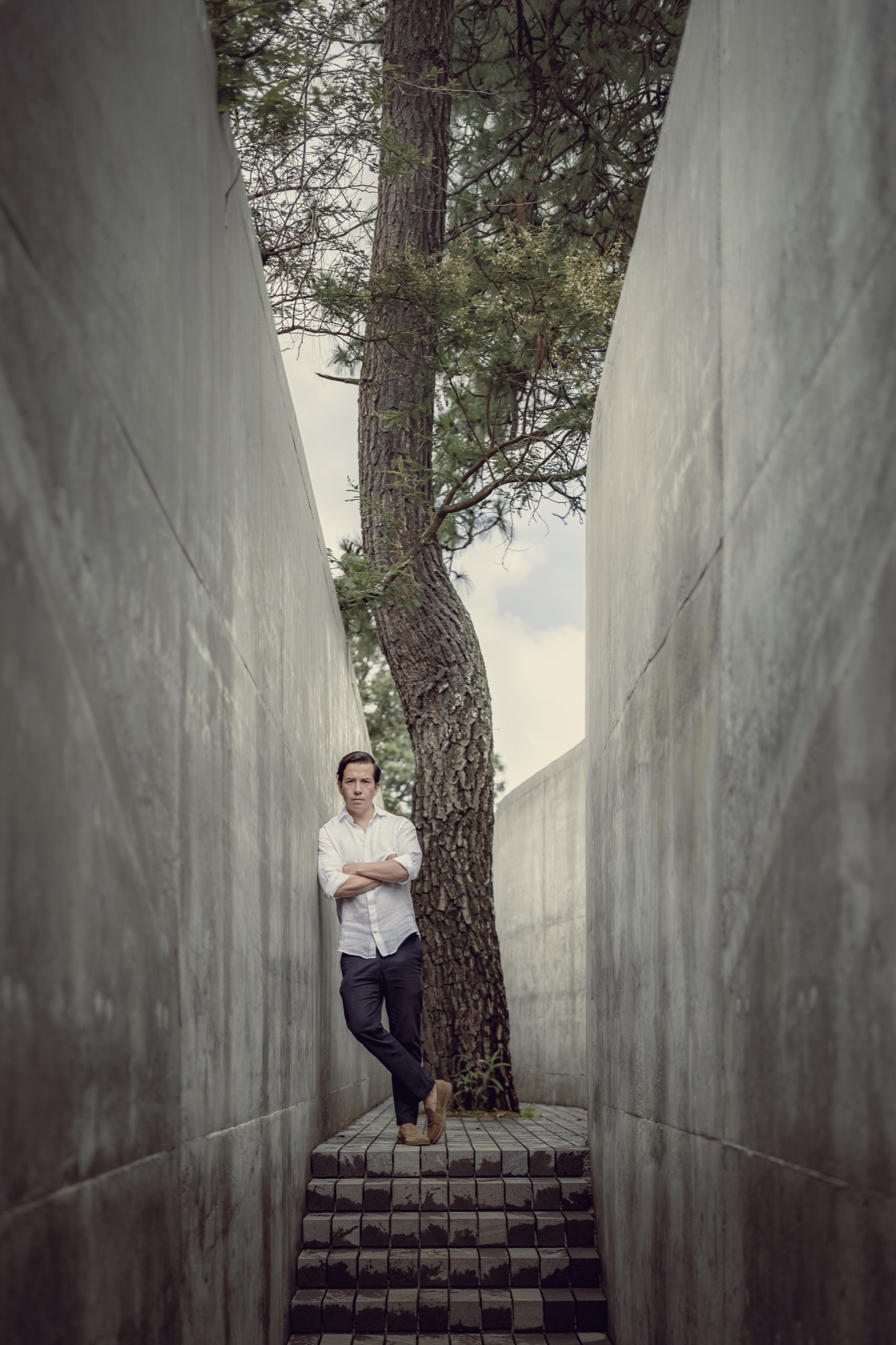
Paris can make architecture feel like a conversation that began long before you arrived. On Île Saint-Louis, the city’s surfaces carry their own chronology: stone worn smooth by weather, stucco patched and repatched, thresholds polished by daily repetition. It’s an apt place to meet an architect whose work begins with a simple refusal. Rather than chasing the clean slate, she prefers to work with what remains, to reconstruct instead of replace, to repair and give a second life to what already exists.

For Amelia Tavella, that stance is neither nostalgia nor restraint. It is method. Repair becomes a way to design continuity without pretending the past is intact, and without forcing the present to mimic it. The projects associated with her practice show this method at different scales, from a rural school that treats landscape as a partner, to the reactivation of a historical convent, to an urban school façade that reads like a civic surface rather than a logo, and finally to a thermal spa where language is asked to behave like material.
A STREGA SCHOOL: BUILDING WITH THE LANDSCAPE, NOT AGAINST IT

A rural school is not just a building. It is a daily ritual repeated over years, shaped as much by thresholds, shade, and outdoor edges as by classrooms and corridors. That is why A Strega matters in Tavella’s story: here, “what already exists” is not a ruin, but a site with its own ecology and scale.
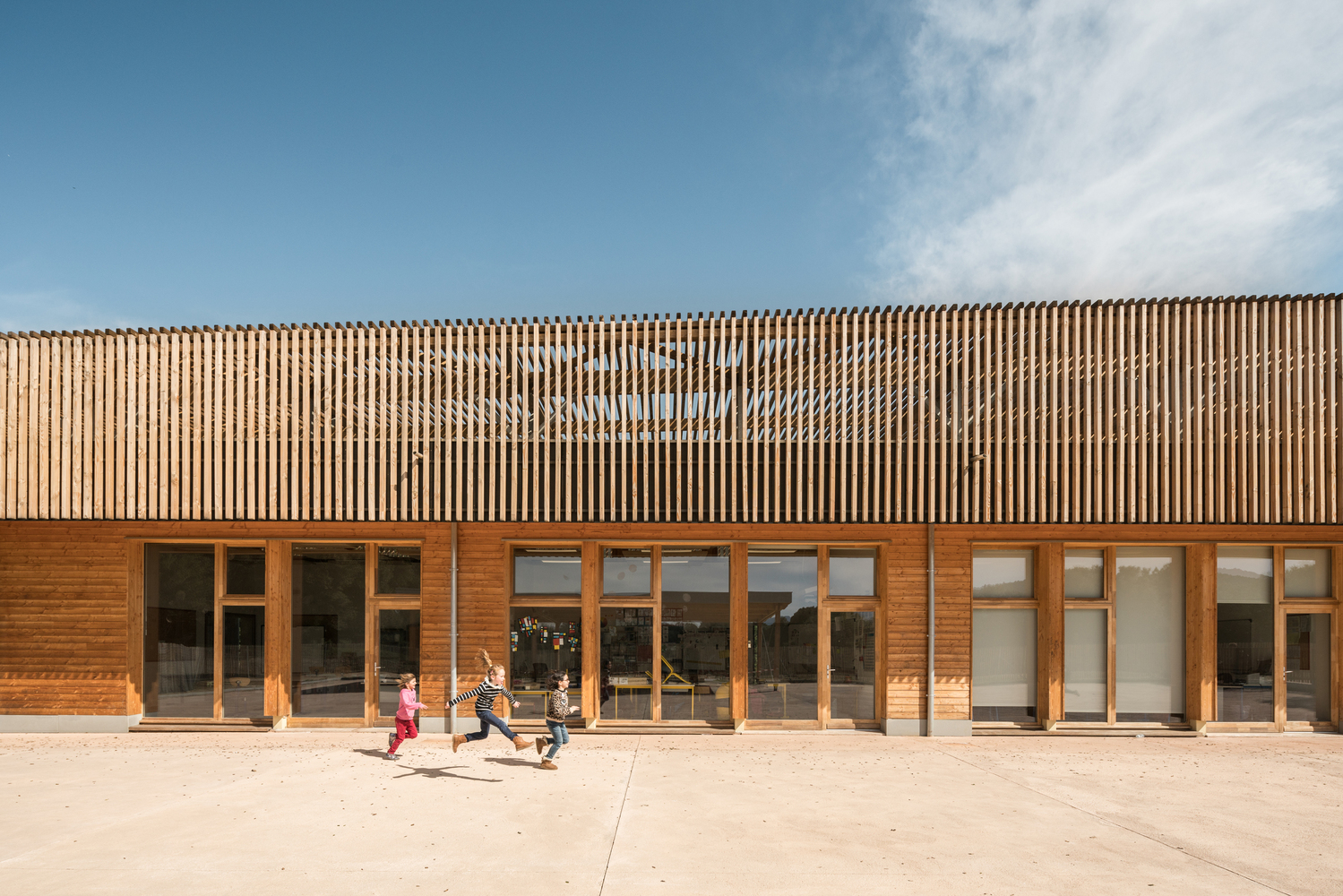
The project’s ambition is quietly demanding. It asks the building to settle into its terrain without becoming a picturesque object. Instead of announcing itself with a single iconic gesture, it makes its case through relationships: how it frames open ground, how it holds space between built and unbuilt, how it allows landscape to remain part of everyday movement. The school does not treat the environment as scenery. It treats it as context in the strict sense, a set of constraints that shape form, comfort, and routine.
Read this way, A Strega is repair before you even have damage. It repairs the modern reflex that turns land into platform. It insists that public architecture can belong to its ground, not by disappearing, but by behaving like it has learned how the place works.

CONVENT SAINT-FRANÇOIS: HERITAGE WITHOUT FREEZING TIME
If a school tests an architect’s relationship to daily life, a convent tests her relationship to history. Heritage work is where repair can fail in two opposite directions: paralysis disguised as respect, or spectacle disguised as renewal. The rehabilitation of the Convent Saint-François is compelling because it accepts a harder premise. The past does not need to be sealed away, but it cannot be overwritten either. The new must be visible, and the old must remain legible.

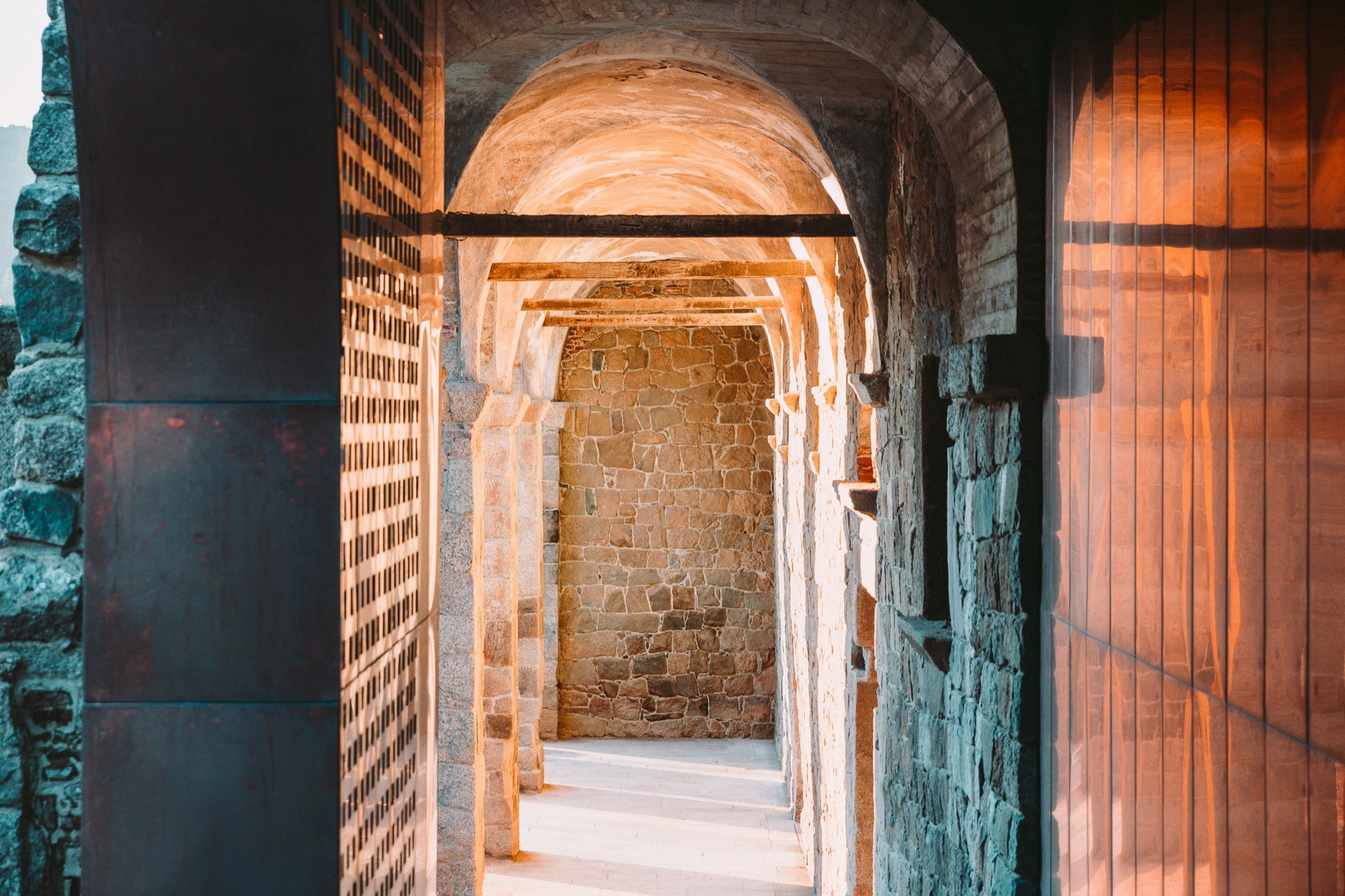
One image captures the intervention’s attitude: the convent dressed in copper. Copper is not a neutral choice. It is conspicuous, exacting, and it will change. That last point is the key. In a heritage project, ageing can be an asset when it is treated as part of the design logic rather than an inconvenience. Copper does not pretend to be timeless. It records weather, shifts tone, and slowly joins the long durée of the site. In that sense, it can act like a seam: a contemporary layer that protects, completes, and clarifies without turning the historic fabric into a stage set.
Yet repair has politics. A reborn monument can return to public life, or it can become a prestige object, open in theory but exclusive in practice. If repair is to mean inclusion, the measure is not only beauty. It is use, access, and whether the building is allowed to be ordinary again, lived in rather than merely admired.
SIMONE VEIL SCHOOL COMPLEX: A CIVIC FAÇADE THAT PERFORMS OVER TIME
Schools are often built under pressure, and that pressure shows. The Simone Veil School complex is interesting because it tries to give a large public facility a readable civic presence without resorting to branding. Its most distinctive move is a brick surface developed as a bas-relief in collaboration with an artist, a “skin” that becomes animated through sunlight and shifting shadows.
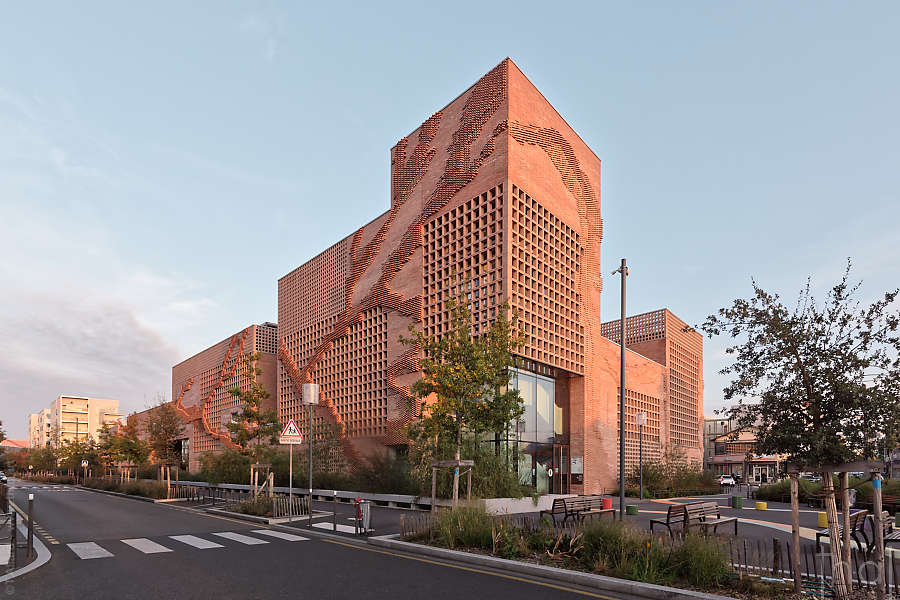
This kind of façade matters because it is not only an image. Brick carries time in a practical way. It weathers, it holds traces, it changes with light. A bas-relief wall becomes something you read while walking, not something you consume once from a fixed angle. The building gains a daily variability that feels appropriate for a place defined by repetition.

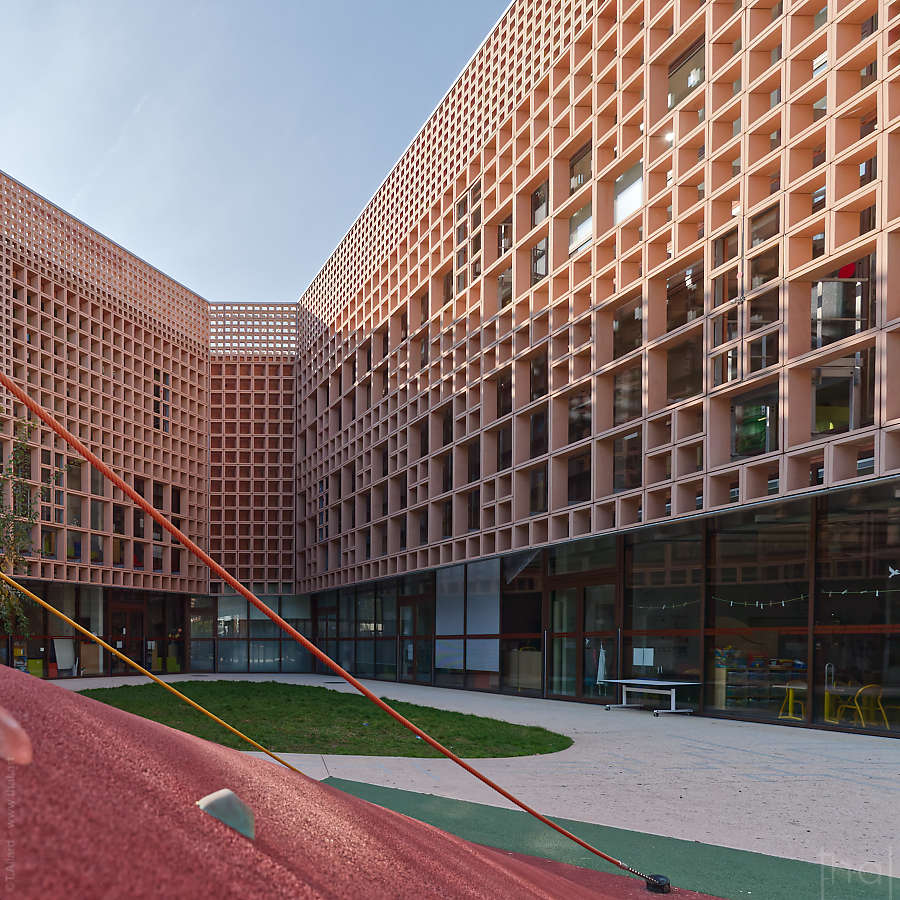
This is also where the ethics of repair becomes tangible. A textured envelope has to age well. It has to be maintainable. It has to survive touch, dirt, rain, and the way children inevitably test every edge condition. When this kind of civic expression works, it is because it stays robust enough to remain generous over years, not because it looks refined on opening day.
O’BALIA THERMAL SPA: WHEN LANGUAGE BECOMES MATERIAL
Tavella’s interest in collaboration extends beyond visual art to literature in the O’balia Thermal Spa project. Here, language is not treated as caption. It is described as carved into stone, integrated into the building’s material presence rather than applied as signage.
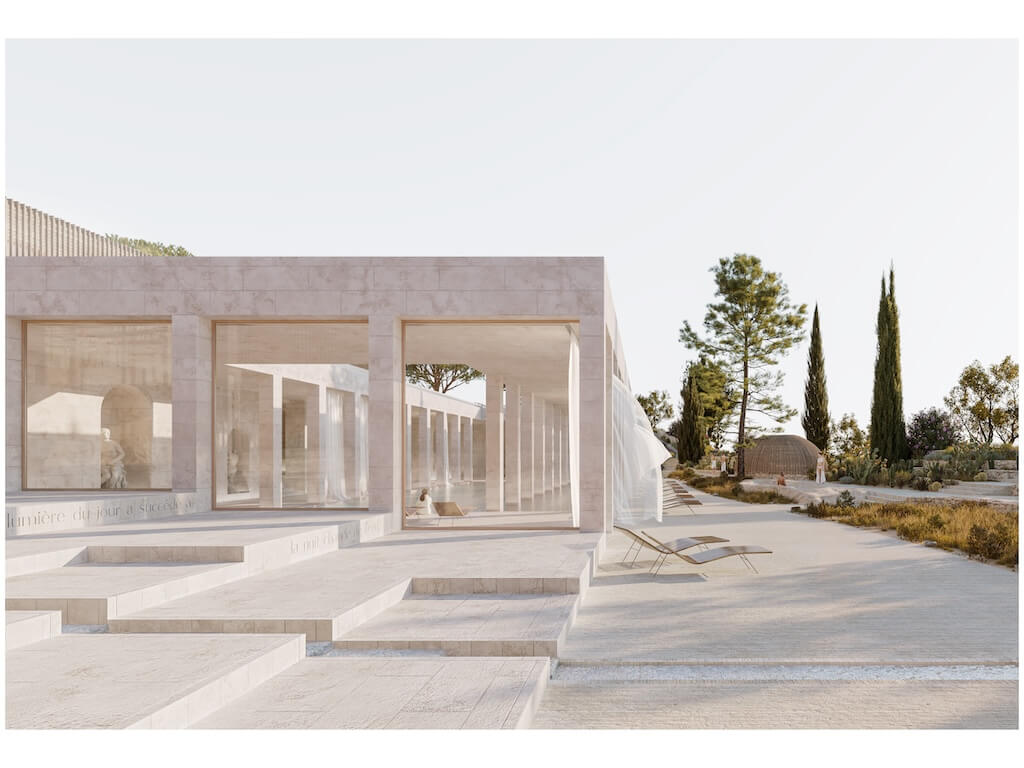
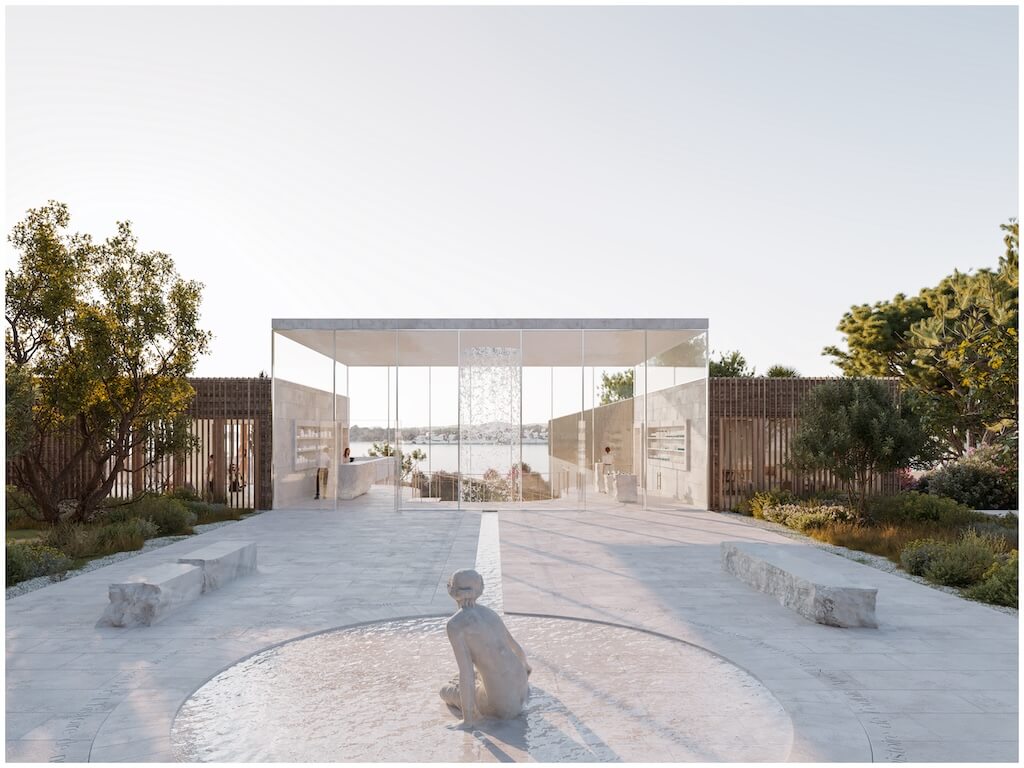
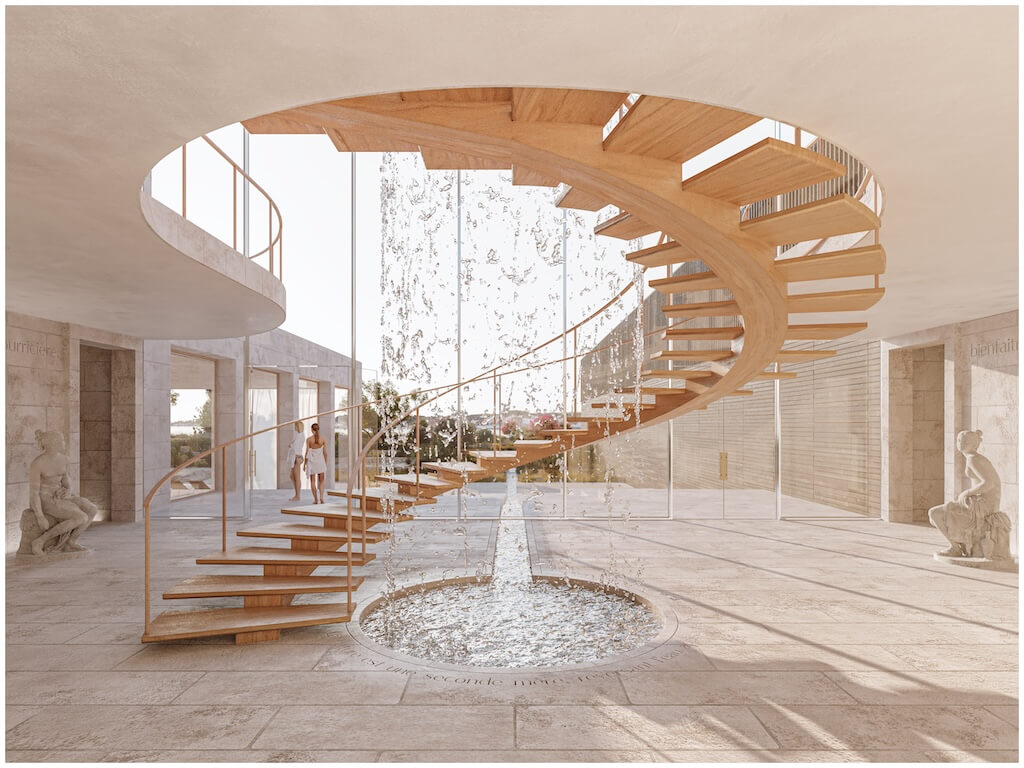
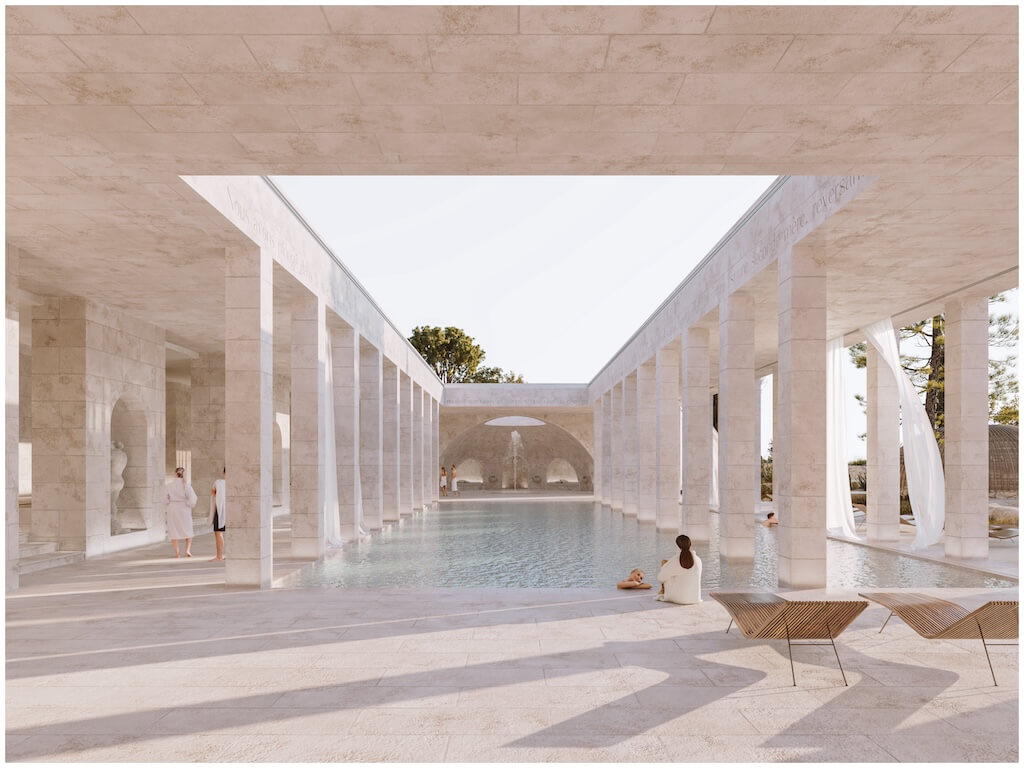
In a thermal spa, this is more than a poetic flourish. Bathing is a ritual of slowing down, and architecture in such settings is largely about pacing: how you move from one atmosphere to the next, how the body is guided, how thresholds recalibrate attention. Inscribed text can function like a pause built into the sequence, a moment that changes tempo without demanding explanation.
The risk is obvious. Words can become a veneer, a refined justification. The opportunity is rarer: language as structure, not commentary. When that happens, collaboration is not an accessory. It becomes a tool for shaping experience.
BEAUTY, REPAIR, AND THE NECESSARY FRICTION
There is a line Tavella returns to, quietly but insistently: beauty can uplift when the horizon disappears. Taken at face value, it is comforting. Taken seriously, it is a responsibility.
Repair is not automatically virtuous. Heritage can be reactivated for public life, or reactivated as prestige. Material boldness can be care, or it can be signal. A façade can be civic generosity, or it can become an anxious artwork that is difficult to maintain. Holding these tensions in view does not weaken Tavella’s work. It gives it weight, because it clarifies what repair is actually up against.
Across these projects, a consistent ambition emerges. Continuity is treated as something active, not sentimental. The future is allowed to arrive, but it is asked to arrive without erasure. Seams remain visible. Materials are allowed to age. Public buildings are designed to be inhabited, used, and tested over time.
In a culture still drawn to demolition as a shortcut to novelty, repair can look like a refusal. In Tavella’s practice, it reads instead as attention made architectural: a commitment to start where the world already is, and to build forward without pretending that history is either intact or irrelevant.