Now Reading: Våga Water Tower in Varberg turns infrastructure into a coastal landmark
- 01
Våga Water Tower in Varberg turns infrastructure into a coastal landmark


On Sweden’s west coast, Varberg has always lived with water in view. Sea, wind, horizon. Yet the city’s most consequential relationship with water is quieter, measured in pressure, storage, and continuity. With Varberg’s population rising by roughly 30 percent since 2000, the need for a larger, contemporary water tower became unavoidable. Rather than treat the upgrade as a purely technical task, Vivab, the municipal water company, launched an architectural competition with a bigger ambition: build capacity, yes, but also build meaning.


White Arkitekter’s winning proposal answers that brief with unusual confidence. Named Våga, a Swedish word that reads as both wave and dare, the project rejects the familiar water tower archetype. Instead of a solitary cylinder punctuating the skyline, it stretches horizontally across the landscape, a long, calm gesture that belongs as much to the coast as to the utility network that sustains the city.

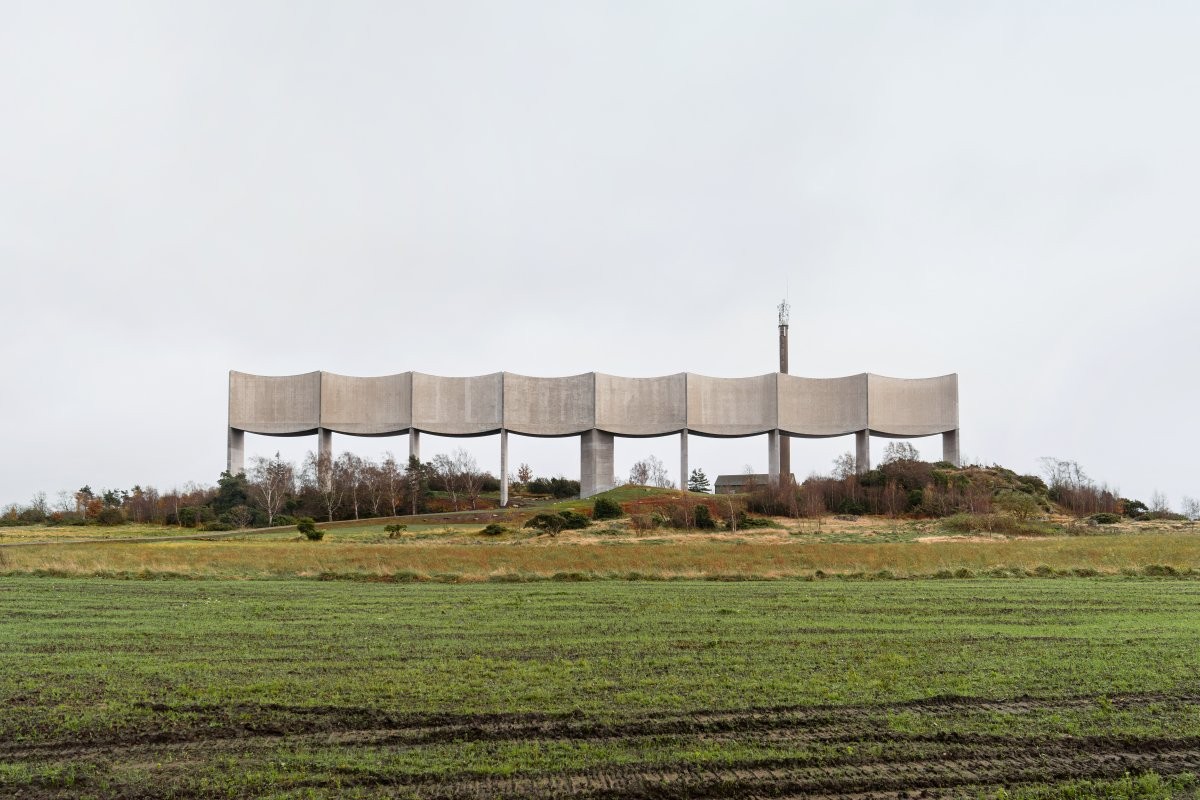
Våga runs 187 metres in length and is carried by nine slender pillars, turning mass into something that appears poised rather than heavy. The silhouette is unmistakably linear, almost pavilion like, and it gives the infrastructure a new kind of public presence. From afar, the tower reads as an extended stroke across the terrain, a deliberate counterpoint to the vertical landmarks that usually define water storage.
Up close, the building’s scale is carefully moderated. The structure is composed of eight concrete segments with concave profiles that catch daylight and release it as shadow. As the sun shifts, the façade changes temperament, moving from crisp definition to softer relief. The repetition becomes a rhythm, and the tower begins to feel less like an object placed on the site and more like a system tuned to it.


What makes the project convincing is not only its headline form, but the precision of its surfaces. The concave mouldings soften the perimeter and reduce the bluntness that large concrete volumes can impose. The finish is smooth, restrained, and quietly crafted, letting the tower project a sense of permanence without resorting to spectacle. It is infrastructure, but it is also architecture in the most direct sense: a built form that choreographs perception, distance, and approach.
Placement is part of that choreography. The tower is positioned to be read from afar as a horizon line, while still rewarding closer viewing with texture, proportion, and shadow. This calibrated relationship between the monumental and the intimate is what allows the structure to feel civic rather than remote.

The tower’s horizontality is not an abstract gesture. It echoes Varberg’s own traditions of long, linear structures in the surrounding territory, from the rows of wind turbines to the Grimeton Radio Station, a UNESCO World Heritage listed site nearby. In that sense, Våga becomes a new member of an existing family of landscapes and machines, extending a regional vocabulary rather than importing a generic icon.
This is where the project’s name becomes more than branding. Wave speaks to the coast. Dare speaks to the typology. Together, they frame the tower as a proposal for how public infrastructure can evolve, not by disguising itself, but by taking responsibility for what it looks like and what it communicates.


Developed through collaboration between Vivab and contractor Veidekke, the project also extends into its immediate ground plane. Wildflowers planted beneath the structure and thoughtfully planned pathways soften the perimeter and invite a slower encounter with a building that could have been fenced off and forgotten. The landscape strategy does not turn the site into a park, but it does signal care, and care is the point. Water is a public resource. Its architecture should feel public too.

Våga ultimately succeeds because it treats the water tower as a cultural commission as much as an engineering one. It expands storage for a growing city while offering Varberg a new landmark that is neither nostalgic nor flashy. Instead, it is specific, coastal, and clear, a long concrete wave that makes the invisible work of water visible again.


Project Credit
Name: The Våga
Location: Sweden, Varberg
Design: White Arkitekter / @whitearkitekter
Photo: Anna Kristinsdóttir